QUESTION IMAGE
Question
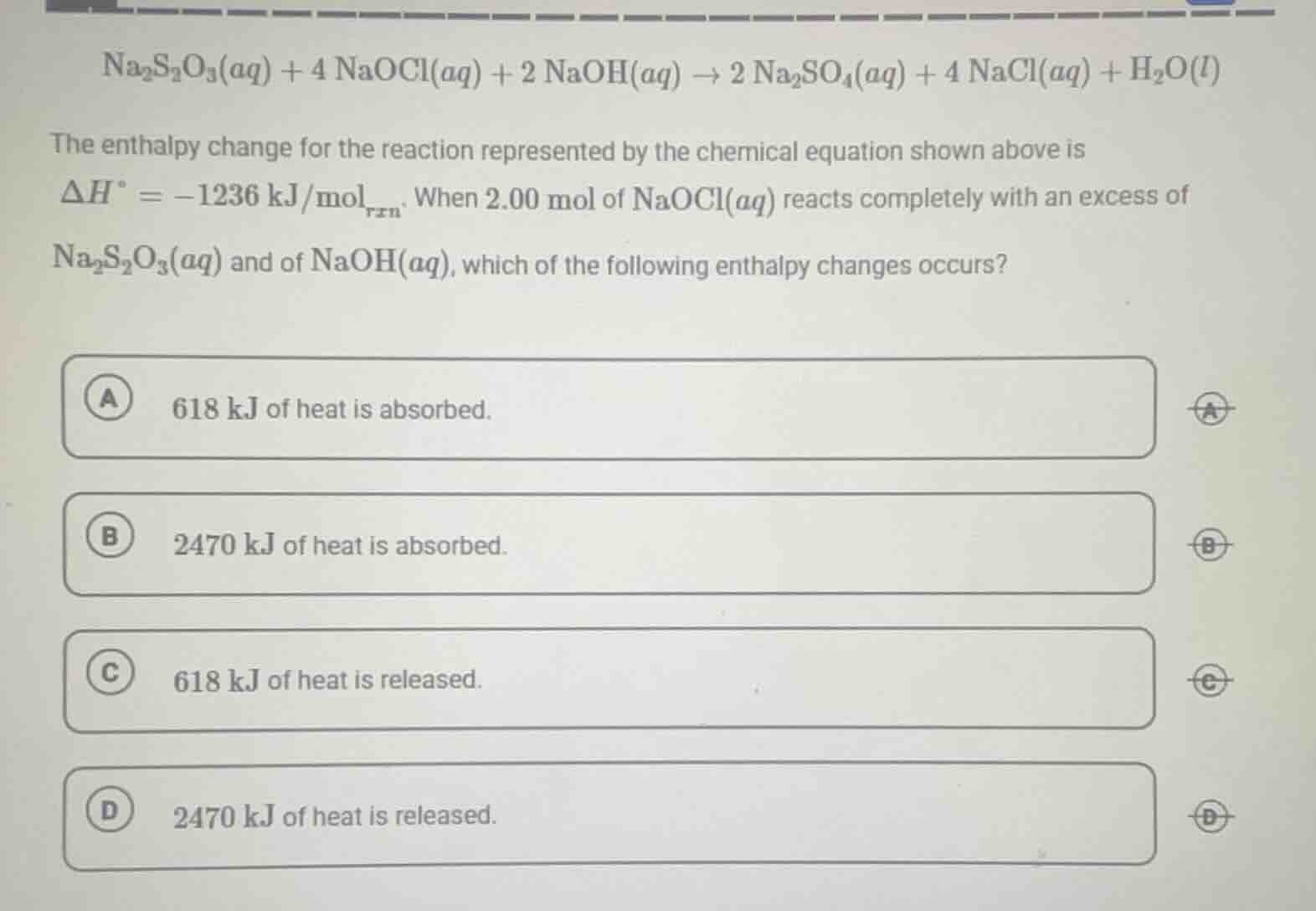
$$ce{na_{2}s_{2}o_{3}(aq) + 4 naocl(aq) + 2 naoh(aq) -> 2 na_{2}so_{4}(aq) + 4 nacl(aq) + h_{2}o(l)}$$
the enthalpy change for the reaction represented by the chemical equation shown above is $delta h^{circ} = -1236 mathrm{kj/mol_{rxn}}$. when $2.00 mathrm{mol}$ of $ce{naocl(aq)}$ reacts completely with an excess of $ce{na_{2}s_{2}o_{3}(aq)}$ and of $ce{naoh(aq)}$, which of the following enthalpy changes occurs?
a. $618 mathrm{kj}$ of heat is absorbed.
b. $2470 mathrm{kj}$ of heat is absorbed.
c. $618 mathrm{kj}$ of heat is released.
d. $2470 mathrm{kj}$ of heat is released.
Step1: Determine the molar ratio
From the balanced equation, 4 moles of \( \text{NaOCl} \) react with \( \text{Na}_2\text{S}_2\text{O}_3 \) and \( \text{NaOH} \) to give the enthalpy change \( \Delta H^{\circ} = -1236 \, \text{kJ/mol}_{\text{rxn}} \). We need to find the enthalpy change for 2.00 moles of \( \text{NaOCl} \). The ratio of moles of \( \text{NaOCl} \) in the reaction to the given moles is \( \frac{2.00 \, \text{mol}}{4 \, \text{mol}} \).
Step2: Calculate the enthalpy change
The enthalpy change for 2.00 moles of \( \text{NaOCl} \) is \( \Delta H = \frac{2.00 \, \text{mol}}{4 \, \text{mol}} \times (-1236 \, \text{kJ/mol}_{\text{rxn}}) \).
First, simplify the fraction: \( \frac{2.00}{4} = 0.5 \).
Then multiply by the enthalpy change: \( 0.5 \times (-1236 \, \text{kJ}) = -618 \, \text{kJ} \). The negative sign indicates that heat is released (exothermic reaction).

Snap & solve any problem in the app
Get step-by-step solutions on Sovi AI
Photo-based solutions with guided steps
Explore more problems and detailed explanations
C. 618 kJ of heat is released.