QUESTION IMAGE
Question
- exercises
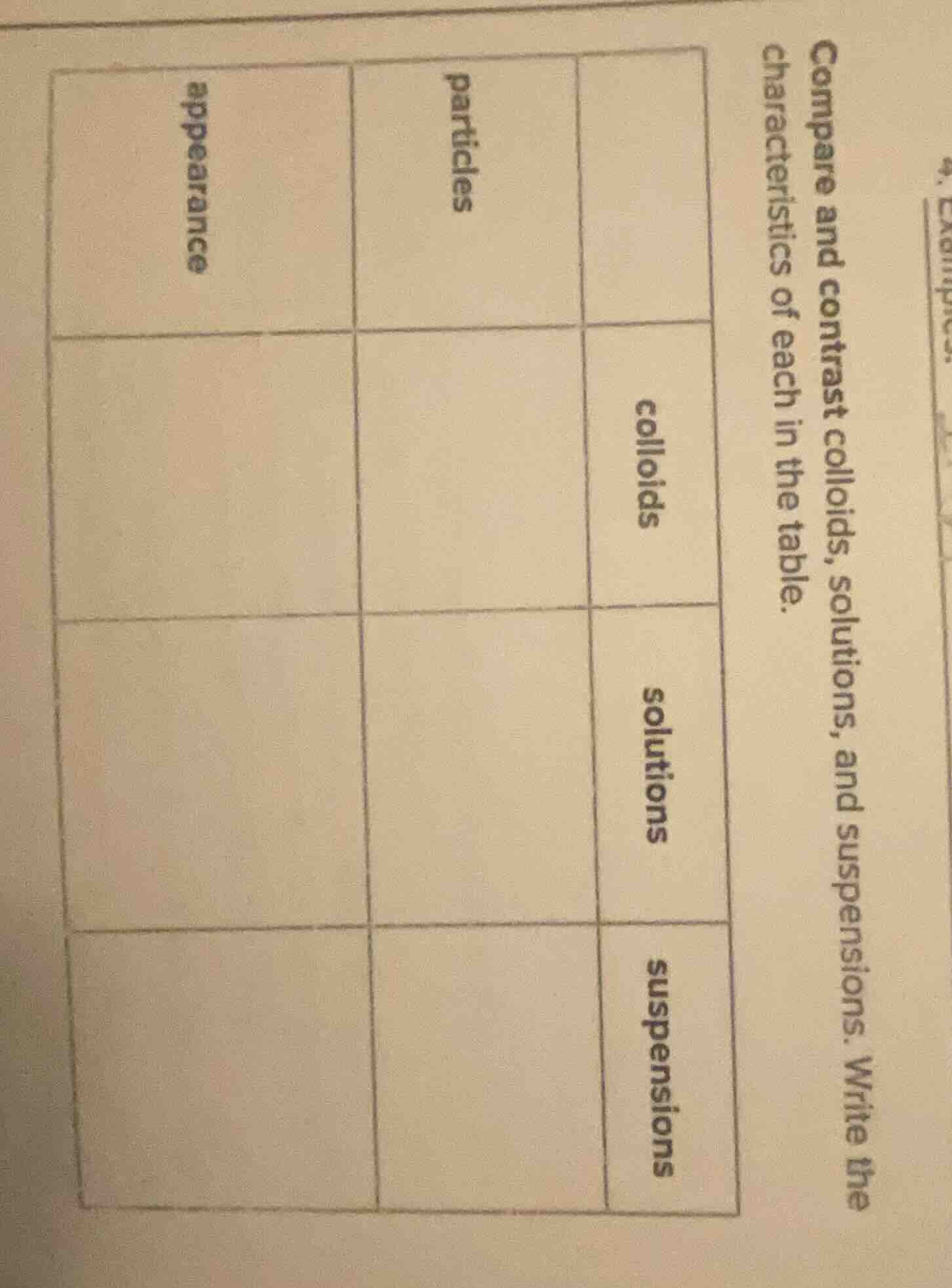
compare and contrast colloids, solutions, and suspensions. write the characteristics of each in the table.
| suspensions | solutions | colloids | |
|---|---|---|---|
| appearance |
Response
To solve this, we analyze the properties of colloids, solutions, and suspensions:
For the "particles" column:
- Suspensions: Particle size is usually greater than \(1000\,\text{nm}\) (or \(1\,\mu\text{m}\)). These particles are large enough to be seen with the naked eye or a light microscope and tend to settle over time.
- Solutions: Particle size is less than \(1\,\text{nm}\). The particles are individual ions or molecules, too small to be seen even with a microscope.
- Colloids: Particle size ranges from \(1\,\text{nm}\) to \(1000\,\text{nm}\). The particles (like micelles, polymer chains, or small aggregates) are larger than in solutions but smaller than in suspensions.
For the "appearance" column:
- Suspensions: Often appear cloudy or opaque because the large particles scatter light and may settle, leaving a sediment at the bottom (e.g., sand in water).
- Solutions: Appear transparent or clear because the small particles do not scatter light significantly (e.g., salt dissolved in water).
- Colloids: Often appear translucent or have a cloudy appearance (due to the Tyndall effect, where light is scattered by the particles). Examples include milk (a colloid of fat globules in water) or fog (water droplets in air).
| Suspensions | Solutions | Colloids | |
|---|---|---|---|
| appearance | Opaque, may settle, cloudy | Transparent, clear | Translucent, cloudy (Tyndall effect) |

Snap & solve any problem in the app
Get step-by-step solutions on Sovi AI
Photo-based solutions with guided steps
Explore more problems and detailed explanations
To solve this, we analyze the properties of colloids, solutions, and suspensions:
For the "particles" column:
- Suspensions: Particle size is usually greater than \(1000\,\text{nm}\) (or \(1\,\mu\text{m}\)). These particles are large enough to be seen with the naked eye or a light microscope and tend to settle over time.
- Solutions: Particle size is less than \(1\,\text{nm}\). The particles are individual ions or molecules, too small to be seen even with a microscope.
- Colloids: Particle size ranges from \(1\,\text{nm}\) to \(1000\,\text{nm}\). The particles (like micelles, polymer chains, or small aggregates) are larger than in solutions but smaller than in suspensions.
For the "appearance" column:
- Suspensions: Often appear cloudy or opaque because the large particles scatter light and may settle, leaving a sediment at the bottom (e.g., sand in water).
- Solutions: Appear transparent or clear because the small particles do not scatter light significantly (e.g., salt dissolved in water).
- Colloids: Often appear translucent or have a cloudy appearance (due to the Tyndall effect, where light is scattered by the particles). Examples include milk (a colloid of fat globules in water) or fog (water droplets in air).
| Suspensions | Solutions | Colloids | |
|---|---|---|---|
| appearance | Opaque, may settle, cloudy | Transparent, clear | Translucent, cloudy (Tyndall effect) |