QUESTION IMAGE
Question
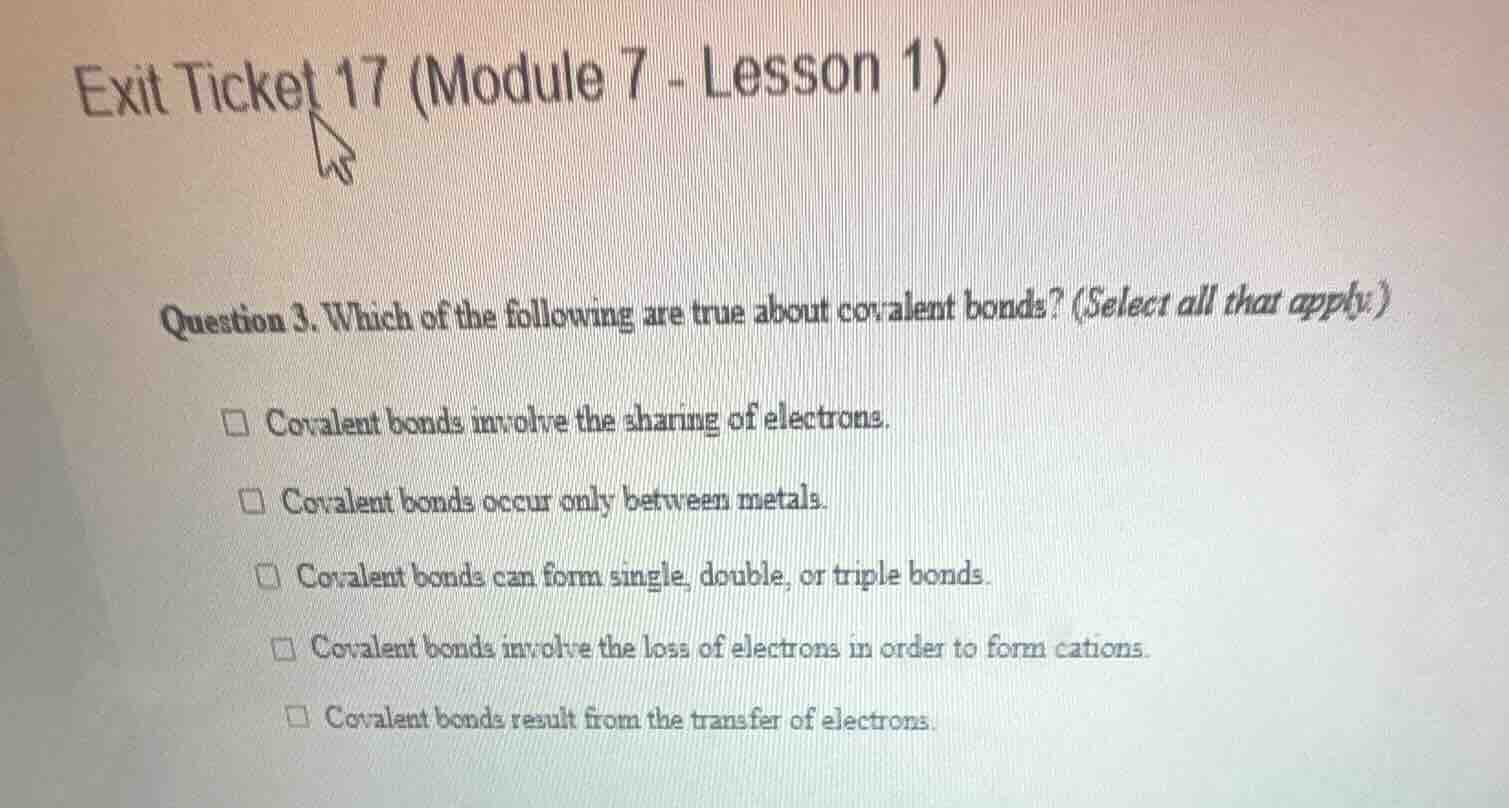
exit ticket 17 (module 7 - lesson 1)
question 3. which of the following are true about covalent bonds? (select all that apply:)
□ covalent bonds involve the sharing of electrons.
□ covalent bonds occur only between metals.
□ covalent bonds can form single, double, or triple bonds.
□ covalent bonds involve the loss of electrons in order to form cations.
□ covalent bonds result from the transfer of electrons.
Brief Explanations
- For the statement "Covalent bonds involve the sharing of electrons": By definition, covalent bonds are formed when atoms share one or more pairs of electrons. So this is true.
- For the statement "Covalent bonds occur only between metals": Covalent bonds typically occur between non - metals (or between a non - metal and a metalloid in some cases), while ionic bonds are more common between metals and non - metals. So this is false.
- For the statement "Covalent bonds can form single, double, or triple bonds": In covalent bonding, depending on the number of electron pairs shared between atoms, single (1 pair), double (2 pairs), or triple (3 pairs) bonds can be formed. For example, in $\ce{H2}$ there is a single bond, in $\ce{O2}$ a double bond, and in $\ce{N2}$ a triple bond. So this is true.
- For the statement "Covalent bonds involve the loss of electrons in order to form cations": The loss of electrons to form cations is a characteristic of ionic bonding (where metals lose electrons to form cations and non - metals gain electrons to form anions). In covalent bonding, there is no loss or gain of electrons in the same sense, just sharing. So this is false.
- For the statement "Covalent bonds result from the transfer of electrons": The transfer of electrons is characteristic of ionic bonding. Covalent bonds result from the sharing of electrons. So this is false.

Snap & solve any problem in the app
Get step-by-step solutions on Sovi AI
Photo-based solutions with guided steps
Explore more problems and detailed explanations
- Covalent bonds involve the sharing of electrons.
- Covalent bonds can form single, double, or triple bonds.