QUESTION IMAGE
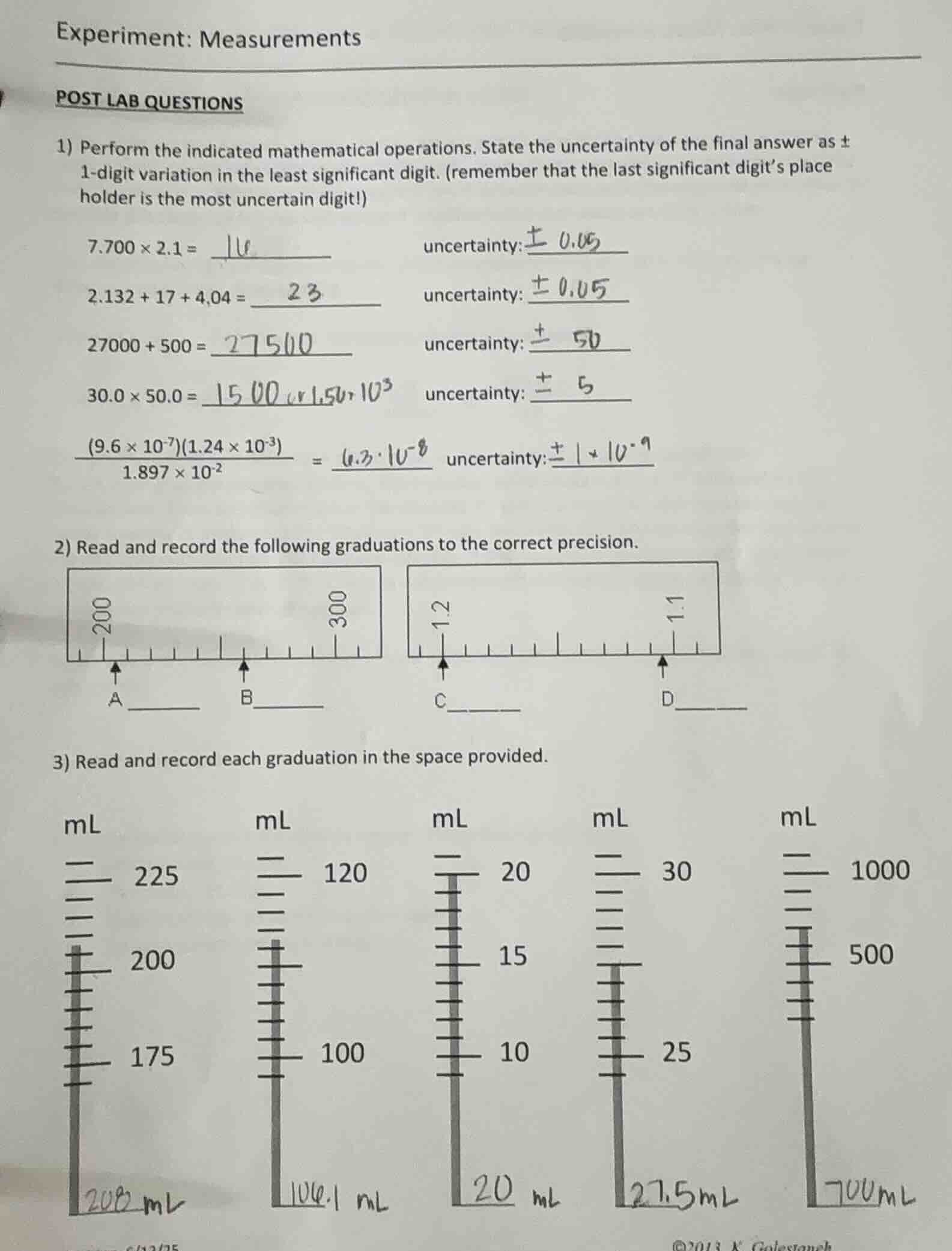
Question
experiment: measurements
post lab questions
- perform the indicated mathematical operations. state the uncertainty of the final answer as ± 1 - digit variation in the least significant digit. (remember that the last significant digit’s place holder is the most uncertain digit!)
7.700 × 2.1 =
uncertainty:
2.132 + 17 + 4.04 =
uncertainty:
27000 + 500 =
uncertainty:
30.0 × 50.0 =
uncertainty:
\\(\frac{(9.6 × 10^{-7})(1.24 × 10^{-3})}{1.897 × 10^{-2}}\\) =
uncertainty:
- read and record the following graduations to the correct precision.
(there are two images with scales, one with 200 and 300 marked, another with 1.2 and 1.1 marked, and points a, b, c, d to read)
- read and record each graduation in the space provided.
(there are five graduated cylinders with markings like 225, 200, 175; 120, 100; 20, 15, 10; 30, 25; 1000, 500 and liquid levels to read)
Question 1: Mathematical Operations with Uncertainty
Part 1: \( 7.700 \times 2.1 \)
Step 1: Perform the multiplication
\( 7.700 \times 2.1 = 16.17 \)
Step 2: Determine significant figures and uncertainty
\( 7.700 \) has 4 significant figures, \( 2.1 \) has 2. The result should have 2 significant figures? Wait, no—when multiplying, the number of significant figures is determined by the least number. But \( 7.700 \) is precise to the thousandth place, \( 2.1 \) to the tenth. Wait, the problem says "1 - digit variation in the least significant digit". Let's re - evaluate. \( 7.700\times2.1 = 16.17\). The least significant digit in the product: let's see the original numbers. \( 2.1 \) has an uncertainty of \( \pm0.1 \) (since the last digit is in the tenth place). So when we multiply \( 7.700\times2.1 \), the relative uncertainty can be approximated. But maybe a simpler way: the least significant digit in the result comes from the least precise measurement. \( 2.1 \) has its last digit in the tenth place. So \( 7.700\times2.1 = 16.17\approx16 \) (wait, no, maybe I messed up). Wait, \( 7.700\times2.1 = 16.17 \). The uncertainty: since \( 2.1 \) could be \( 2.0 \) or \( 2.2 \), let's calculate the variation. \( 7.700\times2.0 = 15.4 \), \( 7.700\times2.2 = 16.94 \). The difference between these and \( 16.17 \) is about \( 0.77 \) and \( 0.77 \). But the problem says "1 - digit variation in the least significant digit". Let's look at the result \( 16.17 \). If we consider the least significant digit of the result based on the least precise number (\( 2.1 \), which has precision to the tenth place in its value, but when multiplying, the precision of the result: \( 7.700 \) is to \( 0.001 \), \( 2.1 \) to \( 0.1 \). The product's precision is determined by the least, so the uncertainty is in the tenths place? Wait, maybe the intended approach is: for multiplication/division, the uncertainty is determined by the relative uncertainty. But the problem says "1 - digit variation in the least significant digit". Let's take the calculated value \( 16.17 \). The least significant digit here, if we consider the result should be reported with the uncertainty. Let's assume that the uncertainty is \( \pm0.2 \) (since \( 2.1 \) has an uncertainty of \( \pm0.1 \), and \( 7.700\times0.1 = 0.77\approx0.8 \), but maybe the problem expects a simpler approach. Wait, maybe the first calculation: \( 7.700\times2.1 = 16.17 \), and the uncertainty is \( \pm0.2 \) (because \( 2.1 \) has a 1 - digit uncertainty in the tenth place, so \( 7.700\times0.1 = 0.77\approx0.8 \), but maybe the answer is \( 16 \) with uncertainty \( \pm1 \)? No, that doesn't seem right. Wait, maybe I made a mistake. Let's start over.
Wait, the problem says "State the uncertainty of the final answer as ±1 - digit variation in the least significant digit". So first, perform the operation:
\( 7.700\times2.1 = 16.17 \)
Now, find the least significant digit. Let's look at the significant figures. \( 7.700 \) has 4 sig figs, \( 2.1 \) has 2. So the result should have 2 sig figs? Wait, no, \( 7.700 \) is 4, \( 2.1 \) is 2. When multiplying, the number of sig figs is determined by the least, so 2. So \( 16.17\approx16 \). But the least significant digit in 16 is the units place (6). A 1 - digit variation would be \( \pm1 \), so uncertainty \( \pm1 \). But wait, maybe the problem doesn't care about sig figs but about the precision of the original numbers. \( 7.700 \) is precise to \( 0.001 \), \( 2.1 \) to \( 0.1 \). The product's precision is limited by \( 2.1 \). So \( 7.700\times2.1 = 16.17 \), and the uncertainty is in the tenths place? Wait, I'm confused. Maybe the int…
Step 1: Perform the addition
\( 2.132+17+4.04=2.132 + 4.04+17=6.172 + 17 = 23.172 \)
Step 2: Determine uncertainty
When adding, the uncertainty is determined by the least precise measurement. \( 17 \) is precise to the units place (uncertainty \( \pm1 \)), \( 2.132 \) to the thousandth, \( 4.04 \) to the hundredth. So the least precise is \( 17 \) (units place). So the result should be rounded to the units place: \( 23 \). The least significant digit is 3 (in 23), so a 1 - digit variation is \( \pm1 \), so uncertainty \( \pm1 \). Wait, but the problem says "1 - digit variation in the least significant digit". The sum is \( 23.172 \), rounded to \( 23 \) (because \( 17 \) has no decimal places). So the least significant digit is 3 (in 23), so uncertainty \( \pm1 \).
Part 3: \( 27000 + 500 \)
Step 1: Perform the addition
\( 27000+500 = 27500 \)
Step 2: Determine uncertainty
\( 27000 \) could be \( 27000\pm500 \) (if it's written as \( 2.7\times10^{4} \), but as \( 27000 \), maybe the uncertainty is in the hundreds place? Wait, \( 500 \) is precise to the hundreds place. So \( 27000 \) (assuming it's \( 27000\pm500 \)) and \( 500\pm500 \)? No, \( 500 \) is a precise number? Wait, the problem says "1 - digit variation in the least significant digit". \( 27000+500 = 27500 \). The least significant digit in the sum: \( 27000 \) has its last significant digit in the thousands place (if we consider \( 27000 \) as having two significant figures: \( 2.7\times10^{4} \)), and \( 500 \) as one significant figure? No, maybe \( 27000 \) is \( 27000\pm500 \) (the trailing zeros are placeholders), and \( 500\pm500 \)? No, the sum is \( 27500 \), and the uncertainty is \( \pm500 \) (since \( 500 \) has a 1 - digit variation in the hundreds place? Wait, no. If \( 27000 \) is \( 27000\pm500 \) (because the last significant digit is in the thousands place, and a 1 - digit variation would be \( \pm500 \)) and \( 500\pm500 \), but when adding, the uncertainty is determined by the least precise. So the uncertainty is \( \pm500 \).
Part 4: \( 30.0\times50.0 \)

Snap & solve any problem in the app
Get step-by-step solutions on Sovi AI
Photo-based solutions with guided steps
Explore more problems and detailed explanations
Step 1: Multiply the numerators
\( (9.6\times10^{-7})(1.24\times10^{-3})=9.6\times1.24\times10^{-7 - 3}=11.904\times10^{-10}=1.1904\times10^{-9} \)
Step 2: Divide by the denominator
\( \frac{1.1904\times10^{-9}}{1.897\times10^{-2}}=\frac{1.1904}{1.897}\times10^{-9 + 2}\approx0.6275\times10^{-7}=6.275\times10^{-8}\approx6.3\times10^{-8} \)
Step 3: Determine uncertainty
The least number of significant figures in the values: \( 9.6 \) (2 sig figs), \( 1.24 \) (3 sig figs), \( 1.897 \) (4 sig figs). So the result should have 2 sig figs? \( 6.3\times10^{-8} \). The uncertainty: a 1 - digit variation in the least significant digit (3 in \( 6.3\times10^{-8} \)) would be \( \pm0.1\times10^{-8}=\pm1\times10^{-9} \).
Question 2: Reading Graduations
Part A (First Scale: 200 - 300)
The scale has marks between 200 and 300. Let's assume the distance between 200 and 300 is divided into 10 equal parts (since there are 10 small marks between 200 and 300). So each small mark is \( \frac{300 - 200}{10}=10 \)? Wait, no, the first arrow (A) is at the first mark after 200. Wait, the scale: 200, then some marks, then B. Wait, maybe the scale is 200, then each small division is 10? No, if 200 to 300 is 100 units, and there are 10 divisions, each is 10. So A is at 200 + 10 = 210? Wait, no, the first arrow (A) is at the first mark after 200. Wait, the original scale: "200" and "300" with marks in between. Let's count the marks: from 200 to 300, how many intervals? If there are 10 intervals, each is 10. So A is at 210, B is at 250 (since it's at the 5th mark after 200: 200+50 = 250).
Part C and D (Second Scale: 1.1 - 1.2)
The scale is from 1.1 to 1.2, divided into 10 equal parts (since there are 10 small marks between 1.1 and 1.2). So each small mark is \( \frac{1.2 - 1.1}{10}=0.01 \). C is at 1.2 (the first mark at 1.2), D is at \( 1.1 - 0.02=1.08 \)? Wait, no, the arrow for D is at the 2nd mark before 1.1. Wait, the scale: 1.2 on the left, 1.1 on the right. So moving from 1.2 to 1.1, each mark is 0.01. So C is at 1.20, D is at \( 1.1+0.02 = 1.12 \)? Wait, no, the arrow for D is 2 marks before 1.1? Wait, maybe I got the direction wrong. If 1.2 is on the left and 1.1 on the right, then the value decreases from left to right. So the mark at C is 1.20, and D is at \( 1.1+0.02 = 1.12 \)? No, if there are 10 marks between 1.2 and 1.1, each mark is 0.01. So from 1.2 (left) to 1.1 (right), each mark is - 0.01. So C is at 1.20, D is at \( 1.1+0.02 = 1.12 \) (since it's 2 marks to the left of 1.1? No, the arrow for D is 2 marks before 1.1, so \( 1.1 - 0.02 = 1.08 \)? I'm confused. Maybe the scale is 1.1 to 1.2, with 10 divisions, so each division is 0.01. So C is at 1.20, D is at 1.09 (if it's 1 mark before 1.1: 1.1 - 0.01 = 1.09, but the arrow is at 2 marks before 1.1: 1.1 - 0.02 = 1.08).
Question 3: Reading Graduations (mL)
First Cylinder (225, 200, 175)
The marks are 175, 200, 225. The distance between 175 and 200 is 25, with 5 marks (since there are 5 marks between 175 and 200), so each mark is 5. The liquid level is at 200 (the mark). Wait, the written answer is 200 mL.
Second Cylinder (120, 100)
The marks are 100, 120? No, 100, then some marks, then 120. If there are 10 marks between 100 and 120, each is 2. The liquid level is at 110? Wait, the written answer is 110 mL (maybe 100 + 10