QUESTION IMAGE
Question
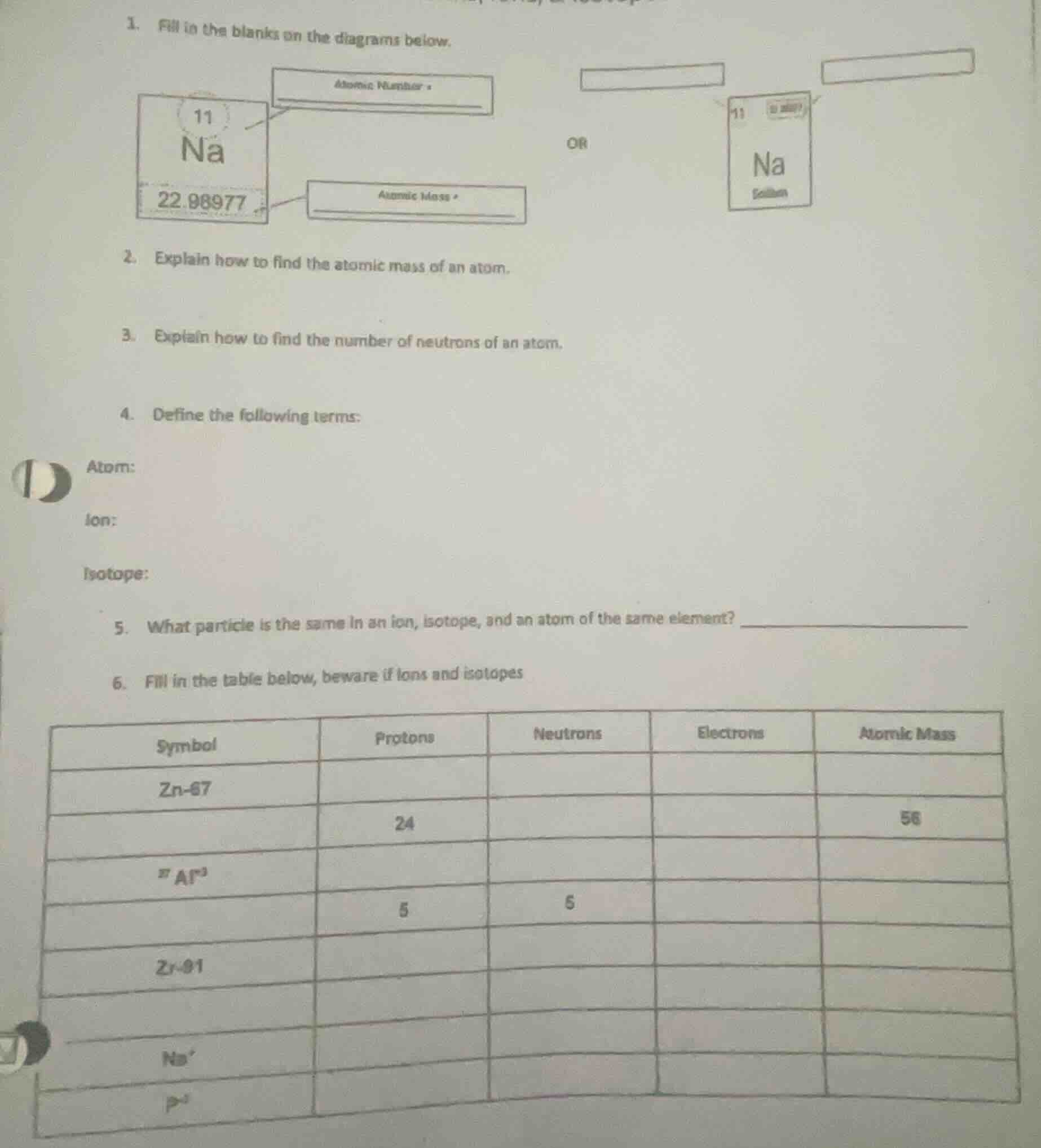
- fill in the blanks on the diagrams below.
- explain how to find the atomic mass of an atom.
- explain how to find the number of neutrons of an atom.
- define the following terms:
atom:
ion:
isotope:
- what particle is the same in an ion, isotope, and an atom of the same element?
- fill in the table below, beware if ions and isotopes
symbol | protons | neutrons | electrons | atomic mass
zn-67 | | | |
| 24 | 56 |
$^{27}$al$^{3+}$ | | | |
| 5 | 5 |
zr-91 | | | |
na$^+$ | | | |
p$^{3-}$ | | | |
Step1: Fill periodic table blanks
For the first diagram:
Atomic Number = $11$
Atomic Mass = $22.98977$
For the right diagram:
Top left blank (Atomic Number): $11$
Top right blank (Atomic Mass): $22.98977$
Step2: Explain atomic mass calculation
Atomic mass is the weighted average of the masses of all naturally occurring isotopes of an element, calculated by:
$$\text{Atomic Mass} = \sum (\text{Isotope Mass} \times \text{Abundance})$$
where abundance is the decimal fraction of the isotope in nature.
Step3: Explain neutron count calculation
Neutrons = Atomic Mass (rounded to nearest whole number, mass number) - Atomic Number
$$\text{Neutrons} = A - Z$$
$A$ = mass number, $Z$ = atomic number
Step4: Define key terms
Atom: Neutral particle with equal protons/electrons.
Ion: Charged atom/molecule (unequal protons/electrons).
Isotope: Same element, different neutron count.
Step5: Identify shared particle
Protons determine element identity, so they are identical across ion, isotope, atom of the same element.
Step6: Fill the table
Row 1 (Zn-87):
Zn has atomic number 30 (protons=30). Neutrons = $87-30=57$. Neutral atom, electrons=30. Atomic Mass=87.
Row 2 (24 protons, mass 56):
Element is Cr (Z=24). Neutrons = $56-24=32$. Neutral atom, electrons=24. Symbol: Cr-56.
Row 3 ($^{27}\text{Al}^{3+}$):
Al has Z=13 (protons=13). Neutrons = $27-13=14$. $3+$ ion: electrons = $13-3=10$. Atomic Mass=27.
Row 4 (5 protons, 5 neutrons):
Element is B (Z=5). Mass = $5+5=10$. Neutral atom, electrons=5. Symbol: B-10.
Row 5 (Zr-91):
Zr has Z=40 (protons=40). Neutrons = $91-40=51$. Neutral atom, electrons=40. Atomic Mass=91.
Row 6 ($\text{Na}^+$):
Na has Z=11 (protons=11). Mass number 23, neutrons = $23-11=12$. $1+$ ion: electrons = $11-1=10$. Atomic Mass=22.99 (or 23).
Row 7 ($\text{P}^{3-}$):
P has Z=15 (protons=15). Mass number 31, neutrons = $31-15=16$. $3-$ ion: electrons = $15+3=18$. Atomic Mass=30.97 (or 31).

Snap & solve any problem in the app
Get step-by-step solutions on Sovi AI
Photo-based solutions with guided steps
Explore more problems and detailed explanations
1.
Left diagram:
Atomic Number = $11$
Atomic Mass = $22.98977$
Right diagram:
Top left blank: $11$
Top right blank: $22.98977$
- Atomic mass is the weighted average of the masses of all naturally occurring isotopes of an element, calculated by multiplying each isotope's mass by its relative abundance (as a decimal) and summing these values.
- Subtract the atomic number (number of protons) from the rounded atomic mass (mass number) of the atom: $\text{Neutrons} = \text{Mass Number} - \text{Atomic Number}$
4.
Atom: A neutral, basic unit of matter with equal numbers of protons and electrons.
Ion: A charged atom or molecule with an unequal number of protons and electrons.
Isotope: Atoms of the same element that have the same number of protons but a different number of neutrons.
- Proton
6.
| Symbol | Protons | Neutrons | Electrons | Atomic Mass |
|---|---|---|---|---|
| Cr-56 | 24 | 32 | 24 | 56 |
| $^{27}\text{Al}^{3+}$ | 13 | 14 | 10 | 27 |
| B-10 | 5 | 5 | 5 | 10 |
| Zr-91 | 40 | 51 | 40 | 91 |
| $\text{Na}^+$ | 11 | 12 | 10 | 23 (22.99) |
| $\text{P}^{3-}$ | 15 | 16 | 18 | 31 (30.97) |