QUESTION IMAGE
Question
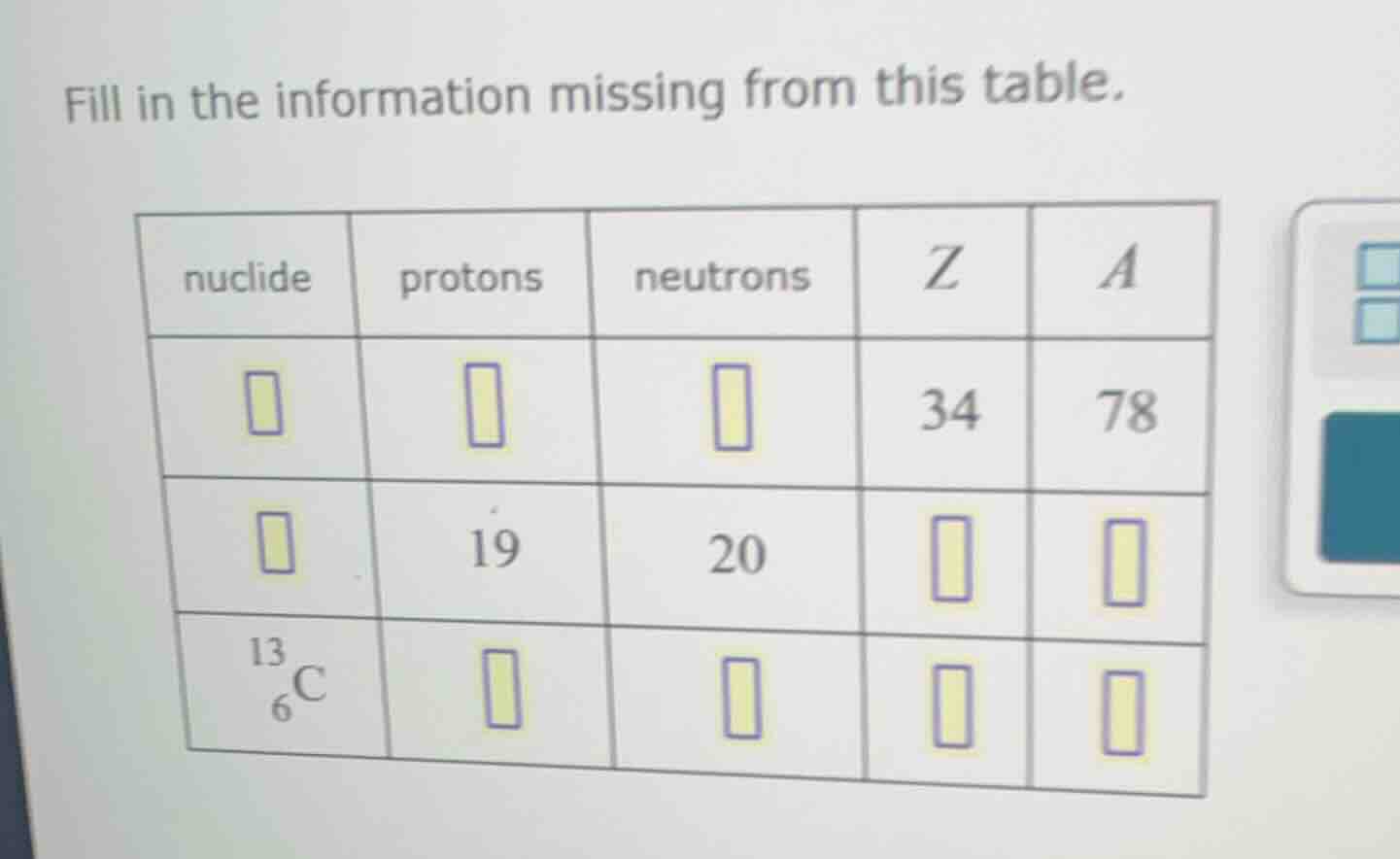
fill in the information missing from this table.
nuclide | protons | neutrons | z | a
--- | --- | --- | --- | ---
| 34 | 78 | ||
| 19 | 20 |
$\ce{^{13}_{6}c}$ | | | |
Step1: Recall definitions
- \( Z \) (atomic number) = number of protons.
- \( A \) (mass number) = number of protons + number of neutrons.
- Nuclide symbol: \( _Z^A X \), where \( X \) is the element symbol (determined by \( Z \) from periodic table).
Step2: First row (Z=34, A=78)
- Protons = \( Z = 34 \).
- Neutrons = \( A - Z = 78 - 34 = 44 \).
- Element with \( Z = 34 \) is Selenium (Se), so nuclide: \( _{34}^{78}\text{Se} \).
Step3: Second row (protons=19, neutrons=20)
- \( Z = \) protons \( = 19 \) (element: Potassium, K).
- \( A = \) protons + neutrons \( = 19 + 20 = 39 \).
- Nuclide: \( _{19}^{39}\text{K} \).
Step4: Third row (\( _{6}^{13}\text{C} \))
- Protons = \( Z = 6 \) (since \( Z = 6 \) for Carbon).
- Neutrons = \( A - Z = 13 - 6 = 7 \).
- \( Z = 6 \), \( A = 13 \).
Filled Table:
| nuclide | protons | neutrons | \( Z \) | \( A \) |
|---|---|---|---|---|
| \( _{19}^{39}\text{K} \) | 19 | 20 | 19 | 39 |
| \( _{6}^{13}\text{C} \) | 6 | 7 | 6 | 13 |
(For the answer, presenting the filled values as per each cell's requirement:)
First row:
- Nuclide: \( \boldsymbol{_{34}^{78}\text{Se}} \)
- Protons: \( \boldsymbol{34} \)
- Neutrons: \( \boldsymbol{44} \)
Second row:
- Nuclide: \( \boldsymbol{_{19}^{39}\text{K}} \)
- \( Z \): \( \boldsymbol{19} \)
- \( A \): \( \boldsymbol{39} \)
Third row:
- Protons: \( \boldsymbol{6} \)
- Neutrons: \( \boldsymbol{7} \)
- \( Z \): \( \boldsymbol{6} \)
- \( A \): \( \boldsymbol{13} \)

Snap & solve any problem in the app
Get step-by-step solutions on Sovi AI
Photo-based solutions with guided steps
Explore more problems and detailed explanations
Step1: Recall definitions
- \( Z \) (atomic number) = number of protons.
- \( A \) (mass number) = number of protons + number of neutrons.
- Nuclide symbol: \( _Z^A X \), where \( X \) is the element symbol (determined by \( Z \) from periodic table).
Step2: First row (Z=34, A=78)
- Protons = \( Z = 34 \).
- Neutrons = \( A - Z = 78 - 34 = 44 \).
- Element with \( Z = 34 \) is Selenium (Se), so nuclide: \( _{34}^{78}\text{Se} \).
Step3: Second row (protons=19, neutrons=20)
- \( Z = \) protons \( = 19 \) (element: Potassium, K).
- \( A = \) protons + neutrons \( = 19 + 20 = 39 \).
- Nuclide: \( _{19}^{39}\text{K} \).
Step4: Third row (\( _{6}^{13}\text{C} \))
- Protons = \( Z = 6 \) (since \( Z = 6 \) for Carbon).
- Neutrons = \( A - Z = 13 - 6 = 7 \).
- \( Z = 6 \), \( A = 13 \).
Filled Table:
| nuclide | protons | neutrons | \( Z \) | \( A \) |
|---|---|---|---|---|
| \( _{19}^{39}\text{K} \) | 19 | 20 | 19 | 39 |
| \( _{6}^{13}\text{C} \) | 6 | 7 | 6 | 13 |
(For the answer, presenting the filled values as per each cell's requirement:)
First row:
- Nuclide: \( \boldsymbol{_{34}^{78}\text{Se}} \)
- Protons: \( \boldsymbol{34} \)
- Neutrons: \( \boldsymbol{44} \)
Second row:
- Nuclide: \( \boldsymbol{_{19}^{39}\text{K}} \)
- \( Z \): \( \boldsymbol{19} \)
- \( A \): \( \boldsymbol{39} \)
Third row:
- Protons: \( \boldsymbol{6} \)
- Neutrons: \( \boldsymbol{7} \)
- \( Z \): \( \boldsymbol{6} \)
- \( A \): \( \boldsymbol{13} \)