QUESTION IMAGE
Question
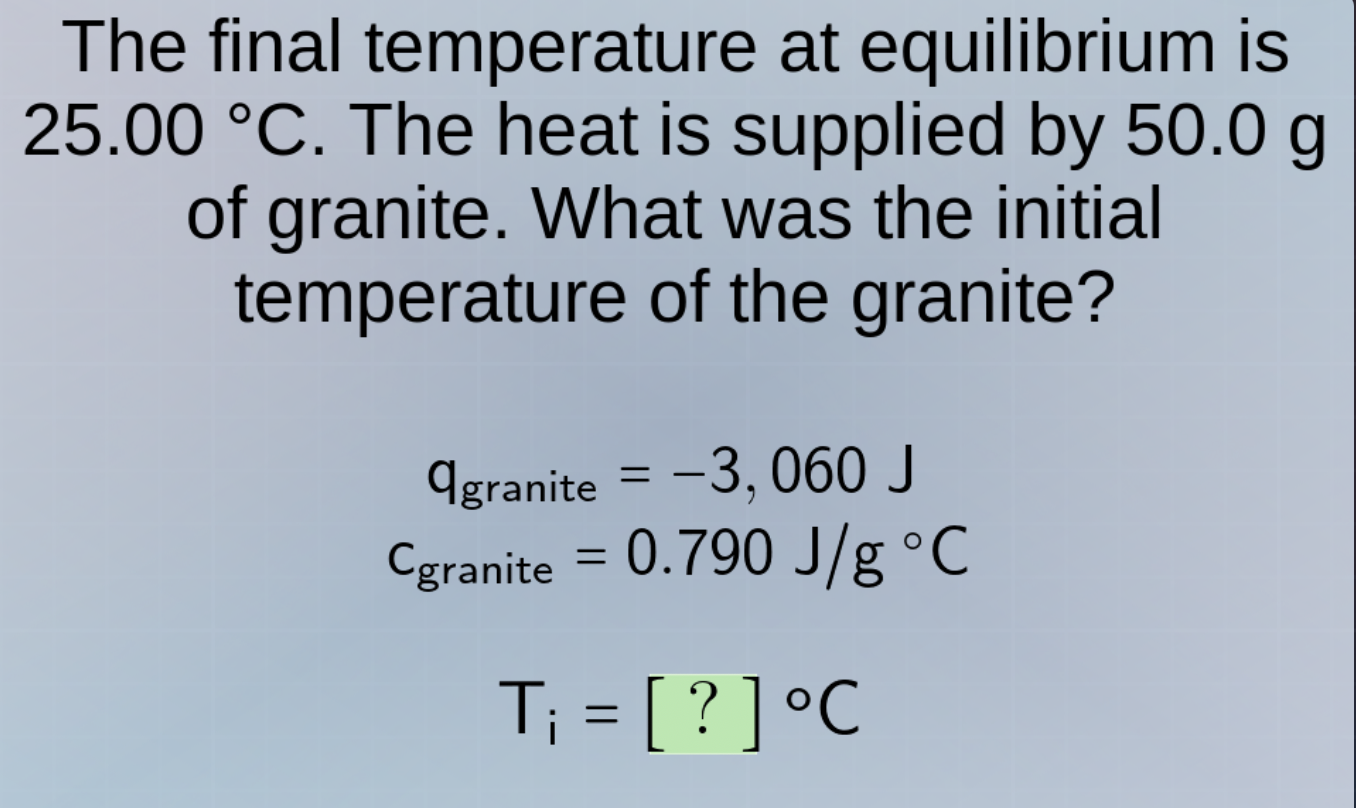
the final temperature at equilibrium is 25.00 °c. the heat is supplied by 50.0 g of granite. what was the initial temperature of the granite?
$q_{granite} = -3,060$ j
$c_{granite} = 0.790$ j/g °c
$t_i = ?$ °c
Step1: Recall the heat formula
The formula for heat transfer is \( q = mc\Delta T \), where \( q \) is heat, \( m \) is mass, \( c \) is specific heat capacity, and \( \Delta T=T_f - T_i \) (change in temperature). Here, \( q_{\text{granite}}=- 3060\space J \), \( m = 50.0\space g \), \( c = 0.790\space J/g^{\circ}C \), and \( T_f=25.00^{\circ}C \). We need to solve for \( T_i \).
First, rearrange the heat formula to solve for \( \Delta T \):
\( \Delta T=\frac{q}{mc} \)
Step2: Substitute the values to find \( \Delta T \)
Substitute \( q=-3060\space J \), \( m = 50.0\space g \), and \( c = 0.790\space J/g^{\circ}C \) into the formula for \( \Delta T \):
\( \Delta T=\frac{- 3060\space J}{50.0\space g\times0.790\space J/g^{\circ}C} \)
Calculate the denominator: \( 50.0\times0.790 = 39.5\space J/^{\circ}C \)
Then, \( \Delta T=\frac{-3060}{39.5}\approx - 77.47^{\circ}C \)
Step3: Relate \( \Delta T \) to \( T_i \) and \( T_f \)
We know that \( \Delta T=T_f - T_i \), so we can rearrange this to solve for \( T_i \):
\( T_i=T_f-\Delta T \)
Substitute \( T_f = 25.00^{\circ}C \) and \( \Delta T=-77.47^{\circ}C \) (note that \( \Delta T=T_f - T_i=-77.47^{\circ}C \), so \( 25 - T_i=-77.47 \), which is equivalent to \( T_i = 25+77.47 \))
\( T_i=25.00^{\circ}C-(- 77.47^{\circ}C)=25.00 + 77.47=102.47^{\circ}C \) (approximate value, let's do the calculation more precisely)
Let's recalculate \( \Delta T \):
\( \Delta T=\frac{-3060}{50\times0.79}=\frac{-3060}{39.5}\approx - 77.468354^{\circ}C \)
Then \( T_i=T_f-\Delta T=25.00-(-77.468354)=25.00 + 77.468354 = 102.468354^{\circ}C\approx102.5^{\circ}C \) (or more precisely, let's check the calculation again)
Wait, let's do the algebra correctly. From \( q = mc(T_f - T_i) \), we can solve for \( T_i \):
\( q=mc(T_f - T_i) \)
Divide both sides by \( mc \):
\( \frac{q}{mc}=T_f - T_i \)
Then, \( T_i=T_f-\frac{q}{mc} \)
Substitute the values:
\( q=-3060\space J \), \( m = 50.0\space g \), \( c = 0.790\space J/g^{\circ}C \), \( T_f = 25.00^{\circ}C \)
\( \frac{q}{mc}=\frac{-3060}{50.0\times0.790}=\frac{-3060}{39.5}\approx - 77.468354 \)
So \( T_i=25.00-(-77.468354)=25.00 + 77.468354=102.468354^{\circ}C\approx102.5^{\circ}C \) (or if we keep more decimals, 102.47 \(^{\circ}C\))

Snap & solve any problem in the app
Get step-by-step solutions on Sovi AI
Photo-based solutions with guided steps
Explore more problems and detailed explanations
\( \boldsymbol{102.5} \) (or more precisely \( 102.47 \)) \(^{\circ}C\) (depending on the required precision, the calculation gives approximately \( 102.5^{\circ}C \) when rounded to one decimal place or \( 102^{\circ}C \) to three significant figures? Wait, let's check the significant figures. The given values: \( q=-3060\space J \) (four significant figures? Wait, 3060 could be three or four, but 50.0 is three, 0.790 is three, 25.00 is four. Let's see:
\( m = 50.0\space g \) (three sig figs), \( c = 0.790\space J/g^{\circ}C \) (three sig figs), \( q=-3060\space J \) (assuming three sig figs, 3.06×10³), \( T_f = 25.00^{\circ}C \) (four sig figs). When we calculate \( \frac{q}{mc} \), the number of sig figs is determined by the least number, which is three (from \( m \) and \( c \)). So \( \frac{-3060}{50.0\times0.790}=\frac{-3060}{39.5}\approx - 77.5 \) (three sig figs). Then \( T_i=25.00-(-77.5)=25.00 + 77.5 = 102.5^{\circ}C \) (four sig figs from \( T_f \) and three from the other term, so the result should have three decimal? No, sig figs: 25.00 (four), 77.5 (three), so when adding, the decimal places: 25.00 has two decimal places, 77.5 has one, so the result should have one decimal place? Wait, no, sig fig rules for addition: the number of decimal places is determined by the least precise measurement. 77.5 has one decimal place, 25.00 has two. So the sum should have one decimal place. So 25.00 + 77.5 = 102.5 (one decimal place). So the answer is approximately \( 102.5^{\circ}C \))