QUESTION IMAGE
Question
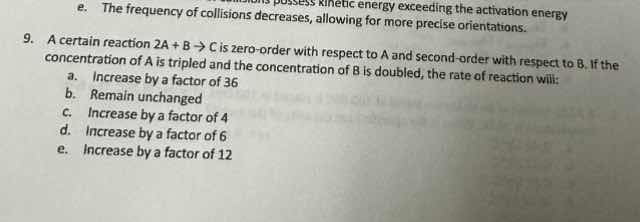
e. the frequency of collisions possessing kinetic energy exceeding the activation energy decreases, allowing for more precise orientations.
- a certain reaction 2a + b → c is zero - order with respect to a and second - order with respect to b. if the concentration of a is tripled and the concentration of b is doubled, the rate of reaction will:
a. increase by a factor of 36
b. remain unchanged
c. increase by a factor of 4
d. increase by a factor of 6
e. increase by a factor of 12
Step1: Recall rate law for zero and second order
For a reaction \(2A + B
ightarrow C\), the rate law is \(rate = k[A]^m[B]^n\), where \(m\) is order with respect to \(A\), \(n\) with respect to \(B\). Given \(m = 0\) (zero - order in \(A\)), \(n=2\) (second - order in \(B\)). So initial rate \(r_1=k[A]_1^0[B]_1^2=k[B]_1^2\).
Step2: Calculate new rate when [B] is doubled
When \([B]\) is doubled, \([B]_2 = 2[B]_1\), and \([A]\) is tripled (but since order in \(A\) is zero, \([A]_2^0 = 1\) as any non - zero number to the power 0 is 1). New rate \(r_2=k[A]_2^0[B]_2^2=k(2[B]_1)^2=k\times4[B]_1^2\).
Step3: Find the factor by which rate increases
Divide \(r_2\) by \(r_1\): \(\frac{r_2}{r_1}=\frac{k\times4[B]_1^2}{k[B]_1^2}=4\). So the rate increases by a factor of 4.

Snap & solve any problem in the app
Get step-by-step solutions on Sovi AI
Photo-based solutions with guided steps
Explore more problems and detailed explanations
c. Increase by a factor of 4