QUESTION IMAGE
Question
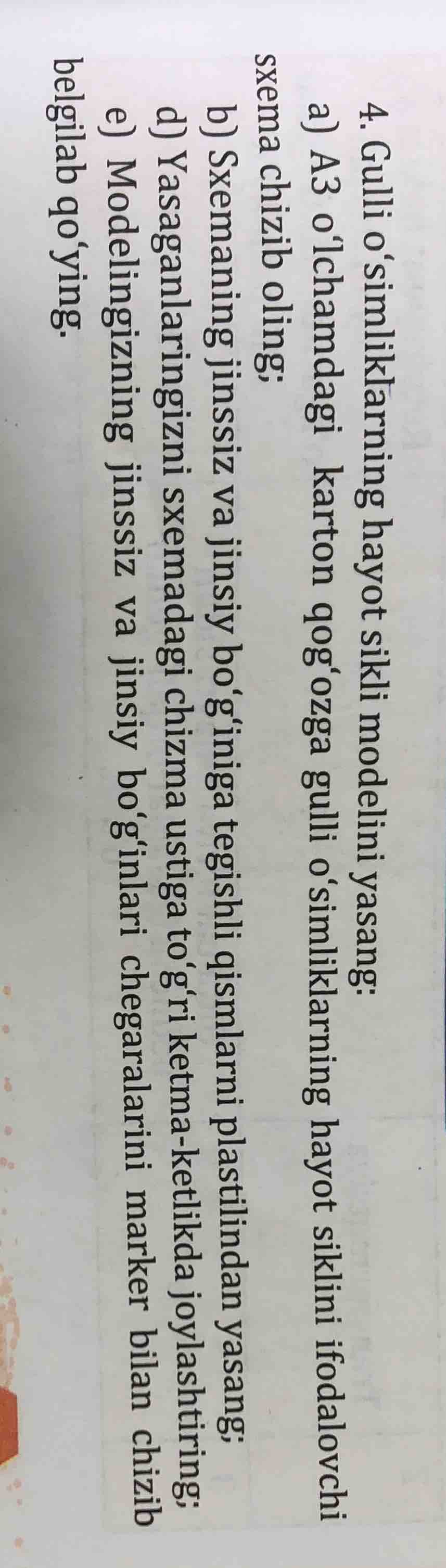
- gulli o‘simi lkl arn i ng hayot sikli modelini yasang:
a) a3 o‘lchamdagi karton dog‘ozga gulli o‘simliklarni ng hayot siklini ifodalovchi sxema chizib oling;
b) sxemaning jinssiz va jinsiy bo‘g‘iniga tegishli dismlarni plastilindan yasang;
d) yasaganlaringizni sxemadagi chizma ustiga to‘g‘ri ketma - ketlikda joylashtiring;
e) modeli ngi zni ng jinssiz va jinsiy bo‘g‘inlari chegaralarini marker bilan chizib belgilab do‘y i ng.
This is a practical task related to creating a life cycle model of a flower (plant) in the context of biology (a subfield of Natural Science). Here's a breakdown of how to approach each step:
Step - by - Step Explanation for Each Part (a - e)
Part a: Draw a Schematic
- Explanation: First, recall the life cycle of a flowering plant. The life cycle includes stages like seed, germination (seedling), growth (vegetative stage), flowering, pollination, fertilization, fruit and seed formation, and then the cycle repeats. Sketch a flowchart - like diagram with these stages connected in order. For example, start with a seed, then an arrow to a seedling (germination), then to a mature plant (growth), then to a flower (flowering), then to pollination (showing transfer of pollen, maybe with two flowers - one as the source, one as the receiver), then to fertilization (inside the flower), then to fruit with seeds (seed formation), and then an arrow back to the seed stage.
Part b: Make Gender - Neutral and Gender - Specific Parts from Plastic
- Explanation: In a flower, the gender - neutral parts include the sepals and petals (they are not directly involved in sexual reproduction in terms of being male or female organs). The gender - specific parts are the male (stamen: anther and filament) and female (pistil: stigma, style, ovary) reproductive organs. Use plastic (like plasticine or cut - out plastic sheets) to model these. For gender - neutral: create sepals (small, green - colored plastic structures around the flower) and petals (colorful, larger structures). For male: make stamens - the anther can be a small round plastic piece on top of a thin plastic filament. For female: make the pistil - a bulbous ovary at the bottom, a thin style, and a sticky - looking stigma on top.
Part c: Arrange the Prohibited (Non - Reproductive) Parts on the Drawn Schematic in Order
- Explanation: Wait, maybe a translation error. If "yasaganlaringizni" refers to the parts you made (the non - reproductive or maybe the parts in the model), arrange them on the schematic (from part a) in the order they appear in the flower structure. So first the sepals (outermost), then the petals (inside the sepals), then the male and female parts inside the petals.
Part d: Mark the Boundaries of Gender - Neutral and Gender - Specific Parts of Your Model with a Marker
- Explanation: On the plastic model (from part b), use a marker to outline the gender - neutral parts (sepals, petals) and the gender - specific parts (stamens, pistil). For example, draw a dashed line around the sepals and petals to mark the gender - neutral region, and a solid line around the stamens (male) and a different - colored solid line around the pistil (female) to mark the gender - specific regions.
Since this is a practical task, the "answer" is the successful completion of each of these steps to create the model and schematics as described. If you need more specific details on any of the steps (like more detailed drawing instructions for the schematic), you can ask for further clarification.

Snap & solve any problem in the app
Get step-by-step solutions on Sovi AI
Photo-based solutions with guided steps
Explore more problems and detailed explanations
To complete this task, follow these steps:
- For part (a), draw a schematic of the flower life cycle including stages: seed → germination (seedling) → mature plant → flowering → pollination → fertilization → fruit/seed formation → seed (cycle repeats).
- For part (b), model gender - neutral (sepals, petals) and gender - specific (stamen: anther + filament; pistil: stigma + style + ovary) flower parts using plastic.
- For part (c), arrange the model parts (from part b) on the schematic (from part a) in the order of flower structure (sepals → petals → reproductive parts).
- For part (d), use a marker to outline the boundaries of gender - neutral (sepals, petals) and gender - specific (stamen, pistil) parts on the plastic model.