QUESTION IMAGE
Question
gunshot residues
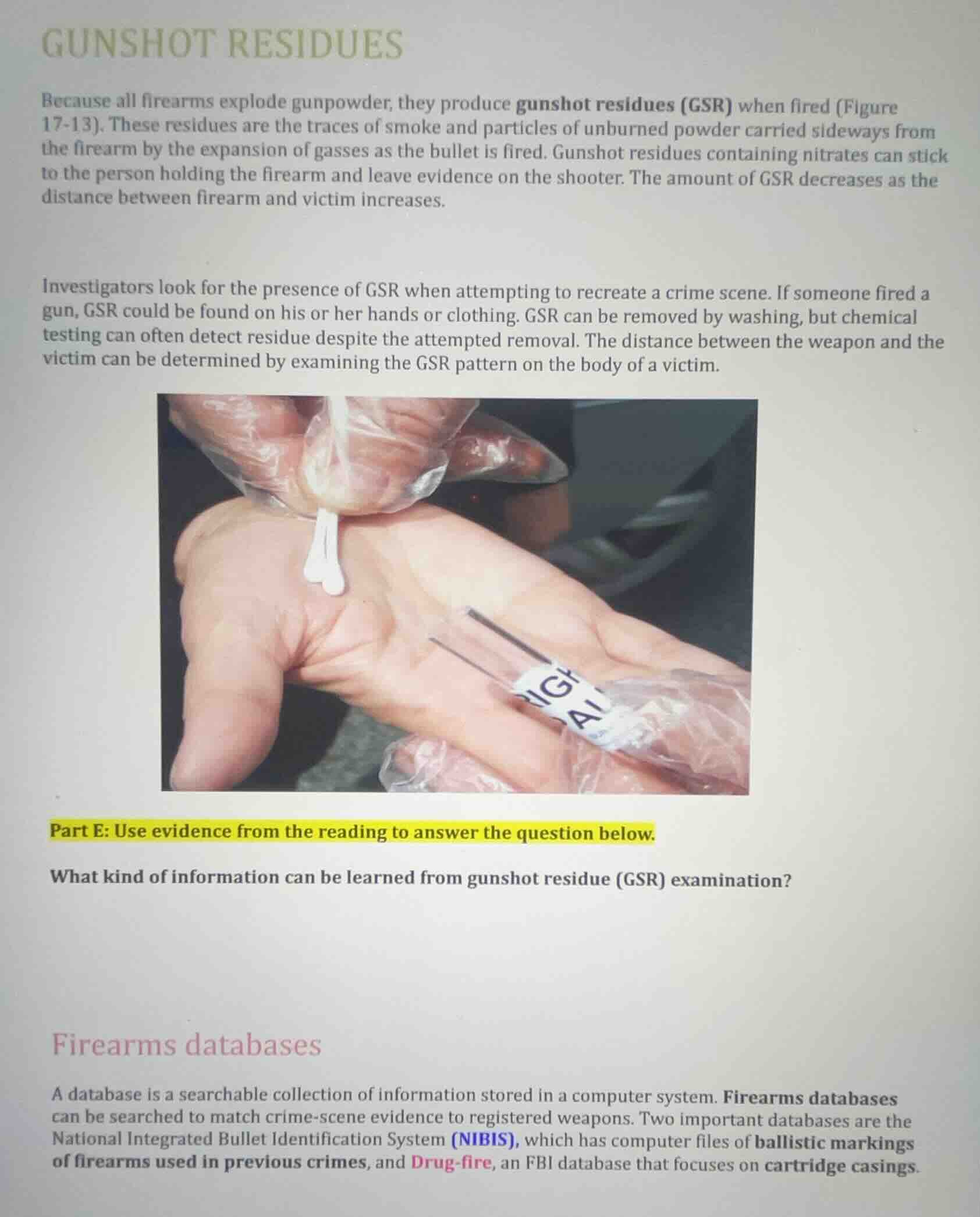
because all firearms explode gunpowder, they produce gunshot residues (gsr) when fired (figure 17 - 13). these residues are the traces of smoke and particles of unburned powder carried sideways from the firearm by the expansion of gasses as the bullet is fired. gunshot residues containing nitrates can stick to the person holding the firearm and leave evidence on the shooter. the amount of gsr decreases as the distance between firearm and victim increases.
investigators look for the presence of gsr when attempting to recreate a crime scene. if someone fired a gun, gsr could be found on his or her hands or clothing. gsr can be removed by washing, but chemical testing can often detect residue despite the attempted removal. the distance between the weapon and the victim can be determined by examining the gsr pattern on the body of a victim.
part e: use evidence from the reading to answer the question below.
what kind of information can be learned from gunshot residue (gsr) examination?
firearms databases
a database is a searchable collection of information stored in a computer system. firearms databases can be searched to match crime - scene evidence to registered weapons. two important databases are the national integrated bullet identification system (nibis), which has computer files of ballistic markings of firearms used in previous crimes, and drug - fire, an fbi database that focuses on cartridge casings.
From the reading: 1. GSR on a person's hands/clothing can show if they fired a gun. 2. Chemical testing can detect GSR even after washing, helping identify shooters. 3. The GSR pattern on a victim's body can determine the distance between the weapon and the victim, aiding in crime scene recreation.

Snap & solve any problem in the app
Get step-by-step solutions on Sovi AI
Photo-based solutions with guided steps
Explore more problems and detailed explanations
From gunshot residue (GSR) examination, we can learn: (1) Whether a person fired a gun (as GSR could be found on their hands or clothing). (2) Even if GSR is attempted to be removed by washing, chemical testing can often detect it, helping identify the shooter. (3) The distance between the weapon and the victim can be determined by examining the GSR pattern on the victim's body, which assists in recreating the crime scene.