QUESTION IMAGE
Question
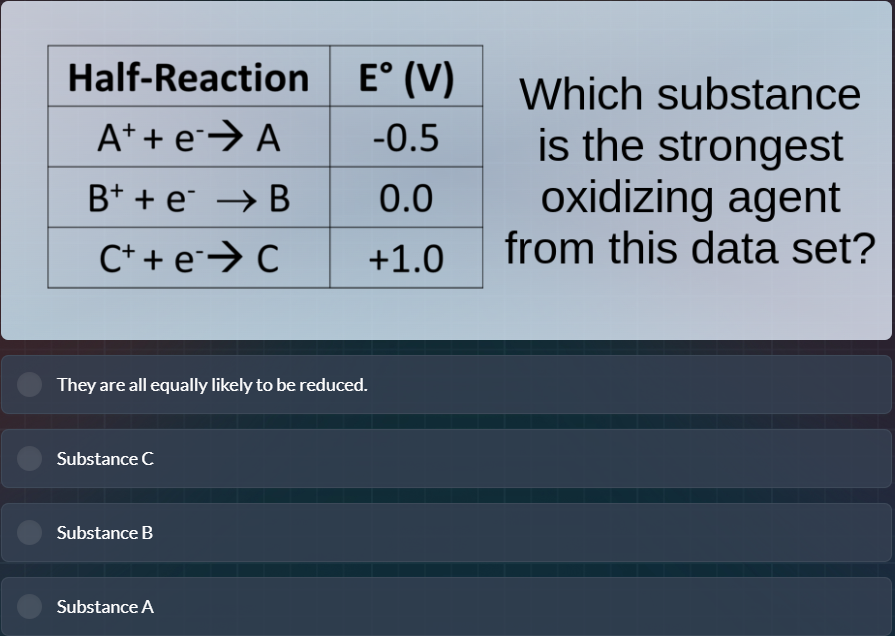
half-reaction | e° (v)
a⁺ + e⁻→ a | -0.5
b⁺ + e⁻ → b | 0.0
c⁺ + e⁻→ c | +1.0
which substance is the strongest oxidizing agent from this data set?
options:
they are all equally likely to be reduced.
substance c
substance b
substance a
To determine the strongest oxidizing agent, we use the concept that a stronger oxidizing agent has a greater tendency to be reduced (gain electrons), and this is related to the standard reduction potential ($E^\circ$). A higher (more positive) $E^\circ$ value for a reduction half - reaction means the species (the cation in this case) is more likely to be reduced.
For the half - reactions:
- For $\ce{A+ + e^- -> A}$, $E^\circ=- 0.5\ V$
- For $\ce{B+ + e^- -> B}$, $E^\circ = 0.0\ V$
- For $\ce{C+ + e^- -> C}$, $E^\circ=+ 1.0\ V$
Among $\ce{A+}$, $\ce{B+}$, and $\ce{C+}$, $\ce{C+}$ has the highest (most positive) $E^\circ$ value. The oxidizing agent is the species that gets reduced (the cation here, and the substance related to the cation's reduction is the one that acts as the oxidizing agent). Wait, actually, the oxidizing agent is the species that causes oxidation (and is itself reduced). So the cation that is most easily reduced (has the highest $E^\circ$ for reduction) means that the substance (the cation, or the species from which the cation comes) is the strongest oxidizing agent. Wait, in the half - reactions, the reactant in the reduction (the cation) is the oxidizing agent. So $\ce{C+}$ is the oxidizing agent here, but the question asks about the substance. Wait, maybe there is a mis - wording, but looking at the options, the options are Substance C, B, A. Wait, perhaps the question has a slight error, but following the logic of reduction potential: the higher the $E^\circ$ of the reduction of the cation, the stronger the oxidizing agent (the cation, but if we consider the substance, maybe it's a mis - phrasing, and we assume that the substance related to the cation with the highest $E^\circ$ is the answer). Since $\ce{C+}$ has the highest $E^\circ$ for reduction, the substance related to the strongest oxidizing agent (the one that is most likely to be reduced, so the cation that is the oxidizing agent) would correspond to Substance C (maybe a mis - phrasing, but among the options, Substance C is the one associated with the cation $\ce{C+}$ which has the highest reduction potential).
Wait, no, actually, the oxidizing agent is the species that is reduced. So in the reduction half - reaction, the reactant (the cation) is the oxidizing agent. But the options are Substance A, B, C (the neutral substances). Maybe the question is using a simplified approach where the substance whose cation has the highest reduction potential is considered the strongest oxidizing agent. So since $\ce{C+}$ has the highest $E^\circ$ for reduction ($+1.0\ V$), the substance C (maybe the question is considering the substance as the source of the cation) is the strongest oxidizing agent (because its cation is most likely to be reduced, so the substance C is the strongest oxidizing agent in the options).

Snap & solve any problem in the app
Get step-by-step solutions on Sovi AI
Photo-based solutions with guided steps
Explore more problems and detailed explanations
Substance C