QUESTION IMAGE
Question
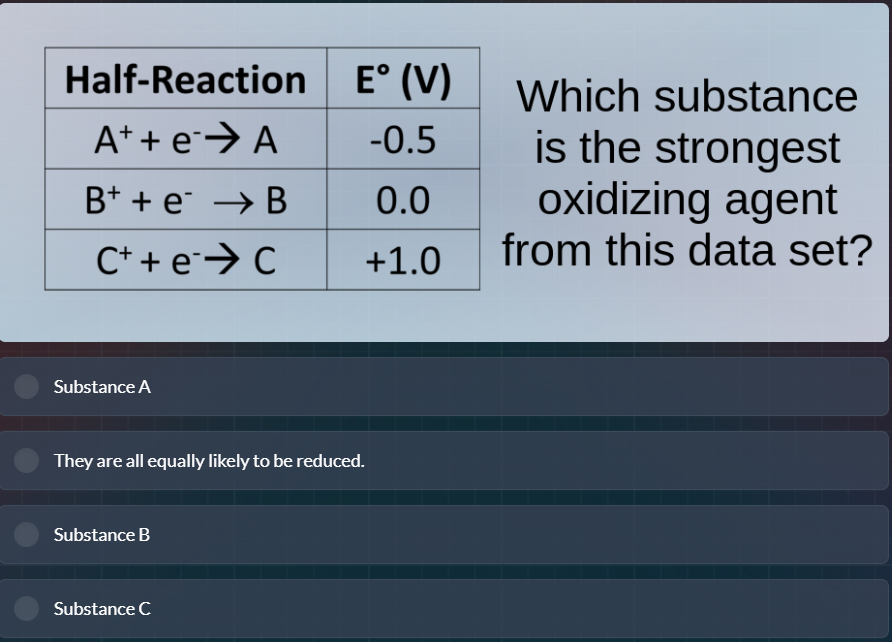
half-reaction | e° (v)
a⁺ + e⁻→ a | -0.5
b⁺ + e⁻ → b | 0.0
c⁺ + e⁻→ c | +1.0
which substance is the strongest oxidizing agent from this data set?
substance a
they are all equally likely to be reduced.
substance b
substance c
Oxidizing agents are substances that get reduced (gain electrons) in a redox reaction. The standard reduction potential ($E^\circ$) indicates the tendency of a substance to be reduced. A higher (more positive) $E^\circ$ means a greater tendency to be reduced, so the substance is a stronger oxidizing agent. Among the given half - reactions, the $E^\circ$ values are: for $A^++e^-\to A$, $E^\circ=- 0.5$ V; for $B^++e^-\to B$, $E^\circ = 0.0$ V; for $C^++e^-\to C$, $E^\circ=+1.0$ V. Since $C^+$ has the highest (most positive) standard reduction potential, $C^+$ (and thus substance C) is the strongest oxidizing agent as it has the greatest tendency to be reduced.

Snap & solve any problem in the app
Get step-by-step solutions on Sovi AI
Photo-based solutions with guided steps
Explore more problems and detailed explanations
Substance C