QUESTION IMAGE
Question
half-reaction | e° (v)
au³⁺ + 3e⁻ → au | + 1.42
ti²⁺ + 2e⁻ → ti | -1.63
cu²⁺ + e⁻ → cu¹⁺ | + 0.16
sn²⁺ + 2e⁻ → sn | - 0.14
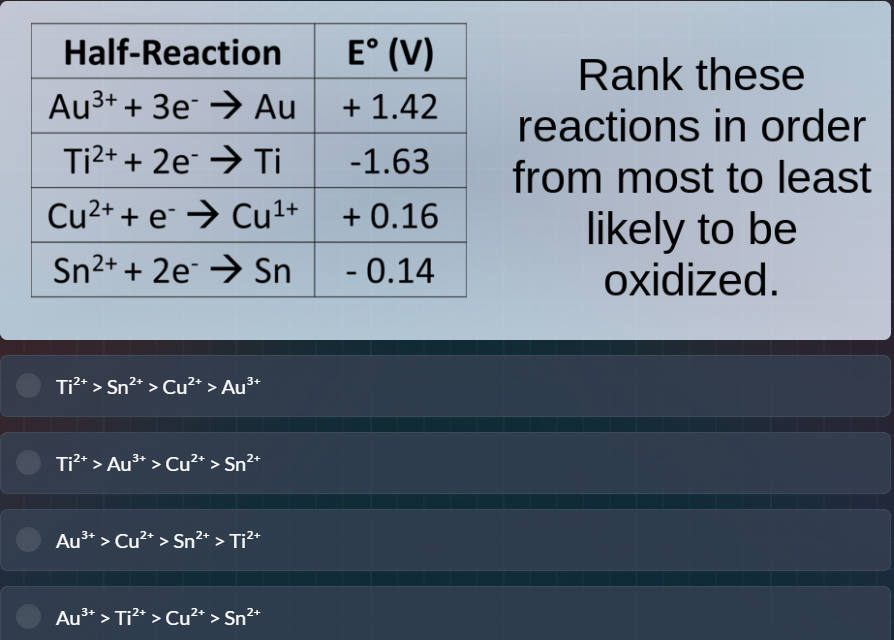
rank these reactions in order from most to least likely to be oxidized.
options:
ti²⁺ > sn²⁺ > cu²⁺ > au³⁺
ti²⁺ > au³⁺ > cu²⁺ > sn²⁺
au³⁺ > cu²⁺ > sn²⁺ > ti²⁺
au³⁺ > ti²⁺ > cu²⁺ > sn²⁺
To determine the likelihood of oxidation, we use the concept of standard reduction potentials (\(E^\circ\)). A lower (more negative) \(E^\circ\) for a reduction half - reaction means the species being reduced (the reactant in the reduction half - reaction) is more likely to be oxidized (act as a reducing agent, get oxidized). The reactants in the given reduction half - reactions are \(Au^{3+}\), \(Ti^{2+}\), \(Cu^{2+}\), and \(Sn^{2+}\).
The \(E^\circ\) values are: \(Au^{3+}+3e^-\to Au\) has \(E^\circ = + 1.42\ V\), \(Ti^{2+}+2e^-\to Ti\) has \(E^\circ=-1.63\ V\), \(Cu^{2+}+e^-\to Cu^{+}\) has \(E^\circ = + 0.16\ V\), \(Sn^{2+}+2e^-\to Sn\) has \(E^\circ=-0.14\ V\).
Arranging the \(E^\circ\) values in increasing order (more negative to less negative, or lower to higher): \(-1.63\ (Ti^{2+})<- 0.14\ (Sn^{2+})<0.16\ (Cu^{2+})<1.42\ (Au^{3+})\). Since a lower \(E^\circ\) for the reduction of a species means the species is more likely to be oxidized, the order of likelihood of oxidation (from most to least) is \(Ti^{2+}>Sn^{2+}>Cu^{2+}>Au^{3+}\).

Snap & solve any problem in the app
Get step-by-step solutions on Sovi AI
Photo-based solutions with guided steps
Explore more problems and detailed explanations
A. \(Ti^{2+}>Sn^{2+}>Cu^{2+}>Au^{3+}\)