QUESTION IMAGE
Question
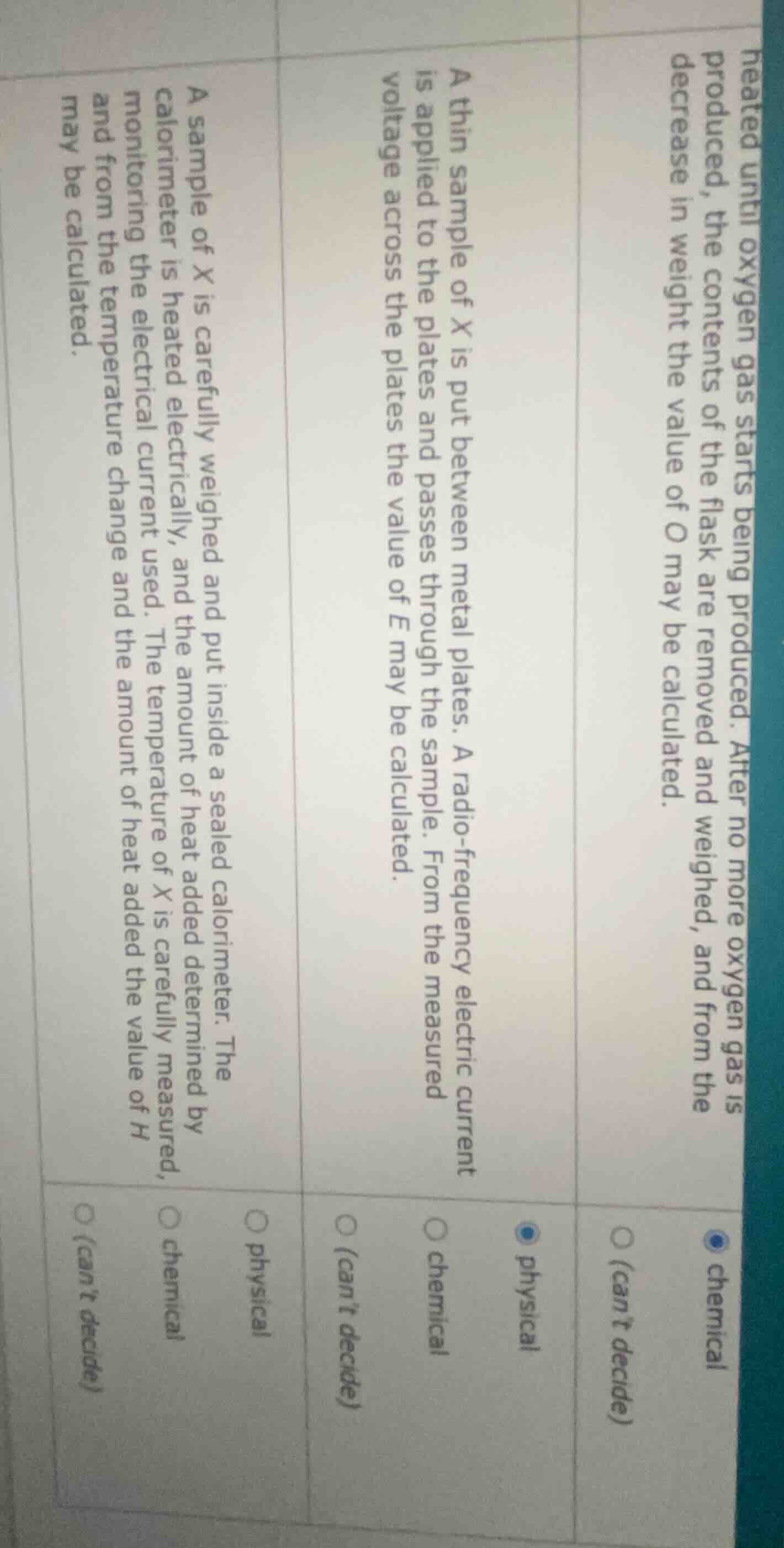
heated until oxygen gas starts being produced. after no more oxygen gas is produced, the contents of the flask are removed and weighed, and from the decrease in weight the value of o may be calculated.
a thin sample of x is put between metal plates. a radio - frequency electric current is applied to the plates and passes through the sample. from the measured voltage across the plates the value of e may be calculated.
a sample of x is carefully weighed and put inside a sealed calorimeter. the calorimeter is heated electrically, and the amount of heat added determined by monitoring the electrical current used. the temperature of x is carefully measured, and from the temperature change and the amount of heat added the value of h may be calculated.
First Experiment (Oxygen Production and Weight Change)
The experiment involves a substance being heated to produce oxygen, with weight change measured. This involves a chemical reaction (production of oxygen, a new substance) and measuring mass change, which is a chemical process (since it's about a chemical reaction's product and mass change related to it). So it's a chemical process.
The experiment involves passing a radio - frequency current through a sample and measuring voltage to calculate E. This is related to the physical properties of the sample (like electrical properties) and the application of electrical energy, which is a physical process (dealing with electrical and physical characteristics, no new substance formation indicated). So it's a physical process.
The experiment uses a calorimeter to measure heat added and temperature change of X. This is about the physical property of heat and temperature of a substance, with no indication of a chemical reaction (just heating and measuring thermal/ physical properties). So it's a physical process.

Snap & solve any problem in the app
Get step-by-step solutions on Sovi AI
Photo-based solutions with guided steps
Explore more problems and detailed explanations
chemical