QUESTION IMAGE
Question
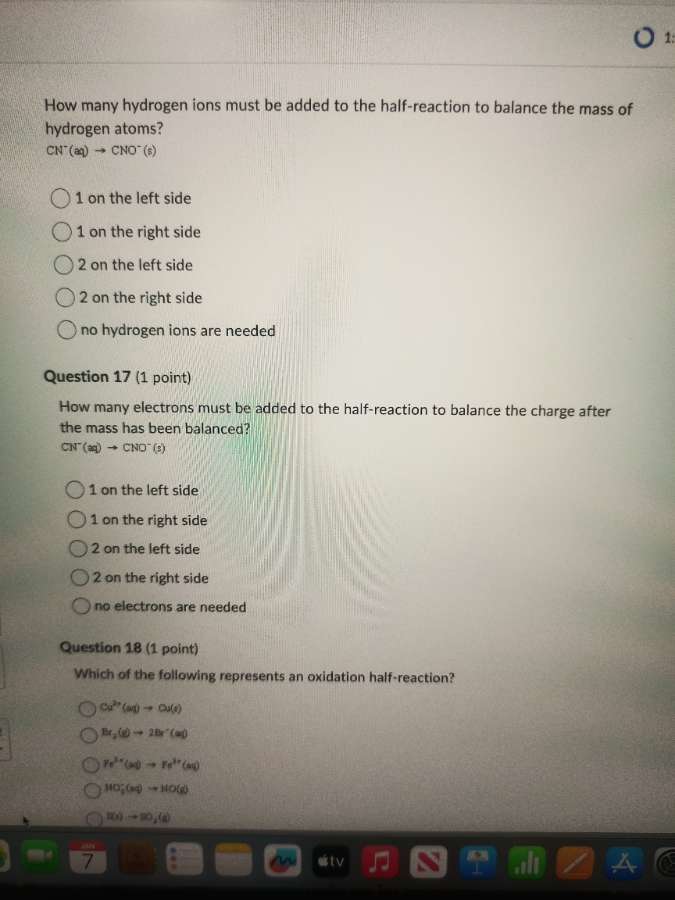
how many hydrogen ions must be added to the half - reaction to balance the mass of hydrogen atoms?
cn⁻(aq) → cno⁻(s)
1 on the left side
1 on the right side
2 on the left side
2 on the right side
no hydrogen ions are needed
question 17 (1 point)
how many electrons must be added to the half - reaction to balance the charge after the mass has been balanced?
cn⁻(aq) → cno⁻(s)
1 on the left side
1 on the right side
2 on the left side
2 on the right side
no electrons are needed
question 18 (1 point)
which of the following represents an oxidation half - reaction?
co²⁺(aq) → co(s)
br₂(l) → 2br⁻(aq)
fe²⁺(aq) → fe³⁺(aq)
no₂(g) → no(g)
h₂o → h₂o₂(aq)
Question (about balancing hydrogen in half - reaction: $\ce{CN^-(aq) -> CNO^-(aq)}$)
Step 1: Analyze hydrogen atoms on each side
First, let's write the unbalanced half - reaction: $\ce{CN^-(aq) -> CNO^-(aq)}$.
On the left - hand side (LHS), the reactant $\ce{CN^-}$ has no hydrogen atoms. On the right - hand side (RHS), the product $\ce{CNO^-}$ also has no hydrogen atoms. But we also need to consider the oxygen balance first (since it's a redox half - reaction in an aqueous medium, we can use water and $\ce{H^+}$ to balance). Wait, actually, let's balance the oxygen first. To balance oxygen, we add $\ce{H2O}$ to the side that needs oxygen. The left - hand side has 0 oxygen atoms, and the right - hand side has 1 oxygen atom. So we add 1 $\ce{H2O}$ to the left - hand side: $\ce{CN^-(aq) + H2O(l) -> CNO^-(aq)}$.
Now, let's balance hydrogen. The left - hand side has 2 hydrogen atoms (from $\ce{H2O}$), and the right - hand side has 0 hydrogen atoms. To balance hydrogen, we add $\ce{H^+}$ (hydrogen ions) to the right - hand side. Since we have 2 H atoms on the left, we need to add $2\ce{H^+}$ to the right - hand side. Wait, no, wait. Wait, the original half - reaction is about balancing hydrogen for mass. Wait, maybe I made a mistake. Wait, the half - reaction is $\ce{CN^- -> CNO^-}$. Let's list the number of each atom:
- C: 1 on LHS, 1 on RHS (balanced)
- N: 1 on LHS, 1 on RHS (balanced)
- O: 0 on LHS, 1 on RHS. So we add 1 $\ce{H2O}$ to LHS: $\ce{CN^- + H2O -> CNO^-}$
Now, H: 2 on LHS (from $\ce{H2O}$), 0 on RHS. So we add $2\ce{H^+}$ to RHS: $\ce{CN^- + H2O -> CNO^- + 2H^+}$
So the number of hydrogen ions added is 2 on the right side.
Question 17 (about balancing charge in $\ce{CN^-(aq) -> CNO^-(aq)}$ after mass balance)
Step 1: Calculate the charge on each side before charge balance
First, let's use the mass - balanced half - reaction: $\ce{CN^- + H2O -> CNO^- + 2H^+}$
- Charge on LHS: The charge of $\ce{CN^-}$ is - 1, and $\ce{H2O}$ is neutral (charge = 0). So total charge on LHS: - 1+0=-1.
- Charge on RHS: The charge of $\ce{CNO^-}$ is - 1, and the charge of $2\ce{H^+}$ is $2\times( + 1)=+2$. So total charge on RHS: - 1+2 = + 1.
Step 2: Determine the number of electrons to add
To balance the charge, we need to make the charge on both sides equal. Let's assume we add $n$ electrons. Electrons have a charge of - 1 per electron.
We want LHS charge = RHS charge.
LHS charge: - 1
RHS charge: + 1
If we add electrons to the right - hand side (since electrons are negatively charged, adding them to the right will decrease the positive charge), let's set up the equation:
- 1=+1 + n\times(- 1)
Solving for $n$:
$n\times(-1)=-1 - 1=-2$
$n = 2$? Wait, no, wait. Wait, the correct way is: The charge on LHS is - 1, on RHS is + 1. The difference in charge is $+1-(-1) = + 2$. Since electrons are negative, we need to add 2 electrons to the right - hand side (because adding 2 electrons (charge - 2) to the RHS will make the RHS charge: $+1-2=-1$, which matches the LHS charge of - 1). Wait, no, wait. Wait, let's do it again.
The half - reaction after mass balance (including $\ce{H^+}$ and $\ce{H2O}$) is $\ce{CN^- + H2O -> CNO^- + 2H^+}$. Now, let's calculate the oxidation state of N. In $\ce{CN^-}$, the oxidation state of C is + 2 (since N is - 3 in $\ce{CN^-}$, and the overall charge is - 1: $C + (-3)=-1\Rightarrow C = + 2$). In $\ce{CNO^-}$, the oxidation state of C is + 4 (O is - 2, N is - 3: $C+(-3)+(-2)=-1\Rightarrow C = + 4$). So N is being oxidized (oxidation state of C increases from + 2 to + 4), so it's an oxidation half - rea…

Snap & solve any problem in the app
Get step-by-step solutions on Sovi AI
Photo-based solutions with guided steps
Explore more problems and detailed explanations
s:
- For the hydrogen ion balance question: 2 on the right side
- For Question 17: 2 on the right side
- For Question 18: $\ce{Fe^{2+}(aq) -> Fe^{3+}(aq)}$ (assuming the option is like, for example, if the option is C. $\ce{Fe^{2+}(aq) -> Fe^{3+}(aq)}$, then the answer is C. $\ce{Fe^{2+}(aq) -> Fe^{3+}(aq)}$)