QUESTION IMAGE
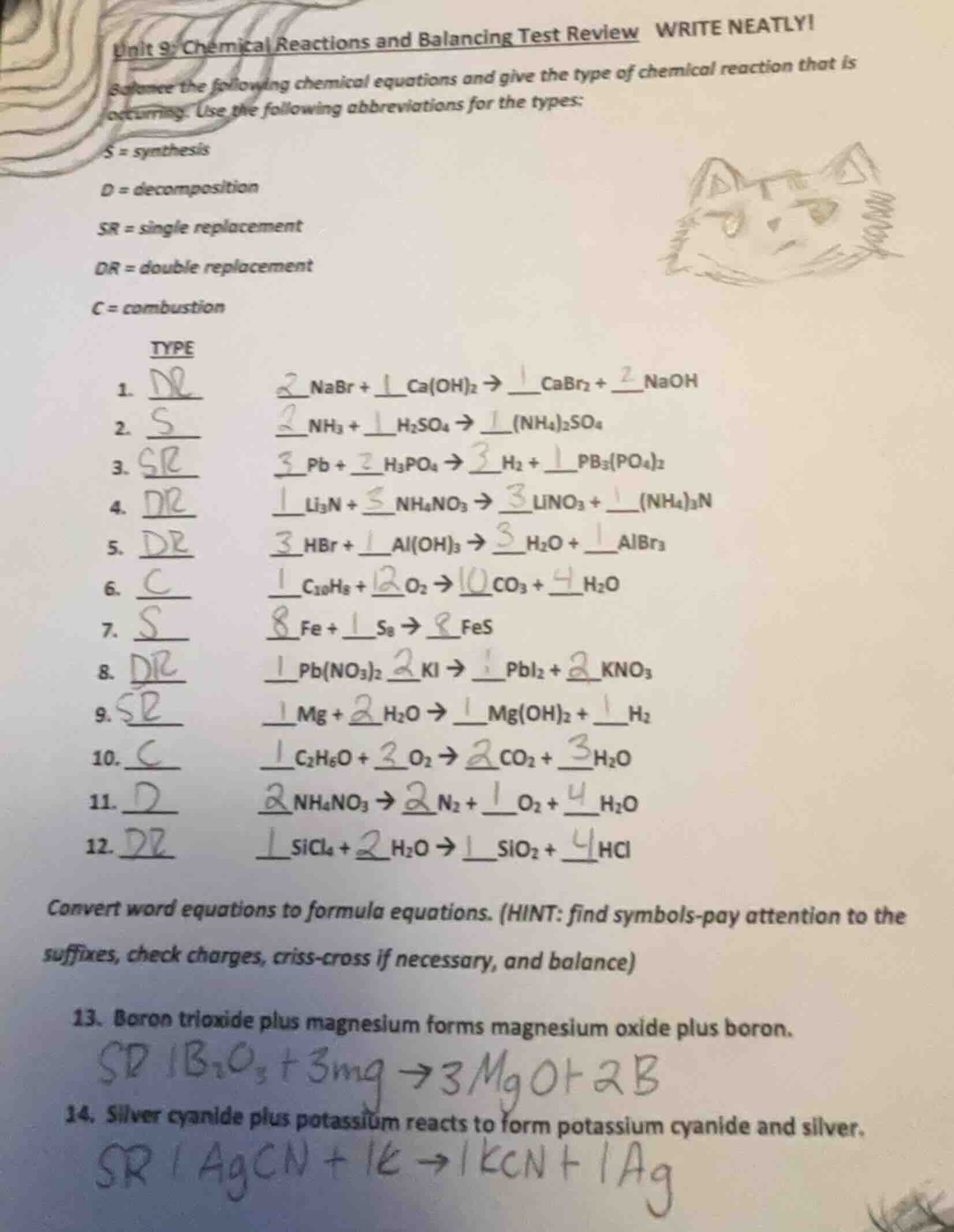
Question
Question was provided via image upload.
Problem 1: Balancing \( \boldsymbol{\ce{NaBr + Ca(OH)2 -> CaBr2 + NaOH}} \) and Identifying Reaction Type
Step 1: Balance Br atoms
On the left, we have 1 Br (from \( \ce{NaBr} \)), and on the right, we have 2 Br (from \( \ce{CaBr2} \)). So we put a coefficient of 2 in front of \( \ce{NaBr} \):
\( 2\ce{NaBr} + \ce{Ca(OH)2} -> \ce{CaBr2} + \ce{NaOH} \)
Step 2: Balance Na atoms
Now we have 2 Na on the left (from \( 2\ce{NaBr} \)), so we put a coefficient of 2 in front of \( \ce{NaOH} \) to balance Na:
\( 2\ce{NaBr} + \ce{Ca(OH)2} -> \ce{CaBr2} + 2\ce{NaOH} \)
Step 3: Check other atoms (Ca, O, H)
- Ca: 1 on left (\( \ce{Ca(OH)2} \)) and 1 on right (\( \ce{CaBr2} \)) – balanced.
- O: 2 on left (\( \ce{Ca(OH)2} \)) and 2 on right (\( 2\ce{NaOH} \)) – balanced.
- H: 2 on left (\( \ce{Ca(OH)2} \)) and 2 on right (\( 2\ce{NaOH} \)) – balanced.
Step 4: Identify reaction type
This is a double replacement (DR) reaction because the cations (\( \ce{Na+} \) and \( \ce{Ca^{2+}} \)) and anions (\( \ce{Br-} \) and \( \ce{OH-} \)) switch partners.
Step 1: Balance \( \ce{NH4+} \) (from \( \ce{NH3} \) and \( \ce{(NH4)2SO4} \))
On the right, we have 2 \( \ce{NH4+} \) (from \( \ce{(NH4)2SO4} \)), so we put a coefficient of 2 in front of \( \ce{NH3} \):
\( 2\ce{NH3} + \ce{H2SO4} -> \ce{(NH4)2SO4} \)
Step 2: Check other atoms (S, O, H)
- S: 1 on left (\( \ce{H2SO4} \)) and 1 on right (\( \ce{(NH4)2SO4} \)) – balanced.
- O: 4 on left (\( \ce{H2SO4} \)) and 4 on right (\( \ce{(NH4)2SO4} \)) – balanced.
- H: Let’s verify:
- Left: \( 2\ce{NH3} \) has \( 2 \times 3 = 6 \) H, \( \ce{H2SO4} \) has 2 H – total 8 H.
- Right: \( \ce{(NH4)2SO4} \) has \( 2 \times 4 = 8 \) H – balanced.
Step 3: Identify reaction type
This is a synthesis (S) reaction because two substances (\( \ce{NH3} \) and \( \ce{H2SO4} \)) combine to form a single product (\( \ce{(NH4)2SO4} \)).
Step 1: Balance \( \ce{PO4^{3-}} \) (from \( \ce{H3PO4} \) and \( \ce{Pb3(PO4)2} \))
On the right, we have 2 \( \ce{PO4^{3-}} \) (from \( \ce{Pb3(PO4)2} \)), so we put a coefficient of 2 in front of \( \ce{H3PO4} \):
\( \ce{Pb} + 2\ce{H3PO4} -> \ce{H2} + \ce{Pb3(PO4)2} \)
Step 2: Balance Pb atoms
On the right, we have 3 Pb (from \( \ce{Pb3(PO4)2} \)), so we put a coefficient of 3 in front of \( \ce{Pb} \):
\( 3\ce{Pb} + 2\ce{H3PO4} -> \ce{H2} + \ce{Pb3(PO4)2} \)
Step 3: Balance H atoms
On the left, \( 2\ce{H3PO4} \) has \( 2 \times 3 = 6 \) H. On the right, \( \ce{H2} \) has 2 H per molecule. Let’s find the coefficient for \( \ce{H2} \):
\( 6 \) H on left \( = 2 \times \) (coefficient of \( \ce{H2} \)) → coefficient of \( \ce{H2} = 3 \):
\( 3\ce{Pb} + 2\ce{H3PO4} -> 3\ce{H2} + \ce{Pb3(PO4)2} \)
Step 4: Check O atoms
Left: \( 2\ce{H3PO4} \) has \( 2 \times 4 = 8 \) O. Right: \( \ce{Pb3(PO4)2} \) has \( 2 \times 4 = 8 \) O – balanced.
Step 5: Identify reaction type
This is a single replacement (SR) reaction because \( \ce{Pb} \) (a metal) replaces \( \ce{H} \) in \( \ce{H3PO4} \) (an acid) to form \( \ce{H2} \) gas.

Snap & solve any problem in the app
Get step-by-step solutions on Sovi AI
Photo-based solutions with guided steps
Explore more problems and detailed explanations
Balanced equation: \( \boldsymbol{2\ce{NaBr} + \ce{Ca(OH)2} -> \ce{CaBr2} + 2\ce{NaOH}} \)
Reaction type: \( \boldsymbol{DR} \)