QUESTION IMAGE
Question
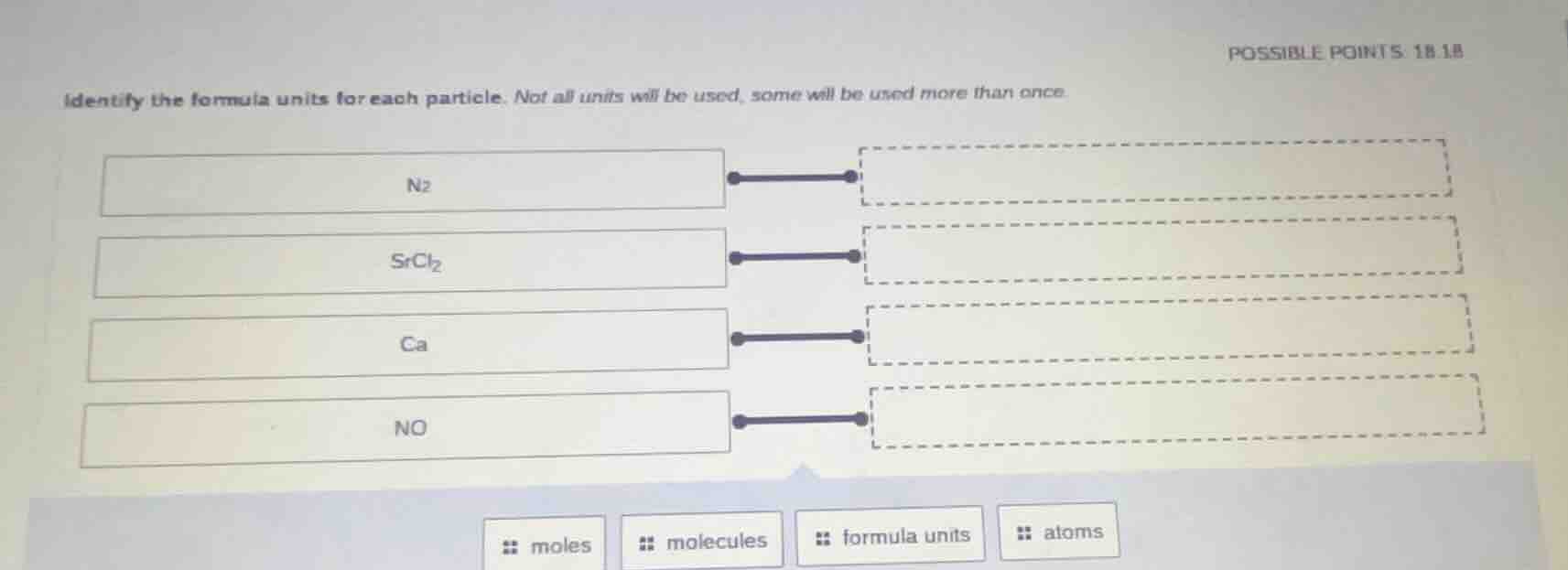
identify the formula units for each particle. not all units will be used, some will be used more than once.
n₂
srcl₂
ca
no
moles molecules formula units atoms
Step1: Analyze \( \text{N}_2 \)
\( \text{N}_2 \) is a molecular compound (diatomic gas), so its formula unit can be molecules (since it exists as discrete molecules) and also moles (amount of substance). But for the particle type, \( \text{N}_2 \) particles are molecules. Also, moles can be used for amount, but the options for particle units: \( \text{N}_2 \) is a molecule, so it can be molecules, and also moles (but the options given are moles, molecules, formula units, atoms). Wait, actually, for molecular compounds, the formula unit is a molecule. So \( \text{N}_2 \): molecules (and moles, but let's match the particle type). Wait, the question is "formula units for each particle". Wait, maybe the options are the units to assign. Let's recall:
- Atoms: for elemental substances that are atoms (like Ca, which is a metal, exists as atoms in metallic structure, or as individual atoms in terms of particle).
- Molecules: for molecular compounds (like \( \text{N}_2 \), \( \text{NO} \)) which exist as discrete molecules.
- Formula units: for ionic compounds (like \( \text{SrCl}_2 \)) which exist as a lattice of ions, so the formula unit is the simplest ratio (formula unit), not a molecule.
- Moles: is an amount unit, but maybe the question is about the type of particle. Wait, maybe the options are the type of particle unit. Let's re-express:
- \( \text{N}_2 \): it's a diatomic molecule, so its particle is a molecule. Also, moles can be used, but the particle type (like what the formula represents as a particle) – \( \text{N}_2 \) is a molecule, so molecules.
- \( \text{SrCl}_2 \): it's an ionic compound (strontium chloride), so the formula unit is a formula unit (since it's a lattice, not discrete molecules).
- \( \text{Ca} \): it's a metal, exists as atoms (in metallic structure), so its particle is an atom.
- \( \text{NO} \): it's a molecular compound (nitric oxide), so its particle is a molecule.
Wait, but also, moles is an amount unit, but maybe the question is assigning the correct particle unit (molecules, formula units, atoms) and moles is a unit of amount, but maybe the options are the types of particles. Wait, let's correct:
- \( \text{N}_2 \): molecules (since it's a molecular substance, exists as \( \text{N}_2 \) molecules)
- \( \text{SrCl}_2 \): formula units (since it's ionic, exists as a lattice, so the formula unit is \( \text{SrCl}_2 \) formula unit)
- \( \text{Ca} \): atoms (since calcium is a metal, its particles are atoms)
- \( \text{NO} \): molecules (since it's a molecular compound, exists as \( \text{NO} \) molecules)
Also, moles can be used for any substance (amount of substance), but maybe the question is about the type of particle (molecules, formula units, atoms) and moles is a unit of amount, but perhaps the options include moles as a possible unit (like the amount of \( \text{N}_2 \) can be in moles, but the particle type is molecule). Wait, maybe the question is to assign each compound to the correct particle unit (moles, molecules, formula units, atoms). Let's clarify:
- \( \text{N}_2 \): is a molecule, so its particle is a molecule; also, the amount can be in moles. But the options are the units to assign. Let's go step by step.
Step2: Assign \( \text{N}_2 \)
\( \text{N}_2 \) is a molecular substance, so the particle is a molecule. So assign to molecules. Also, moles can be used, but let's check the other compounds.
Step3: Assign \( \text{SrCl}_2 \)
\( \text{SrCl}_2 \) is an ionic compound (strontium is a metal, chlorine is a non-metal), so it exists as a crystal lattice of \( \text{Sr}^{…

Snap & solve any problem in the app
Get step-by-step solutions on Sovi AI
Photo-based solutions with guided steps
Explore more problems and detailed explanations
- \( \text{N}_2 \): molecules (and moles)
- \( \text{SrCl}_2 \): formula units (and moles)
- \( \text{Ca} \): atoms (and moles)
- \( \text{NO} \): molecules (and moles)
But based on the particle type (what the formula represents as a particle):
- \( \text{N}_2 \) is a molecule → molecules
- \( \text{SrCl}_2 \) is an ionic compound → formula units
- \( \text{Ca} \) is a metal (monatomic) → atoms
- \( \text{NO} \) is a molecule → molecules
(Note: Moles is a unit of amount, so all can also be associated with moles, but the question is about the formula units for each particle (the type of particle), so the above are the particle-type assignments.)