QUESTION IMAGE
Question
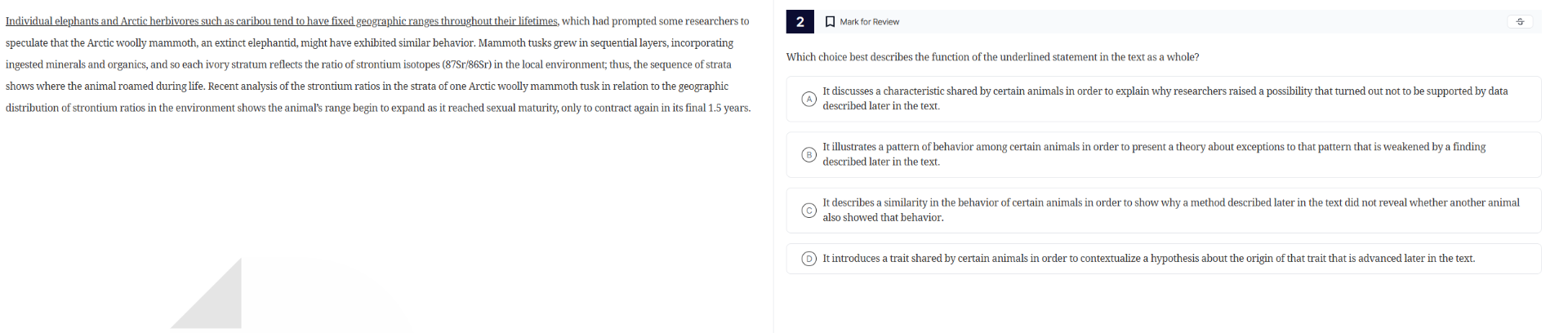
individual elephants and arctic herbivores such as caribou tend to have fixed geographic ranges throughout their lifetimes, which had prompted some researchers to speculate that the arctic woolly mammoth, an extinct elephantid, might have exhibited similar behavior. mammoth tusks grew in sequential layers, incorporating ingested minerals and organics, and so each ivory stratum reflects the ratio of strontium isotopes (87sr/86sr) in the local environment; thus, the sequence of strata shows where the animal roamed during life. recent analysis of the strontium ratios in the strata of one arctic woolly mammoth tusk in relation to the geographic distribution of strontium ratios in the environment shows the animals range begin to expand as it reached sexual maturity, only to contract again in its final 1.5 years.
which choice best describes the function of the underlined statement in the text as a whole?
a it discusses a characteristic shared by certain animals in order to explain why researchers raised a possibility that turned out not to be supported by data described later in the text.
b it illustrates a pattern of behavior among certain animals in order to present a theory about exceptions to that pattern that is weakened by a finding described later in the text.
c it describes a similarity in the behavior of certain animals in order to show why a method described later in the text did not reveal whether another animal also showed that behavior.
d it introduces a trait shared by certain animals in order to contextualize a hypothesis about the origin of that trait that is advanced later in the text.
- Analyze the underlined statement: It says individual elephants and Arctic herbivores (like caribou) have fixed geographic ranges. This is a trait shared by these animals.
- Then, researchers speculate mammoths (another animal) might have similar behavior. Later, analysis of mammoth tusk strontium ratios shows the mammoth's range changed (expanded at sexual maturity, contracted later), which means the initial speculation (that mammoths had fixed ranges like elephants/caribou) was not supported.
- Now check options:
- Option A: The underlined statement discusses a characteristic (fixed geographic ranges) of certain animals (elephants, caribou) to explain why researchers raised a possibility (mammoths had similar behavior) that turned out not to be supported by later data (mammoth's range changed). This matches.
- Option B: The underlined statement is about a shared behavior, not a pattern to present a theory about exceptions. The later finding doesn't weaken a theory about exceptions, but shows the initial speculation was wrong. Eliminate.
- Option C: The later method (analyzing strontium ratios) did reveal the mammoth's behavior (range changed), so it's not that the method didn't reveal. Eliminate.
- Option D: The text doesn't discuss the origin of the trait (fixed ranges), just a speculation about mammoths having the trait. Eliminate.

Snap & solve any problem in the app
Get step-by-step solutions on Sovi AI
Photo-based solutions with guided steps
Explore more problems and detailed explanations
A. It discusses a characteristic shared by certain animals in order to explain why researchers raised a possibility that turned out not to be supported by data described later in the text.