QUESTION IMAGE
Question
introduction
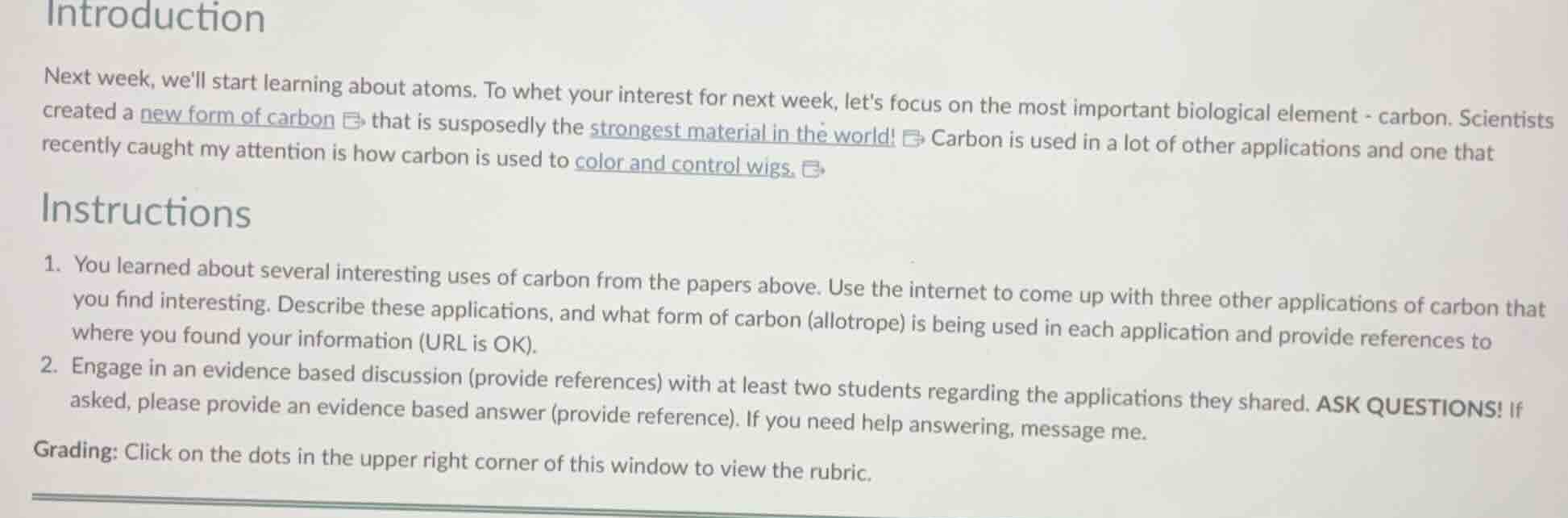
next week, well start learning about atoms. to whet your interest for next week, lets focus on the most important biological element - carbon. scientists created a new form of carbon that is supposedly the strongest material in the world! carbon is used in a lot of other applications and one that recently caught my attention is how carbon is used to color and control wigs.
instructions
- you learned about several interesting uses of carbon from the papers above. use the internet to come up with three other applications of carbon that you find interesting. describe these applications, and what form of carbon (allotrope) is being used in each application and provide references to where you found your information (url is ok).
- engage in an evidence based discussion (provide references) with at least two students regarding the applications they shared. ask questions! if asked, please provide an evidence based answer (provide reference). if you need help answering, message me.
grading: click on the dots in the upper right corner of this window to view the rubric.
Application 1: Carbon in Batteries (Graphite)
- Description: Graphite (a carbon allotrope) is a key component in lithium - ion batteries, which are widely used in smartphones, laptops, and electric vehicles. In these batteries, graphite serves as the anode. During charging, lithium ions are inserted into the graphite structure, and during discharging, they are released. This allows for the storage and release of electrical energy.
- Reference: https://www.chemistryworld.com/news/graphite - the - unsung - hero - of - lithium - ion - batteries/4010.article
Application 2: Carbon in Water Filtration (Activated Carbon)
- Description: Activated carbon, which has a highly porous structure, is used in water filtration systems. Its large surface area allows it to adsorb a wide range of impurities from water, such as organic compounds, chlorine, and some heavy metals. This makes the water safer and more pleasant to drink.
- Reference: https://www.sciencedirect.com/topics/engineering/activated - carbon - filtration
Application 3: Carbon in Pencil Leads (Graphite)
- Description: Pencil "leads" are actually made of graphite mixed with clay. The graphite in pencil leads allows for smooth writing or drawing on paper. The amount of clay mixed with the graphite determines the hardness of the pencil lead (e.g., a 2B pencil has more graphite and is softer, while an HB pencil has a more balanced mixture).
- Reference: https://www.scientificamerican.com/article/why - is - pencil - lead - made - of/
For the discussion part, if a student shares that carbon is used in diamond - tipped drills (diamond is a carbon allotrope) for cutting hard materials like concrete:
- Question: How does the hardness of diamond (as a carbon allotrope) compare to other materials used in drill bits, and what are the limitations of using diamond - tipped drills?
- Evidence - based Answer with Reference: Diamond is one of the hardest known materials, with a Mohs hardness of 10, which is much higher than materials like steel (Mohs hardness around 4 - 7) used in traditional drill bits. This allows diamond - tipped drills to cut through very hard materials more efficiently. However, diamond - tipped drills can be expensive to produce, and the diamond coating can wear off over time, especially when used on materials with abrasive particles. (Reference: https://www.engineeringtoolbox.com/mohs - hardness - scale - d_1086.html)
If another student shares that carbon fiber (a form of carbon) is used in sports equipment like tennis rackets:
- Question: What are the mechanical properties of carbon fiber that make it suitable for use in sports equipment, and how does it compare to traditional materials like aluminum in terms of weight and strength?
- Evidence - based Answer with Reference: Carbon fiber has a high strength - to - weight ratio, meaning it is very strong while being relatively light. It also has good stiffness, which is important for providing stability in sports equipment like tennis rackets. Compared to aluminum, carbon fiber is generally lighter and can have a higher strength in some applications. For example, a carbon - fiber tennis racket can be more maneuverable due to its lower weight while still being able to withstand the forces during a hit. (Reference: https://www.sciencedirect.com/topics/materials - science/carbon - fiber - reinforced - polymer)

Snap & solve any problem in the app
Get step-by-step solutions on Sovi AI
Photo-based solutions with guided steps
Explore more problems and detailed explanations
Application 1: Carbon in Batteries (Graphite)
- Description: Graphite (a carbon allotrope) is a key component in lithium - ion batteries, which are widely used in smartphones, laptops, and electric vehicles. In these batteries, graphite serves as the anode. During charging, lithium ions are inserted into the graphite structure, and during discharging, they are released. This allows for the storage and release of electrical energy.
- Reference: https://www.chemistryworld.com/news/graphite - the - unsung - hero - of - lithium - ion - batteries/4010.article
Application 2: Carbon in Water Filtration (Activated Carbon)
- Description: Activated carbon, which has a highly porous structure, is used in water filtration systems. Its large surface area allows it to adsorb a wide range of impurities from water, such as organic compounds, chlorine, and some heavy metals. This makes the water safer and more pleasant to drink.
- Reference: https://www.sciencedirect.com/topics/engineering/activated - carbon - filtration
Application 3: Carbon in Pencil Leads (Graphite)
- Description: Pencil "leads" are actually made of graphite mixed with clay. The graphite in pencil leads allows for smooth writing or drawing on paper. The amount of clay mixed with the graphite determines the hardness of the pencil lead (e.g., a 2B pencil has more graphite and is softer, while an HB pencil has a more balanced mixture).
- Reference: https://www.scientificamerican.com/article/why - is - pencil - lead - made - of/
For the discussion part, if a student shares that carbon is used in diamond - tipped drills (diamond is a carbon allotrope) for cutting hard materials like concrete:
- Question: How does the hardness of diamond (as a carbon allotrope) compare to other materials used in drill bits, and what are the limitations of using diamond - tipped drills?
- Evidence - based Answer with Reference: Diamond is one of the hardest known materials, with a Mohs hardness of 10, which is much higher than materials like steel (Mohs hardness around 4 - 7) used in traditional drill bits. This allows diamond - tipped drills to cut through very hard materials more efficiently. However, diamond - tipped drills can be expensive to produce, and the diamond coating can wear off over time, especially when used on materials with abrasive particles. (Reference: https://www.engineeringtoolbox.com/mohs - hardness - scale - d_1086.html)
If another student shares that carbon fiber (a form of carbon) is used in sports equipment like tennis rackets:
- Question: What are the mechanical properties of carbon fiber that make it suitable for use in sports equipment, and how does it compare to traditional materials like aluminum in terms of weight and strength?
- Evidence - based Answer with Reference: Carbon fiber has a high strength - to - weight ratio, meaning it is very strong while being relatively light. It also has good stiffness, which is important for providing stability in sports equipment like tennis rackets. Compared to aluminum, carbon fiber is generally lighter and can have a higher strength in some applications. For example, a carbon - fiber tennis racket can be more maneuverable due to its lower weight while still being able to withstand the forces during a hit. (Reference: https://www.sciencedirect.com/topics/materials - science/carbon - fiber - reinforced - polymer)