QUESTION IMAGE
Question
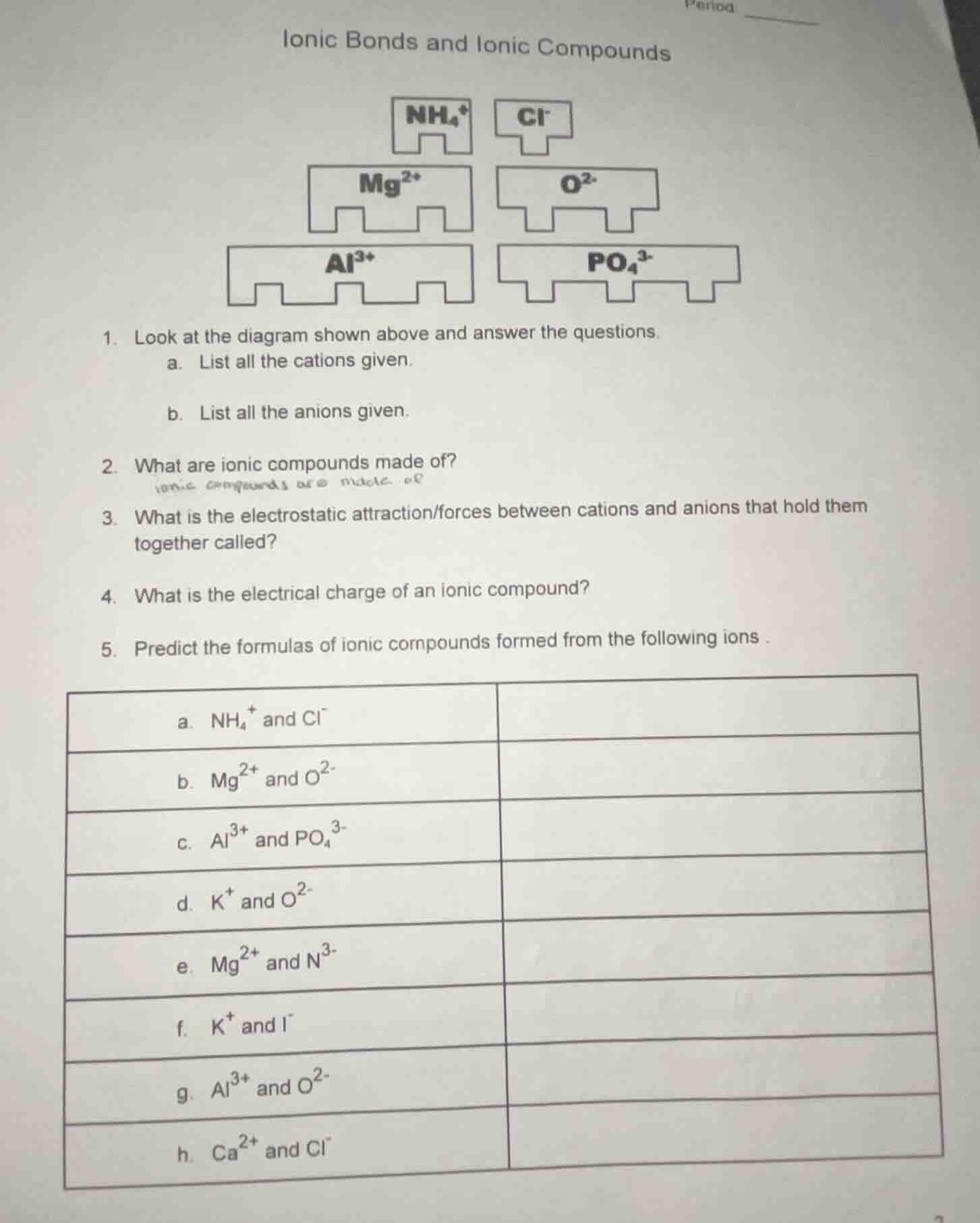
ionic bonds and ionic compounds1. look at the diagram shown above and answer the questions.a. list all the cations given.b. list all the anions given.2. what are ionic compounds made of?3. what is the electrostatic attraction/forces between cations and anions that hold them together called?4. what is the electrical charge of an ionic compound?5. predict the formulas of ionic compounds formed from the following ions .a. $\text{nh}_4^+$ and $\text{cl}^-$b. $\text{mg}^{2+}$ and $\text{o}^{2-}$c. $\text{al}^{3+}$ and $\text{po}_4^{3-}$d. $\text{k}^+$ and $\text{o}^{2-}$e. $\text{mg}^{2+}$ and $\text{n}^{3-}$f. $\text{k}^+$ and $\text{i}^-$g. $\text{al}^{3+}$ and $\text{o}^{2-}$h. $\text{ca}^{2+}$ and $\text{cl}^-$
Step1: Identify cations (positive ions)
Cations are ions with a positive charge. From the diagram, these are: $\text{NH}_4^+$, $\text{Mg}^{2+}$, $\text{Al}^{3+}$
Step2: Identify anions (negative ions)
Anions are ions with a negative charge. From the diagram, these are: $\text{Cl}^-$, $\text{O}^{2-}$, $\text{PO}_4^{3-}$
Step3: Define ionic compound composition
Ionic compounds form from cations and anions.
Step4: Name the electrostatic attraction
The force holding cations/anions is an ionic bond.
Step5: Determine ionic compound charge
Total positive and negative charges cancel out, so net charge is 0.
Step6: Balance charges for $\text{NH}_4^+$ and $\text{Cl}^-$
+1 and -1 charges balance 1:1. Formula: $\text{NH}_4\text{Cl}$
Step7: Balance charges for $\text{Mg}^{2+}$ and $\text{O}^{2-}$
+2 and -2 charges balance 1:1. Formula: $\text{MgO}$
Step8: Balance charges for $\text{Al}^{3+}$ and $\text{PO}_4^{3-}$
+3 and -3 charges balance 1:1. Formula: $\text{AlPO}_4$
Step9: Balance charges for $\text{K}^+$ and $\text{O}^{2-}$
2 $\text{K}^+$ (+1 each) balance 1 $\text{O}^{2-}$. Formula: $\text{K}_2\text{O}$
Step10: Balance charges for $\text{Mg}^{2+}$ and $\text{N}^{3-}$
3 $\text{Mg}^{2+}$ (+2 each) and 2 $\text{N}^{3-}$ (-3 each) balance. Formula: $\text{Mg}_3\text{N}_2$
Step11: Balance charges for $\text{K}^+$ and $\text{I}^-$
+1 and -1 charges balance 1:1. Formula: $\text{KI}$
Step12: Balance charges for $\text{Al}^{3+}$ and $\text{O}^{2-}$
2 $\text{Al}^{3+}$ (+3 each) and 3 $\text{O}^{2-}$ (-2 each) balance. Formula: $\text{Al}_2\text{O}_3$
Step13: Balance charges for $\text{Ca}^{2+}$ and $\text{Cl}^-$
1 $\text{Ca}^{2+}$ and 2 $\text{Cl}^-$ (-1 each) balance. Formula: $\text{CaCl}_2$

Snap & solve any problem in the app
Get step-by-step solutions on Sovi AI
Photo-based solutions with guided steps
Explore more problems and detailed explanations
1.
a. $\text{NH}_4^+$, $\text{Mg}^{2+}$, $\text{Al}^{3+}$
b. $\text{Cl}^-$, $\text{O}^{2-}$, $\text{PO}_4^{3-}$
- Ionic compounds are made of positively charged cations and negatively charged anions (formed from metals and nonmetals/ polyatomic ions).
- Ionic bond (or ionic bonding)
- Neutral (a net electrical charge of 0)
5.
a. $\text{NH}_4\text{Cl}$
b. $\text{MgO}$
c. $\text{AlPO}_4$
d. $\text{K}_2\text{O}$
e. $\text{Mg}_3\text{N}_2$
f. $\text{KI}$
g. $\text{Al}_2\text{O}_3$
h. $\text{CaCl}_2$