QUESTION IMAGE
Question
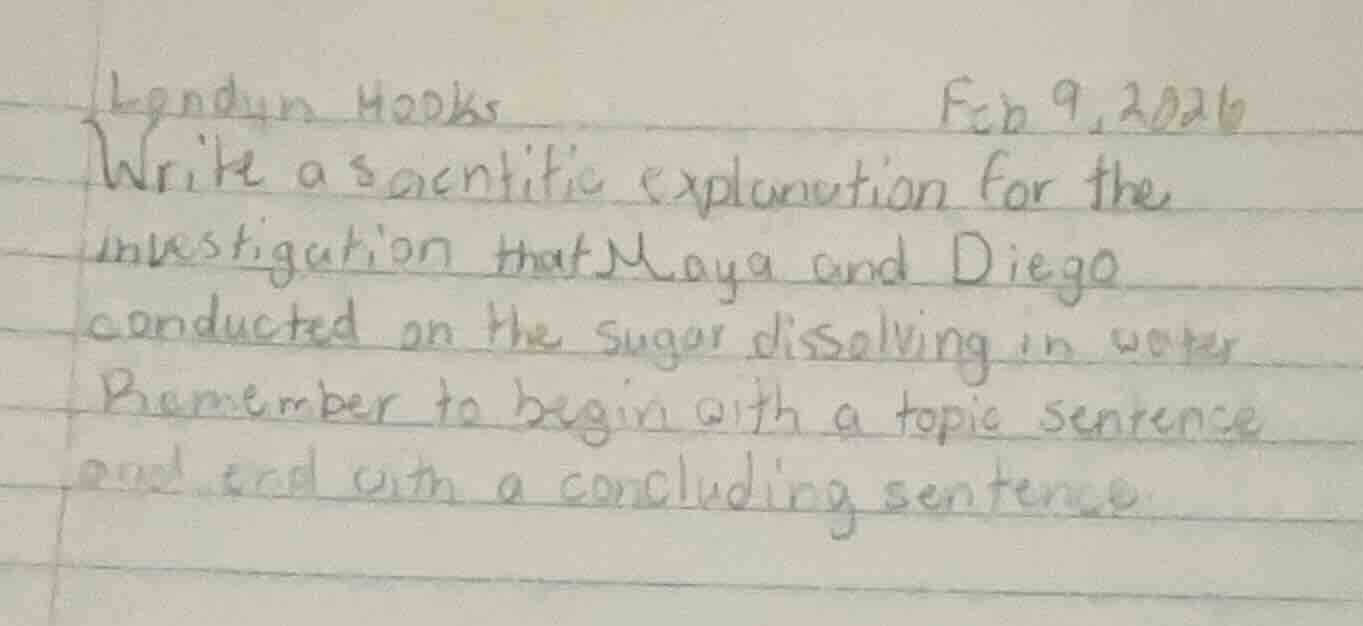
london hooks feb 9, 2026
write a scientific explanation for the investigation that maya and diego conducted on the sugar dissolving in water. remember to begin with a topic sentence and end with a concluding sentence.
First, a topic sentence introduces the core of the investigation: Maya and Diego’s experiment explores how sugar dissolves in water by testing factors that impact the dissolution rate. Next, explain the scientific basis: sugar (a polar covalent compound) dissolves in polar water because water molecules surround sugar molecules, breaking the intermolecular forces holding sugar crystals together (a process called solvation). If their investigation tested variables like temperature, surface area, or stirring, detail that: for example, if they heated water, higher temperatures increase water molecule kinetic energy, speeding up solvation; crushing sugar increases surface area, letting more water interact with sugar at once; stirring disperses dissolved sugar molecules, exposing fresh sugar to water. Finally, wrap up with a concluding sentence that ties the results to the scientific principle: Maya and Diego’s investigation demonstrates that solvent properties, molecular interactions, and environmental variables directly control the rate and extent of sugar dissolving in water, confirming core solution chemistry principles.

Snap & solve any problem in the app
Get step-by-step solutions on Sovi AI
Photo-based solutions with guided steps
Explore more problems and detailed explanations
Scientific Explanation:
Maya and Diego’s investigation into sugar dissolving in water tests key factors that govern the dissolution process through core solution chemistry principles.
Sugar, a polar covalent compound, is soluble in polar water because water molecules’ partial positive and negative charges form weak bonds with sugar molecules, overcoming the intermolecular forces that hold sugar crystals together. This process, called solvation, breaks sugar crystals into individual molecules that disperse evenly throughout the water. If their experiment included variables like water temperature, Maya and Diego would have observed that warmer water speeds up dissolution: higher temperatures increase the kinetic energy of water molecules, allowing them to break apart sugar crystals more quickly and efficiently. Testing sugar surface area would show that crushed sugar dissolves faster than whole crystals, as a larger surface area lets more water molecules interact with sugar at once. Stirring would also accelerate dissolution by dispersing already dissolved sugar molecules away from the crystal surface, exposing fresh sugar to unsaturated water.
In total, Maya and Diego’s investigation confirms that the solubility and dissolution rate of sugar in water depend on molecular polarity, solvation interactions, and modifiable environmental variables, all of which follow fundamental rules of solution chemistry.