QUESTION IMAGE
Question
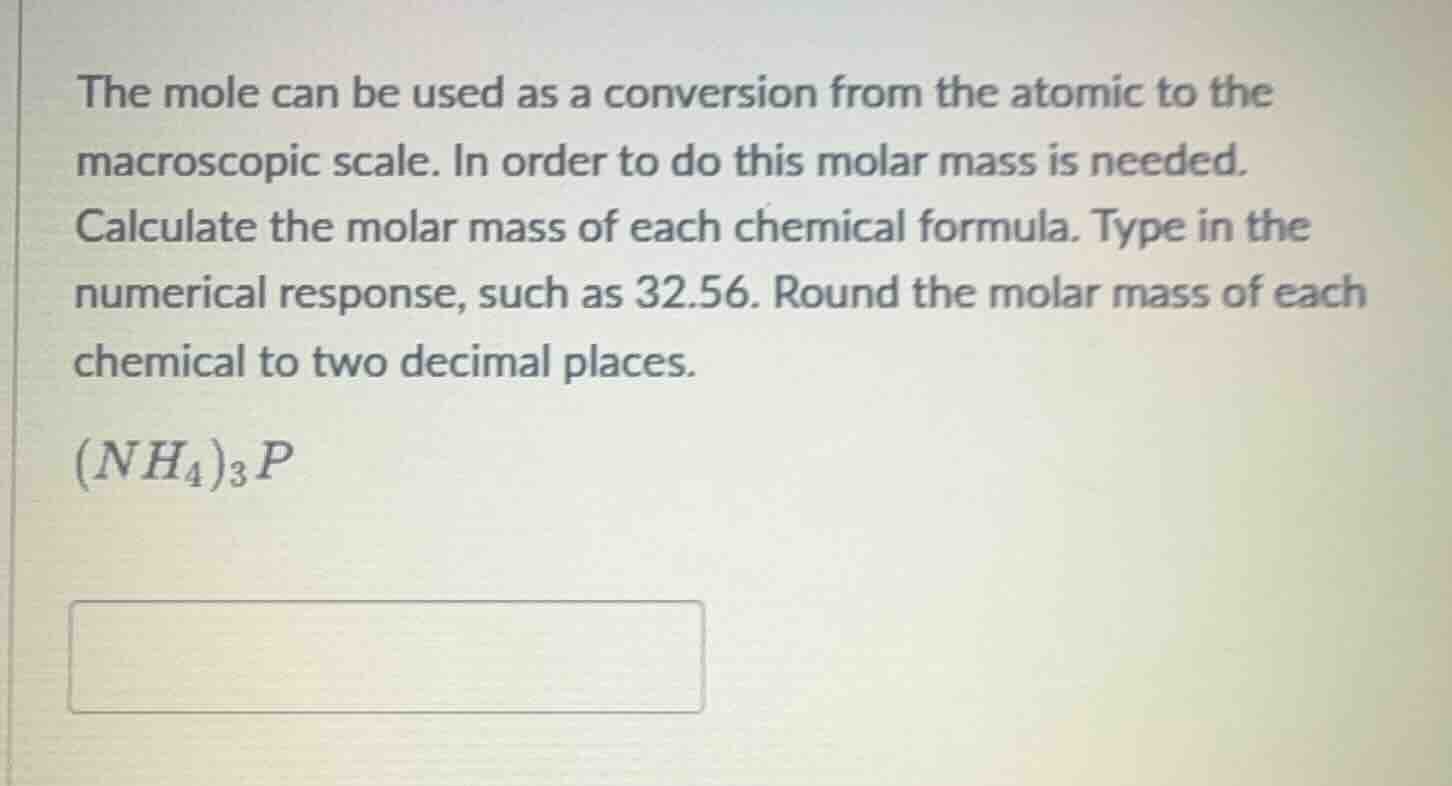
the mole can be used as a conversion from the atomic to the macroscopic scale. in order to do this molar mass is needed. calculate the molar mass of each chemical formula. type in the numerical response, such as 32.56. round the molar mass of each chemical to two decimal places. (nh₄)₃p
Step1: Identify atomic masses
Atomic masses (from periodic table, rounded): \( N = 14.01 \, \text{g/mol} \), \( H = 1.01 \, \text{g/mol} \), \( P = 30.97 \, \text{g/mol} \).
Step2: Calculate moles of each atom
In \( (NH_4)_3P \):
- \( N \): \( 3 \times 1 = 3 \) moles (from \( (NH_4)_3 \), 3 groups of \( NH_4 \)).
- \( H \): \( 3 \times 4 = 12 \) moles (4 H per \( NH_4 \), 3 groups).
- \( P \): \( 1 \) mole.
Step3: Calculate total mass for each atom
- \( N \): \( 3 \times 14.01 = 42.03 \, \text{g} \)
- \( H \): \( 12 \times 1.01 = 12.12 \, \text{g} \)
- \( P \): \( 1 \times 30.97 = 30.97 \, \text{g} \)
Step4: Sum the masses
Total molar mass \( = 42.03 + 12.12 + 30.97 \)
\( = 85.12 \, \text{g/mol} \) (already two decimal places).

Snap & solve any problem in the app
Get step-by-step solutions on Sovi AI
Photo-based solutions with guided steps
Explore more problems and detailed explanations
85.12