QUESTION IMAGE
Question
name:
date:
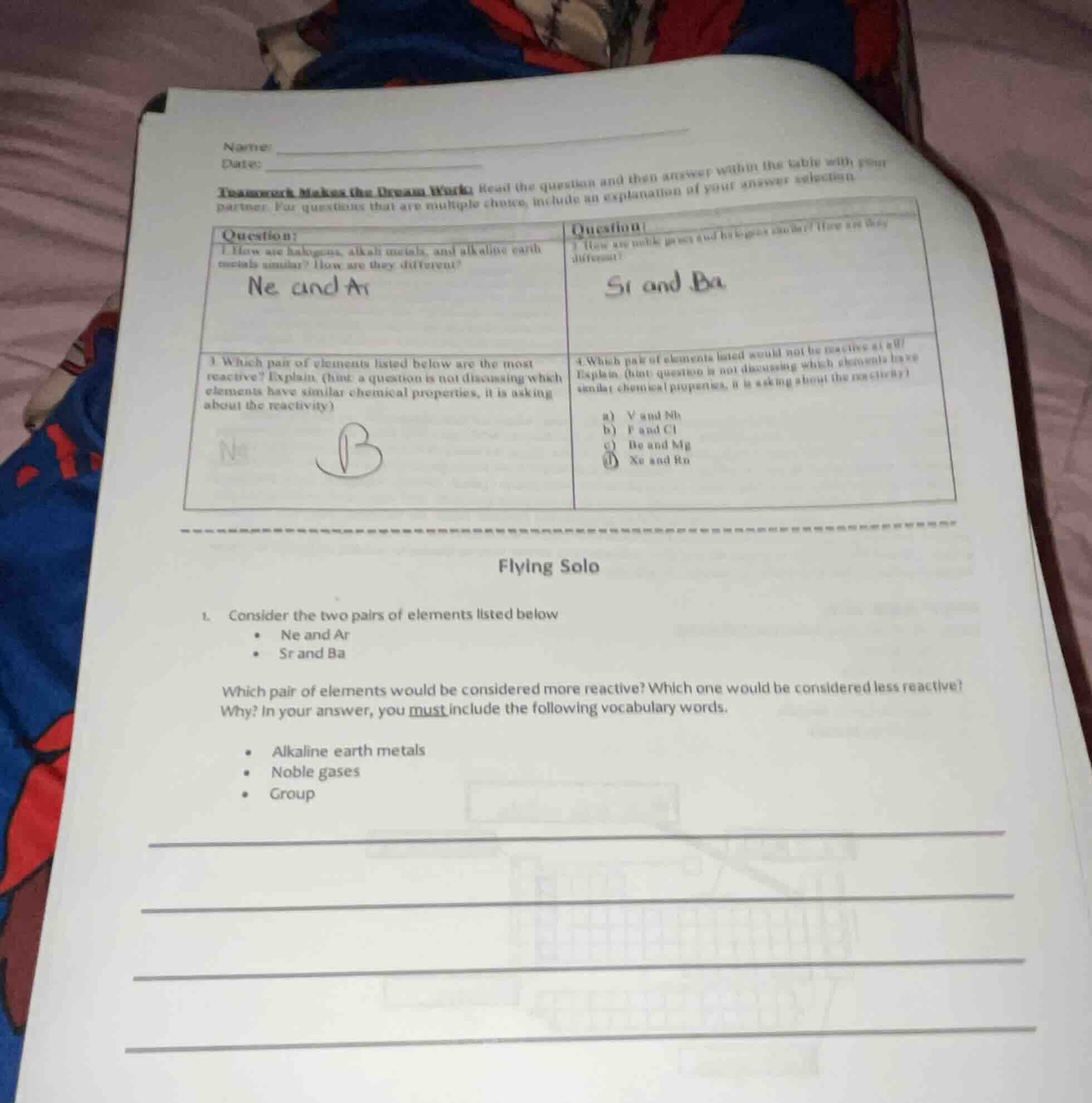
teamwork makes the dream work: read the question and then answer within the table with your partner. for questions that are multiple choice, include an explanation of your answer selection.
question:
- how are halogens, alkali metals, and alkaline earth metals similar? how are they different?
ne and ar
question:
- how are noble gases and halogens similar? how are they different?
sr and ba
- which pair of elements listed below are the most reactive? explain. (hint: a question is not discussing which elements have similar chemical properties, it is asking about the reactivity)
b
- which pair of elements listed would not be reactive at all? explain. (hint: question is not discussing which elements have similar chemical properties, it is asking about the reactivity)
a) v and nb
b) f and cl
c) be and mg
d) xe and rn
flying solo
- consider the two pairs of elements listed below
- ne and ar
- sr and ba
which pair of elements would be considered more reactive? which one would be considered less reactive? why? in your answer, you must include the following vocabulary words.
- alkaline earth metals
- noble gases
- group
Response
For the "Flying Solo" question (comparing reactivity of Sr & Ba vs Ne & Ar):
Brief Explanations
- Identify Element Groups:
- Ne (Neon) and Ar (Argon) belong to Group 18, known as noble gases. Noble gases have full valence electron shells, making them extremely stable and non - reactive (inert) under normal conditions.
- Sr (Strontium) and Ba (Barium) are in Group 2, classified as alkaline earth metals. Alkaline earth metals have 2 valence electrons and readily lose these electrons to form positive ions, which means they are reactive (they tend to participate in chemical reactions to achieve a stable electron configuration).
- Compare Reactivity:
- Since alkaline earth metals (Sr, Ba) are reactive and noble gases (Ne, Ar) are inert, the pair Sr and Ba is more reactive.
- The pair Ne and Ar (noble gases) is less reactive because their full valence shells give them stability, so they rarely react.
Brief Explanations
- Analyze Each Option:
- Option a: V (Vanadium) and Nb (Niobium) are transition metals. Transition metals are generally reactive (they can form various ions and participate in reactions).
- Option b: F (Fluorine) and Cl (Chlorine) are halogens (Group 17). Halogens are highly reactive as they need 1 electron to fill their valence shell.
- Option c: Be (Beryllium) and Mg (Magnesium) are alkaline earth metals (Group 2). They are reactive, losing 2 electrons to react.
- Option d: Xe (Xenon) and Rn (Radon) are noble gases (Group 18). Noble gases have full valence electron shells, so they are not reactive at all (inert) under normal circumstances.
- Conclusion:
- Among the given pairs, Xe and Rn (noble gases) have full valence shells, resulting in no reactivity.

Snap & solve any problem in the app
Get step-by-step solutions on Sovi AI
Photo-based solutions with guided steps
Explore more problems and detailed explanations
- More reactive pair: Sr and Ba (they are alkaline earth metals in Group 2, have 2 valence electrons, and readily react by losing electrons).
- Less reactive pair: Ne and Ar (they are noble gases in Group 18, have full valence shells, and are inert/non - reactive).