QUESTION IMAGE
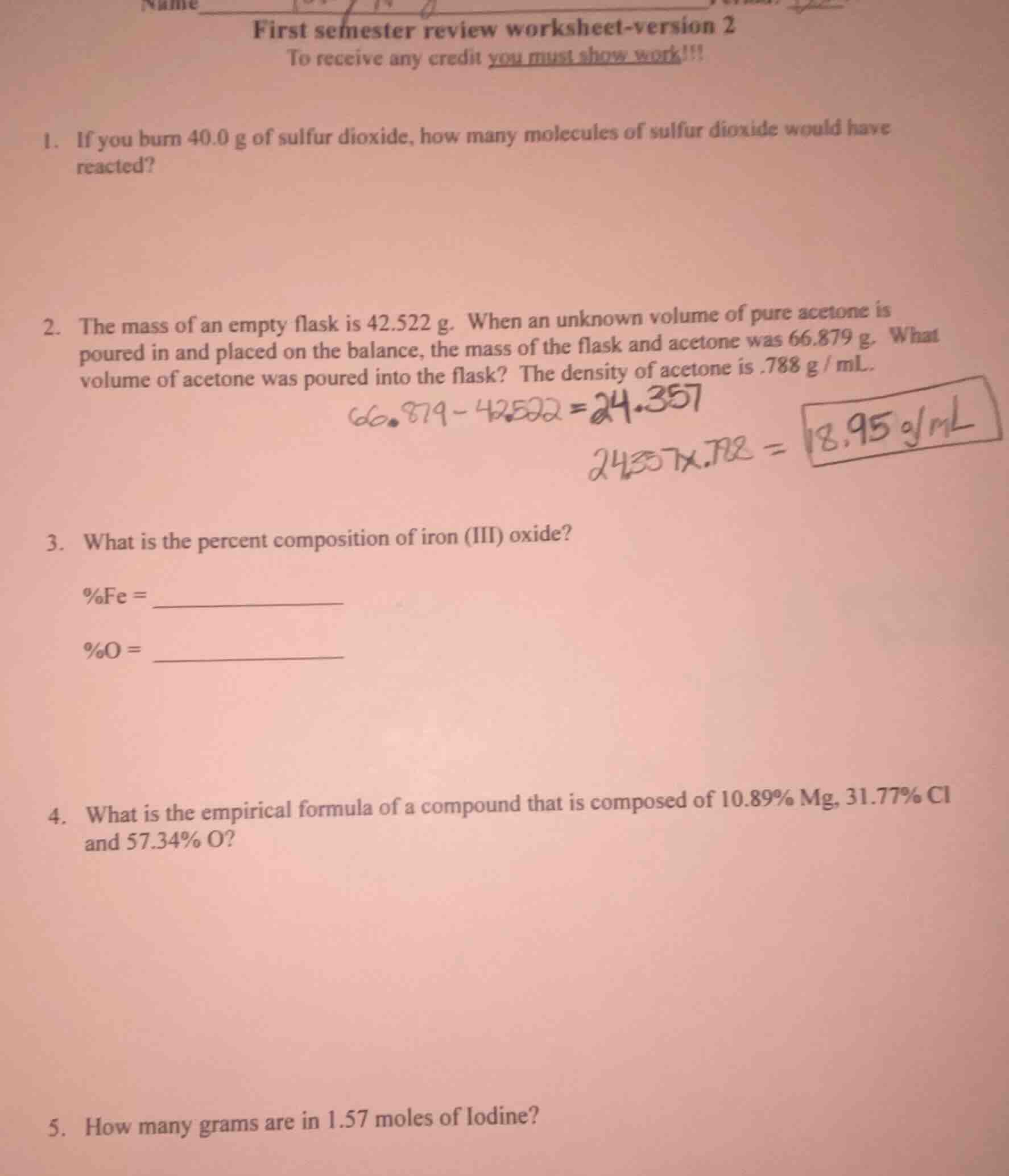
Question
name______
first semester review worksheet-version 2
to receive any credit you must show work!!!
- if you burn 40.0 g of sulfur dioxide, how many molecules of sulfur dioxide would have reacted?
- the mass of an empty flask is 42.522 g. when an unknown volume of pure acetone is poured in and placed on the balance, the mass of the flask and acetone was 66.879 g. what volume of acetone was poured into the flask? the density of acetone is.788 g / ml.
- what is the percent composition of iron (iii) oxide?
%fe = ____________
%o = ____________
- what is the empirical formula of a compound that is composed of 10.89% mg, 31.77% cl and 57.34% o?
- how many grams are in 1.57 moles of iodine?
Question 1:
Step1: Calculate moles of \(SO_2\)
Molar mass of \(SO_2\): \(S = 32.07\ g/mol\), \(O = 16.00\ g/mol\), so \(M(SO_2)=32.07 + 2\times16.00 = 64.07\ g/mol\).
Moles \(n=\frac{mass}{molar\ mass}=\frac{40.0\ g}{64.07\ g/mol}\approx0.624\ mol\).
Step2: Calculate molecules using Avogadro's number
Avogadro's number \(N_A = 6.022\times10^{23}\ molecules/mol\).
Molecules \(N = n\times N_A=0.624\ mol\times6.022\times10^{23}\ molecules/mol\approx3.76\times10^{23}\ molecules\).
Step1: Find mass of acetone
Mass of acetone \(m = 66.879\ g - 42.522\ g = 24.357\ g\).
Step2: Calculate volume using density formula
Density formula \(
ho=\frac{m}{V}\), so \(V=\frac{m}{
ho}\).
\(V=\frac{24.357\ g}{0.788\ g/mL}\approx30.9\ mL\).
Step1: Formula of iron(III) oxide
Iron(III) oxide is \(Fe_2O_3\). Molar mass: \(Fe = 55.85\ g/mol\), \(O = 16.00\ g/mol\).
Molar mass of \(Fe_2O_3 = 2\times55.85 + 3\times16.00 = 159.7\ g/mol\).
Step2: Percent composition of Fe
\(\%Fe=\frac{2\times55.85}{159.7}\times100\%\approx69.94\%\).
Step3: Percent composition of O
\(\%O=\frac{3\times16.00}{159.7}\times100\%\approx30.06\%\).

Snap & solve any problem in the app
Get step-by-step solutions on Sovi AI
Photo-based solutions with guided steps
Explore more problems and detailed explanations
\(3.76\times10^{23}\) molecules