QUESTION IMAGE
Question
the number of atoms on the product side total mass of products. the total amount of moles in the reactants compared to the total amount of moles in the product reaction (will always be the same / may vary) since some atoms may rearrange to form new products.
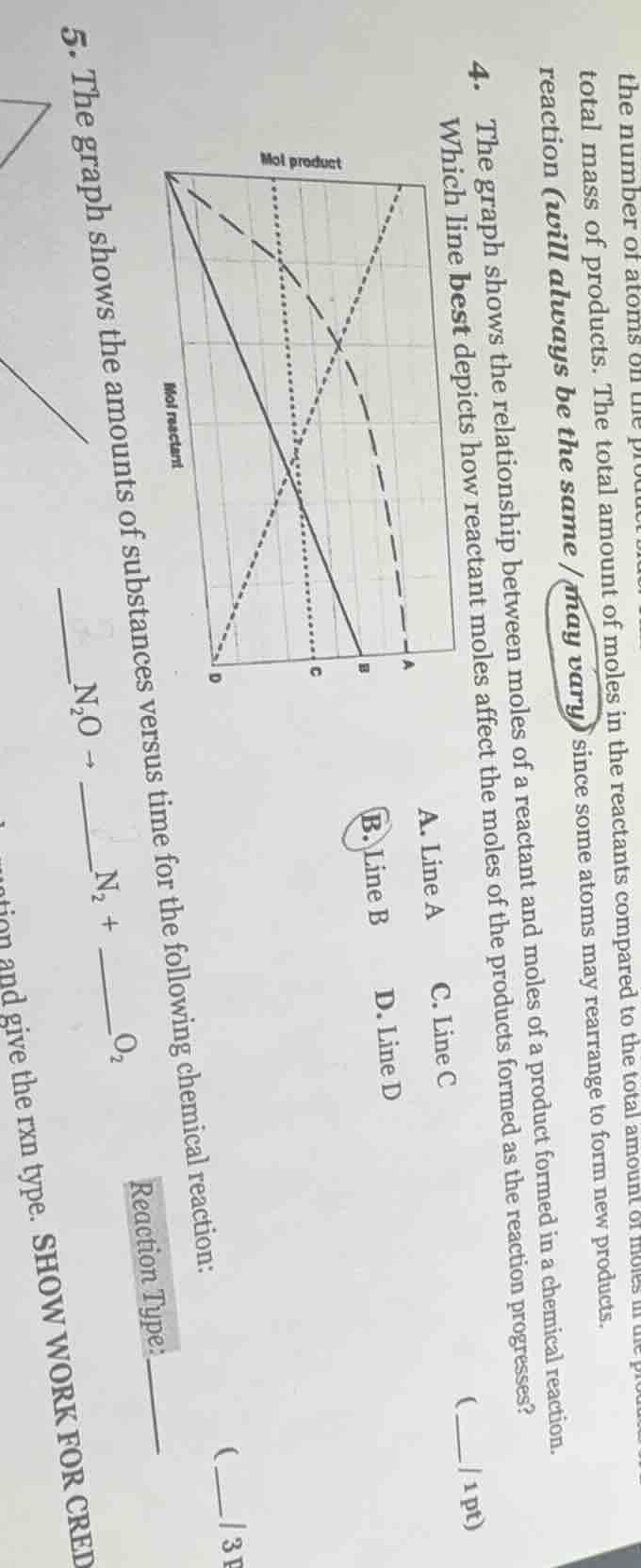
- the graph shows the relationship between moles of a reactant and moles of a product formed in a chemical reaction.
which line best depicts how reactant moles affect the moles of the products formed as the reaction progresses?
a. line a c. line c
b. line b d. line d
(___/1pt)
- the graph shows the amounts of substances versus time for the following chemical reaction:
__n₂o → n₂ + __o₂
reaction type: ____
(___/3 pt)
and give the rxn type. show work for cred
Question 4
Step1: Analyze reactant trend
As reaction proceeds, moles of reactant decrease. So the line for reactant slopes downward.
Step2: Analyze product trend
As reaction proceeds, moles of product increase. So the line for product slopes upward.
Step3: Match to correct line
We need a line that shows decreasing reactant (downward) corresponding to increasing product (upward). Line B shows a downward slope for reactant, which aligns with the consumption of reactant as product forms.
Step1: Balance nitrogen atoms
On the left, there are 2 N in $\text{N}_2\text{O}$. On the right, $\text{N}_2$ has 2 N, so the coefficient for $\text{N}_2\text{O}$ is 2 to get 4 N, and $\text{N}_2$ gets coefficient 2: $2\text{N}_2\text{O}
ightarrow 2\text{N}_2 + \text{O}_2$
Step2: Balance oxygen atoms
Left side (2 $\text{N}_2\text{O}$) has 2 O. Right side $\text{O}_2$ has 2 O, so oxygen is balanced.
Step3: Identify reaction type
One reactant breaks into two simpler products, which is decomposition.

Snap & solve any problem in the app
Get step-by-step solutions on Sovi AI
Photo-based solutions with guided steps
Explore more problems and detailed explanations
B. Line B
---