QUESTION IMAGE
Question
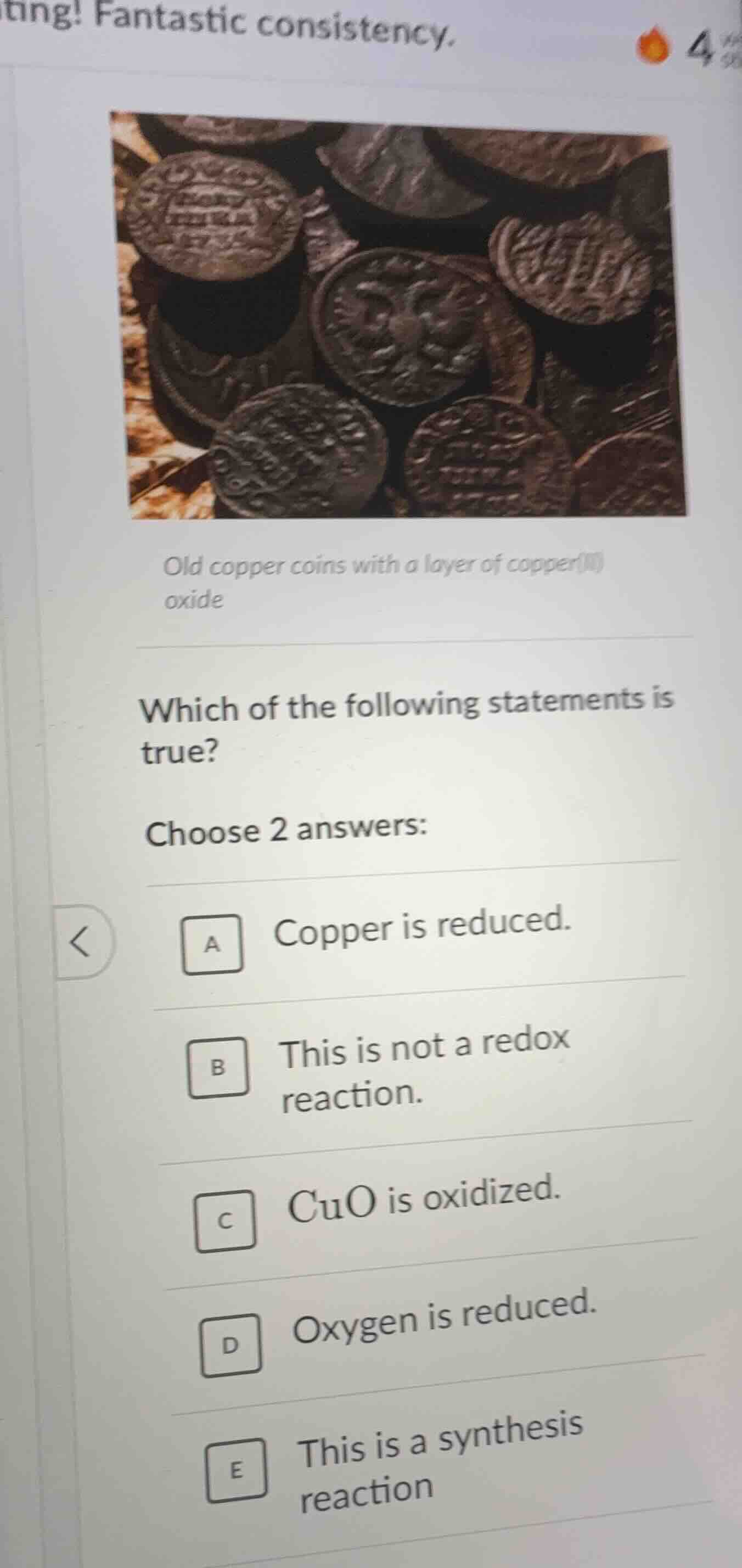
old copper coins with a layer of copper(ii) oxide
which of the following statements is true?
choose 2 answers:
a copper is reduced.
b this is not a redox reaction.
c cuo is oxidized.
d oxygen is reduced.
e this is a synthesis reaction
Brief Explanations
- For option A: In the formation of copper(II) oxide (CuO) from copper (Cu), copper loses electrons (oxidation state increases from 0 in Cu to +2 in CuO), but if we consider the reverse (like reduction of CuO to Cu), copper is reduced. However, in the context of the copper coins forming CuO (oxidation of Cu), but maybe the question is about the reaction related to the oxide layer. Wait, actually, when copper forms CuO, Cu is oxidized, but if we think of a reaction where CuO is involved in a redox process (e.g., reduction), then Cu in CuO is reduced. But let's re - evaluate. The process of copper turning into copper(II) oxide is oxidation of Cu (Cu → Cu²⁺ + 2e⁻), but if we consider a reaction where CuO is being reduced (e.g., CuO + H₂ → Cu + H₂O), then Cu in CuO is reduced (oxidation state from +2 to 0) and H is oxidized. But the question is about the old copper coins with CuO layer. Maybe the reaction in mind is the oxidation of Cu to CuO: 2Cu + O₂ → 2CuO. In this synthesis reaction (option E), it is a redox reaction. In 2Cu + O₂ → 2CuO, Cu is oxidized (0 to +2), O is reduced (0 to -2).
- For option D: In the reaction 2Cu + O₂ → 2CuO, oxygen (O₂) has an oxidation state of 0. In CuO, oxygen has an oxidation state of - 2. So oxygen gains electrons and is reduced.
- For option E: The reaction 2Cu + O₂ → 2CuO is a synthesis reaction (combination of two substances to form one).
- Eliminating other options:
- Option B: The reaction 2Cu + O₂ → 2CuO is a redox reaction (change in oxidation states), so B is wrong.
- Option C: In the reaction 2Cu + O₂ → 2CuO, CuO is the product. Cu is oxidized, O is reduced. CuO is not being oxidized in this reaction. If we consider a different reaction (e.g., CuO → Cu + O₂, which is decomposition), but that's not the case here. So C is wrong.
- Option A: If we consider the reaction 2Cu + O₂ → 2CuO, Cu is oxidized, not reduced. But if we consider a reduction reaction of CuO, then Cu is reduced. There is some ambiguity, but when combined with D and E, let's see. The correct answers are D and E. Wait, let's re - check the reaction 2Cu + O₂ = 2CuO. It is a synthesis reaction (E is correct). In this reaction, O₂ is reduced (D is correct), Cu is oxidized (so A is wrong in the context of this reaction). But maybe the question has a different reaction in mind. Alternatively, if we consider the formation of the oxide layer: Cu is oxidized, O is reduced (D is correct), and the reaction is a synthesis reaction (E is correct).

Snap & solve any problem in the app
Get step-by-step solutions on Sovi AI
Photo-based solutions with guided steps
Explore more problems and detailed explanations
D. Oxygen is reduced.
E. This is a synthesis reaction