QUESTION IMAGE
Question
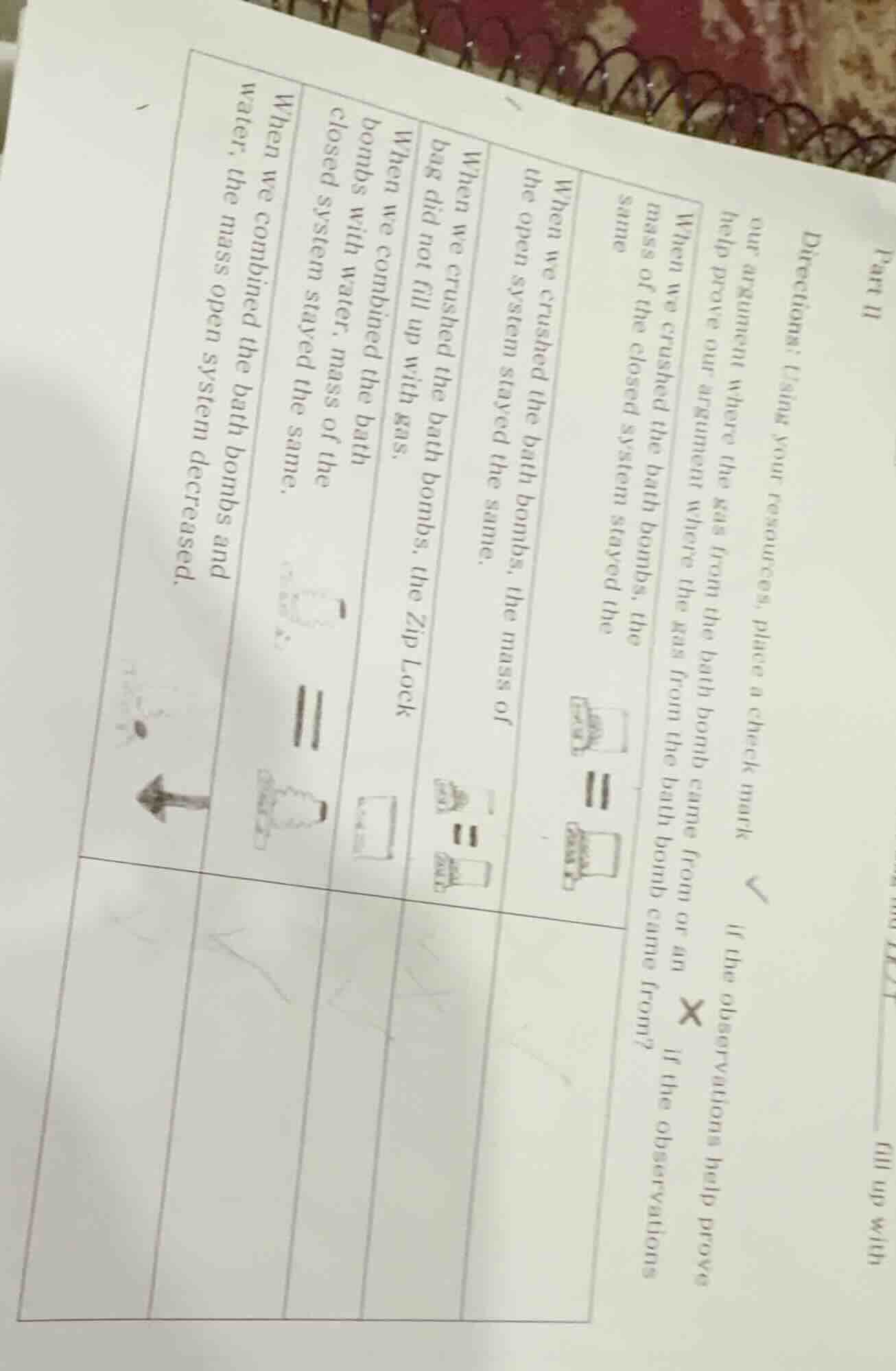
part ii directions: using your resources, place a check mark ✓ if the observations help prove our argument where the gas from the bath bomb came from or an x if the observations help prove the mass of the bath bomb came from? when we crushed the bath bombs, the mass of the closed system stayed the same when we crushed the bath bombs, the mass of the open system stayed the same. when we crushed the bath bombs, the zip lock bag did not fill up with gas. when we combined the bath bombs with water, mass of the closed system stayed the same. when we combined the bath bombs and water, the mass open system decreased.
To solve this, we analyze each observation's relevance to the argument about the gas source (bath bomb) by checking if it supports the idea that gas comes from the bath bomb or refutes it.
1. Observation: "When we crushed the bath bombs, the mass of the closed system stayed the same."
- In a closed system, matter can’t escape. If crushing (a physical change) doesn’t change mass, it shows the system’s mass is conserved before reaction. But this doesn’t directly link to gas coming from the bath bomb (since it’s just crushing, not reacting with water). So it does not help prove the gas comes from the bath bomb. Mark: $\boldsymbol{\times}$
2. Observation: "When we crushed the bath bombs, the mass of the open system stayed the same."
- In an open system, matter can escape. If crushing (physical change) doesn’t change mass, it’s inconsistent with gas escaping (which would decrease mass). This actually weakens the idea of gas coming from the bath bomb (since no mass loss in open system during crushing). So it does not help. Mark: $\boldsymbol{\times}$
3. Observation: "When we crushed the bath bombs, the Ziplock bag did not fill up with gas."
- Crushing a bath bomb (physical change) not producing gas suggests the gas is from a chemical reaction (like dissolving in water), not just crushing. This supports that gas comes from the bath bomb’s reaction (not physical crushing), so it helps. Mark: $\boldsymbol{\checkmark}$
4. Observation: "When we combined the bath bombs with water, the mass of the closed system stayed the same."
- In a closed system, mass is conserved (Law of Conservation of Mass). If combining with water (reaction) keeps mass the same, it shows the gas produced is trapped (so total mass stays). This supports that gas comes from the bath bomb (since reaction with water produces gas, and closed system mass is constant). Mark: $\boldsymbol{\checkmark}$
5. Observation: "When we combined the bath bombs and water, the mass of the open system decreased."
- In an open system, gas can escape. If mass decreases when combining with water, it’s because gas (from the bath bomb’s reaction) escaped. This directly shows gas is produced (and lost) from the bath bomb + water reaction. So it helps. Mark: $\boldsymbol{\checkmark}$
Final Answers (Marks per Observation):
- $\boldsymbol{\times}$
- $\boldsymbol{\times}$
- $\boldsymbol{\checkmark}$
- $\boldsymbol{\checkmark}$
- $\boldsymbol{\checkmark}$
(Note: Mark $\checkmark$ if the observation helps prove the gas comes from the bath bomb; $\times$ if it does not.)

Snap & solve any problem in the app
Get step-by-step solutions on Sovi AI
Photo-based solutions with guided steps
Explore more problems and detailed explanations
To solve this, we analyze each observation's relevance to the argument about the gas source (bath bomb) by checking if it supports the idea that gas comes from the bath bomb or refutes it.
1. Observation: "When we crushed the bath bombs, the mass of the closed system stayed the same."
- In a closed system, matter can’t escape. If crushing (a physical change) doesn’t change mass, it shows the system’s mass is conserved before reaction. But this doesn’t directly link to gas coming from the bath bomb (since it’s just crushing, not reacting with water). So it does not help prove the gas comes from the bath bomb. Mark: $\boldsymbol{\times}$
2. Observation: "When we crushed the bath bombs, the mass of the open system stayed the same."
- In an open system, matter can escape. If crushing (physical change) doesn’t change mass, it’s inconsistent with gas escaping (which would decrease mass). This actually weakens the idea of gas coming from the bath bomb (since no mass loss in open system during crushing). So it does not help. Mark: $\boldsymbol{\times}$
3. Observation: "When we crushed the bath bombs, the Ziplock bag did not fill up with gas."
- Crushing a bath bomb (physical change) not producing gas suggests the gas is from a chemical reaction (like dissolving in water), not just crushing. This supports that gas comes from the bath bomb’s reaction (not physical crushing), so it helps. Mark: $\boldsymbol{\checkmark}$
4. Observation: "When we combined the bath bombs with water, the mass of the closed system stayed the same."
- In a closed system, mass is conserved (Law of Conservation of Mass). If combining with water (reaction) keeps mass the same, it shows the gas produced is trapped (so total mass stays). This supports that gas comes from the bath bomb (since reaction with water produces gas, and closed system mass is constant). Mark: $\boldsymbol{\checkmark}$
5. Observation: "When we combined the bath bombs and water, the mass of the open system decreased."
- In an open system, gas can escape. If mass decreases when combining with water, it’s because gas (from the bath bomb’s reaction) escaped. This directly shows gas is produced (and lost) from the bath bomb + water reaction. So it helps. Mark: $\boldsymbol{\checkmark}$
Final Answers (Marks per Observation):
- $\boldsymbol{\times}$
- $\boldsymbol{\times}$
- $\boldsymbol{\checkmark}$
- $\boldsymbol{\checkmark}$
- $\boldsymbol{\checkmark}$
(Note: Mark $\checkmark$ if the observation helps prove the gas comes from the bath bomb; $\times$ if it does not.)