QUESTION IMAGE
Question
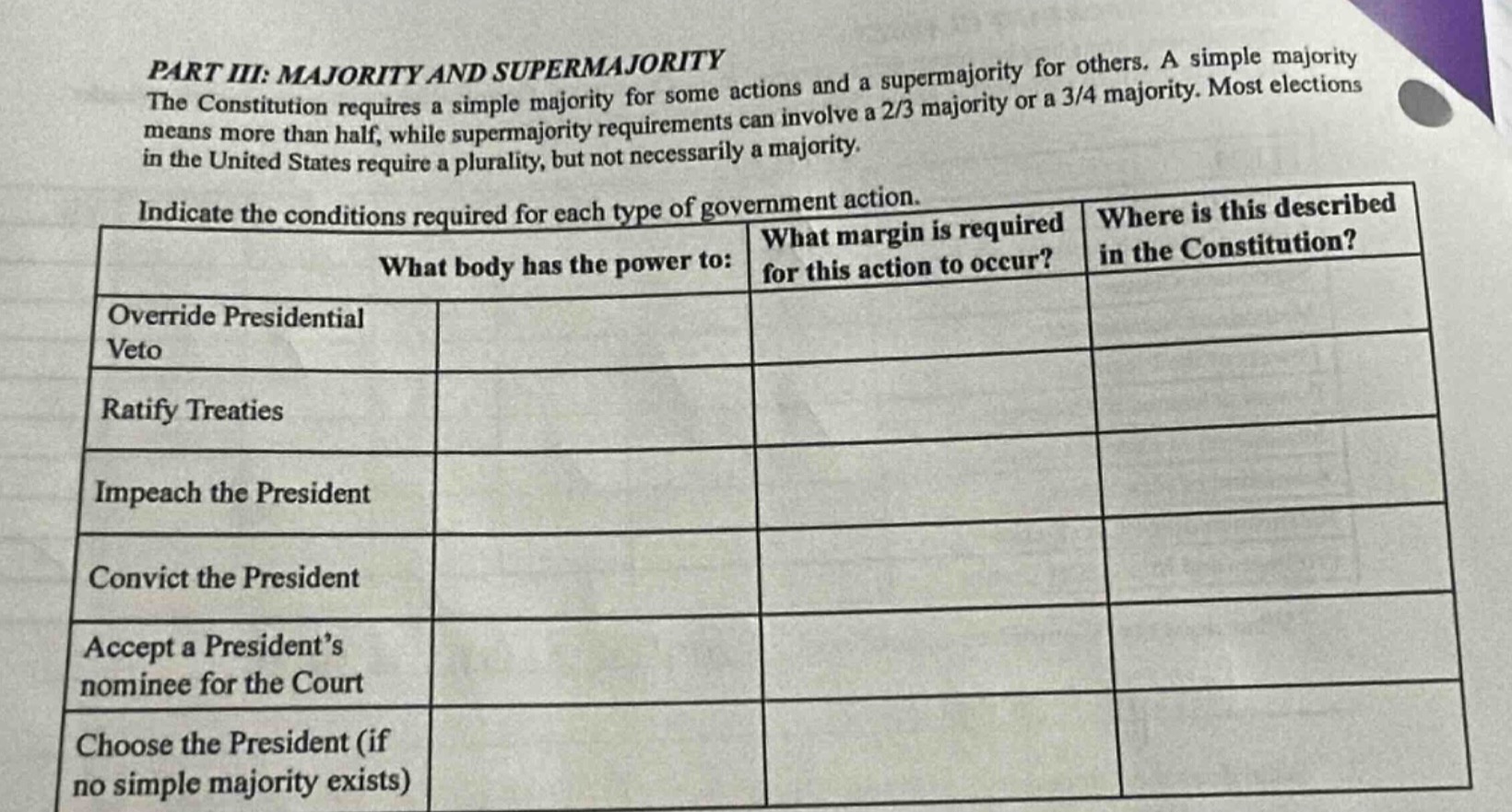
part iii: majority and supermajority
the constitution requires a simple majority for some actions and a supermajority for others. a simple majority means more than half, while supermajority requirements can involve a 2/3 majority or a 3/4 majority. most elections in the united states require a plurality, but not necessarily a majority.
indicate the conditions required for each type of government action.
| what body has the power to: | what margin is required for this action to occur? | where is this described in the constitution? |
|---|---|---|
| ratify treaties | ||
| impeach the president | ||
| convict the president | ||
| accept a president’s nominee for the court | ||
| choose the president (if no simple majority exists) |
1. Override Presidential Veto
The body with the power to override a presidential veto is Congress (both the House of Representatives and the Senate). The margin required is a 2/3 majority in both chambers. This is described in Article I, Section 7 of the Constitution.
The body that ratifies treaties is the Senate. The margin required is a 2/3 majority of the Senate. This is described in Article II, Section 2 of the Constitution.
The body that can impeach the President is the House of Representatives. A simple majority (more than half) is required. This is described in Article I, Section 2 and Article II, Section 4 of the Constitution.

Snap & solve any problem in the app
Get step-by-step solutions on Sovi AI
Photo-based solutions with guided steps
Explore more problems and detailed explanations
- What body has the power to: Congress (House of Representatives and Senate)
- What margin is required for this action to occur: 2/3 majority in both chambers
- Where is this described in the Constitution: Article I, Section 7