QUESTION IMAGE
Question
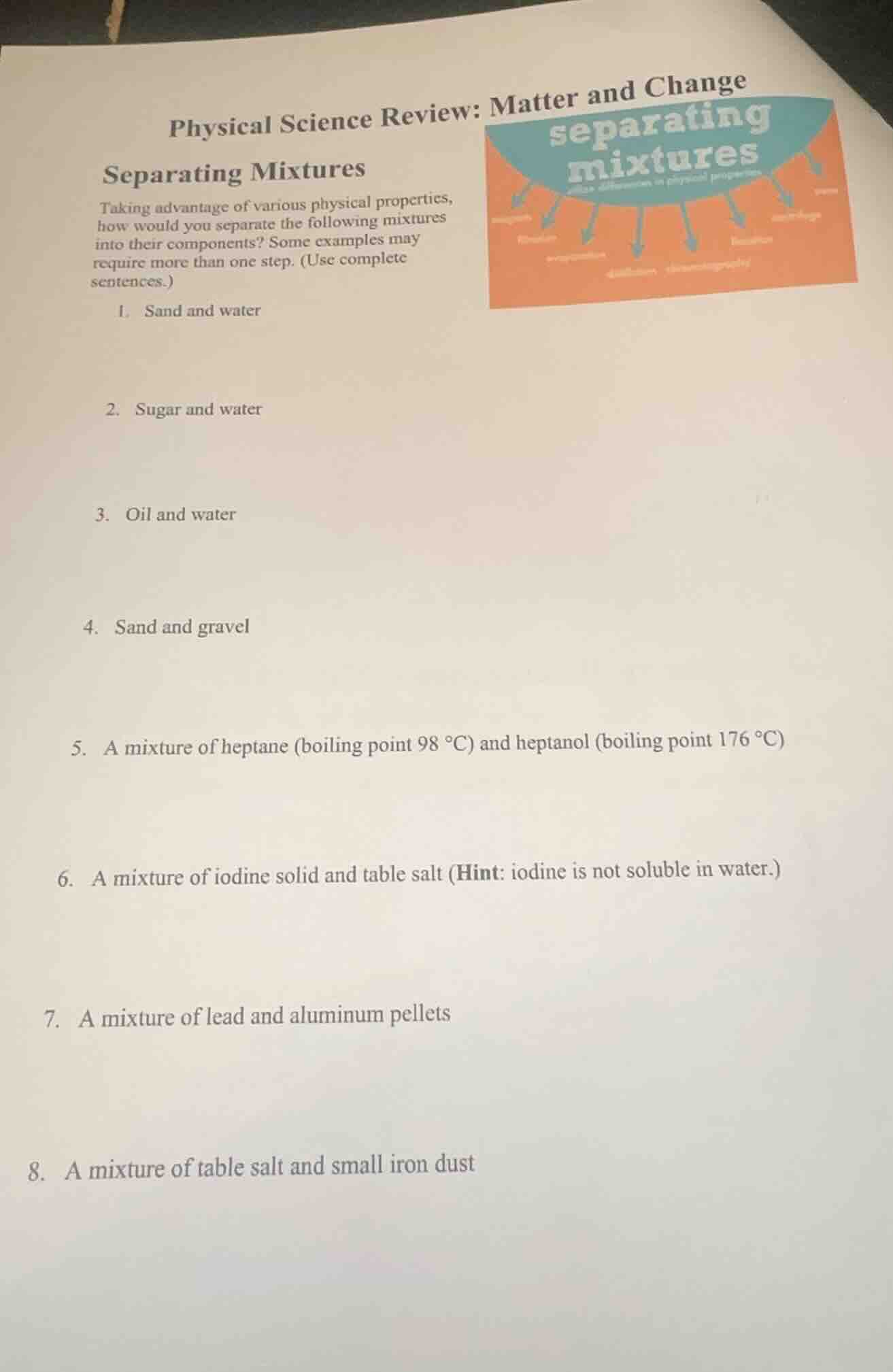
physical science review: matter and change
separating mixtures
taking advantage of various physical properties,
how would you separate the following mixtures
into their components? some examples may
require more than one step. (use complete
sentences.)
- sand and water
- sugar and water
- oil and water
- sand and gravel
- a mixture of heptane (boiling point 98 °c) and heptanol (boiling point 176 °c)
- a mixture of iodine solid and table salt (hint: iodine is not soluble in water.)
- a mixture of lead and aluminum pellets
- a mixture of table salt and small iron dust
Brief Explanations
- Sand is insoluble in water and denser, so filtration traps sand.
- Sugar dissolves in water; boiling removes water, leaving sugar.
- Oil and water are immiscible; decantation skims the top oil layer.
- Gravel has larger particles than sand, so a sieve separates them.
- The two liquids have very different boiling points, so distillation vaporizes and collects the lower-boiling heptane first.
- Iodine sublimes when heated, while salt does not; the iodine vapor condenses back to solid for collection.
- Lead has a much lower melting point than aluminum; melting lead leaves solid aluminum to separate.
- Iron is magnetic, so a magnet attracts the iron dust away from non-magnetic salt.

Snap & solve any problem in the app
Get step-by-step solutions on Sovi AI
Photo-based solutions with guided steps
Explore more problems and detailed explanations
- You can separate sand and water by pouring the mixture through filter paper in a funnel; the water will pass through the filter paper, and the sand will be trapped on the paper.
- You can separate sugar and water by boiling the mixture until all the water evaporates; the sugar will remain as a solid residue once the water is gone.
- You can separate oil and water by letting the mixture sit undisturbed until the two layers fully separate, then carefully pouring (decanting) the less dense oil layer off the top of the water layer.
- You can separate sand and gravel by pouring the mixture through a sieve with holes large enough for sand to pass through but small enough to trap the larger gravel pieces.
- You can separate heptane and heptanol using distillation: heat the mixture to 98 °C, which will vaporize the heptane, then cool and condense the heptane vapor to collect it as a liquid, leaving the higher-boiling heptanol behind.
- You can separate iodine solid and table salt by gently heating the mixture; the iodine will sublime into a purple vapor, which can be collected and cooled to turn back into solid iodine, while the non-volatile table salt remains.
- You can separate lead and aluminum pellets by heating the mixture to around 327.5 °C (the melting point of lead); the lead will melt, and you can pour the liquid lead away from the still-solid aluminum pellets.
- You can separate table salt and small iron dust by passing a magnet through the mixture; the magnet will attract the iron dust, leaving the non-magnetic table salt behind.