QUESTION IMAGE
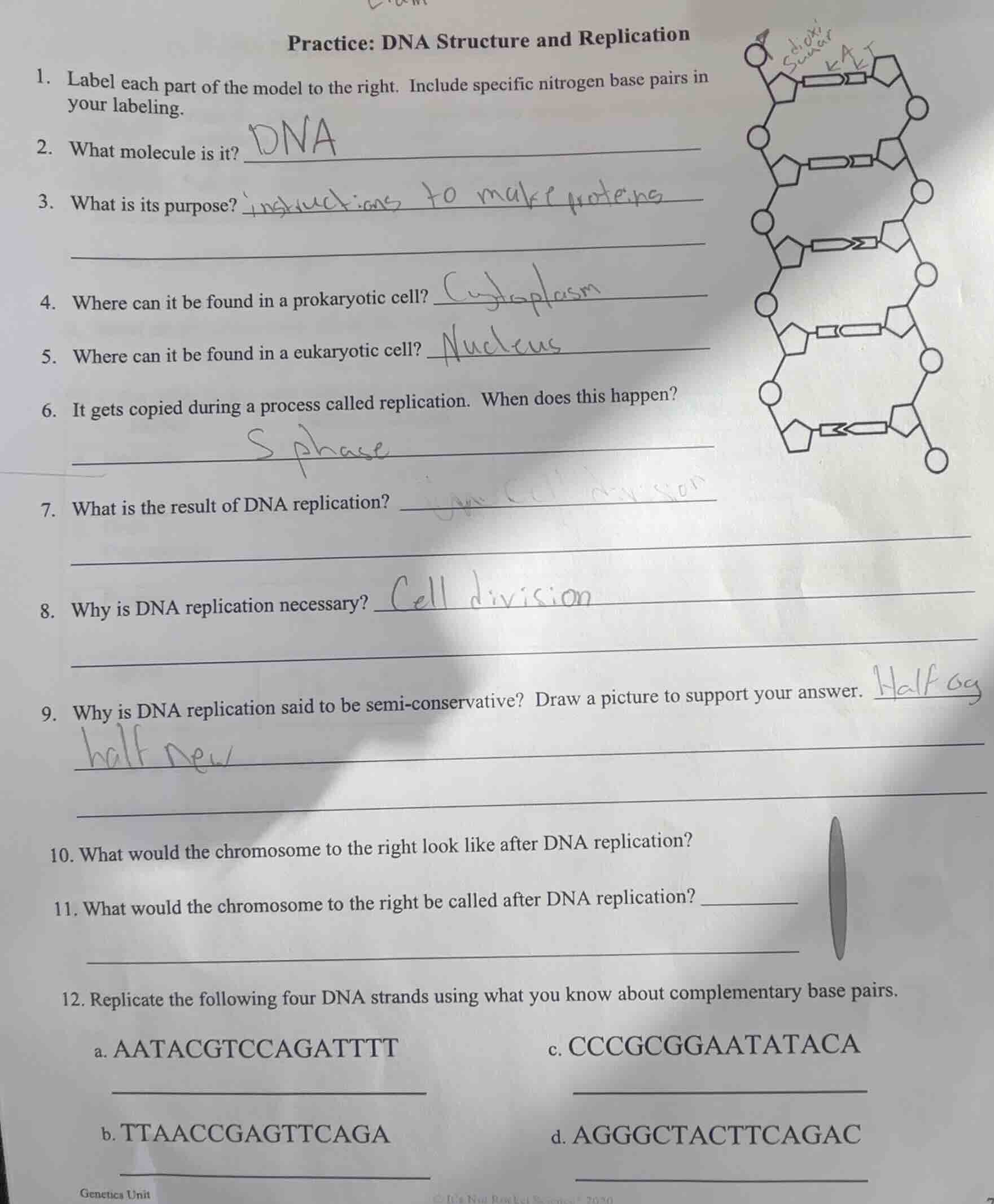
Question
practice: dna structure and replication
- label each part of the model to the right. include specific nitrogen base pairs in your labeling.
- what molecule is it?
- what is its purpose?
- where can it be found in a prokaryotic cell?
- where can it be found in a eukaryotic cell?
- it gets copied during a process called replication. when does this happen?
- what is the result of dna replication?
- why is dna replication necessary?
- why is dna replication said to be semi - conservative? draw a picture to support your answer.
- what would the chromosome to the right look like after dna replication?
- what would the chromosome to the right be called after dna replication?
- replicate the following four dna strands using what you know about complementary base pairs.
a. aatacgtccagatttt
b. ttaaccgagttcaga
c. cccgcggaatataca
d. agggctacttcagac
genetics unit
Question 2
The molecule shown in the model (with a double - helix - like structure and nucleotide components) is DNA (Deoxyribonucleic Acid). The structure with sugar - phosphate backbones and nitrogenous base pairs is characteristic of DNA.
The purpose of DNA is to store genetic information. This genetic information is used to direct the synthesis of proteins, regulate cell functions, and is passed on from one generation of cells (or organisms) to the next.
Prokaryotic cells do not have a nucleus. DNA in prokaryotic cells (like bacteria) is found in the cytoplasm, specifically in a region called the nucleoid, and also as plasmids (small circular DNA molecules) in the cytoplasm.

Snap & solve any problem in the app
Get step-by-step solutions on Sovi AI
Photo-based solutions with guided steps
Explore more problems and detailed explanations
DNA (Deoxyribonucleic Acid)