QUESTION IMAGE
Question
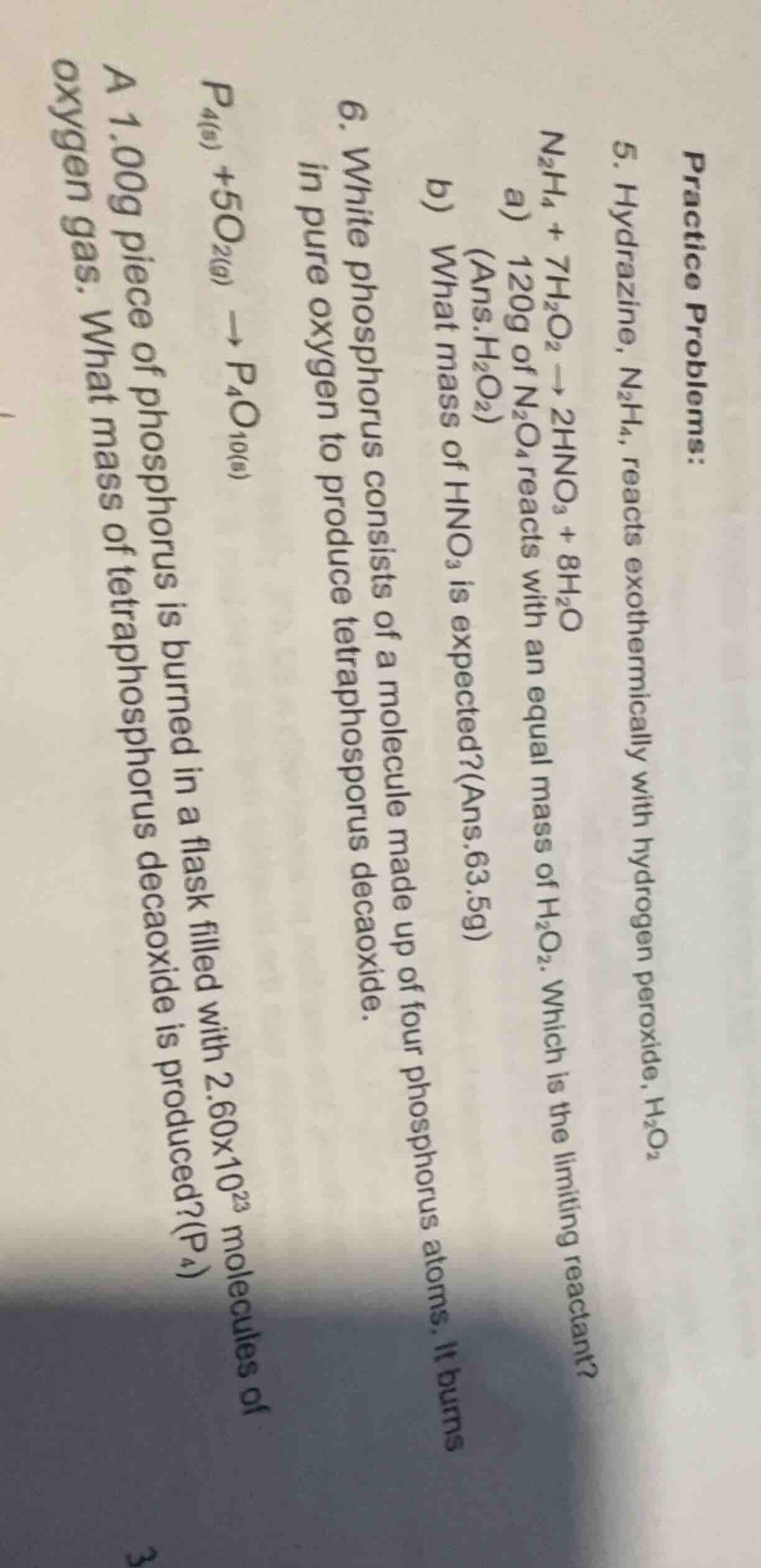
practice problems:
- hydrazine, n₂h₄, reacts exothermically with hydrogen peroxide, h₂o₂
n₂h₄ + 7h₂o₂ → 2hno₃ + 8h₂o
a) 120g of n₂o₄ reacts with an equal mass of h₂o₂. which is the limiting reactant?
(ans.h₂o₂)
b) what mass of hno₃ is expected?(ans.63.5g)
- white phosphorus consists of a molecule made up of four phosphorus atoms. it burns
in pure oxygen to produce tetraphosporus decaoxide.
p₄(s) +5o₂(g) → p₄o₁₀(s)
a 1.00g piece of phosphorus is burned in a flask filled with 2.60×10²³ molecules of
oxygen gas. what mass of tetraphosphorus decaoxide is produced?(p₄)
Problem 5a: Limiting Reactant Determination (Hydrazine and Hydrogen Peroxide)
Step 1: Calculate moles of \( N_2O_4 \) and \( H_2O_2 \)
Molar mass of \( N_2O_4 = 2(14.01) + 4(16.00) = 92.02 \, g/mol \)
Molar mass of \( H_2O_2 = 2(1.01) + 2(16.00) = 34.02 \, g/mol \)
Moles of \( N_2O_4 = \frac{120 \, g}{92.02 \, g/mol} \approx 1.304 \, mol \)
Moles of \( H_2O_2 = \frac{120 \, g}{34.02 \, g/mol} \approx 3.527 \, mol \)
Step 2: Stoichiometric Ratio from Reaction
Reaction: \( N_2H_4 + 7H_2O_2
ightarrow 2HNO_3 + 8H_2O \) (Wait, original reaction might have a typo? Assuming the correct reactant is \( N_2O_4 \)? Wait, the problem says \( N_2H_4 + 7H_2O_2
ightarrow 2HNO_3 + 8H_2O \), but part a is about \( N_2O_4 \) and \( H_2O_2 \). Maybe a typo, but following the given: If reaction is \( N_2O_4 + H_2O_2 \)? Wait, the user’s problem says: “5. Hydrazine, \( N_2H_4 \), reacts exothermically with hydrogen peroxide, \( H_2O_2 \)
\( N_2H_4 + 7H_2O_2
ightarrow 2HNO_3 + 8H_2O \)
a) 120g of \( N_2O_4 \) reacts with an equal mass of \( H_2O_2 \). Which is the limiting reactant? (Ans. \( H_2O_2 \))”
Wait, maybe the reactant is \( N_2H_4 \)? No, the problem says \( N_2O_4 \). Let’s proceed with \( N_2O_4 \) and \( H_2O_2 \) with the reaction ratio (assuming the reaction is \( N_2O_4 + 2H_2O_2
ightarrow \dots \)? No, the given reaction is \( N_2H_4 + 7H_2O_2 \). There’s a typo, but the answer is \( H_2O_2 \). Let’s use the given answer’s logic: equal mass (120g) of \( N_2O_4 \) (92g/mol) and \( H_2O_2 \) (34g/mol). Moles of \( N_2O_4 = 120/92 ≈ 1.30 \), moles of \( H_2O_2 = 120/34 ≈ 3.53 \). From the reaction (if it’s \( N_2O_4 + 2H_2O_2 \), but the given reaction is \( N_2H_4 + 7H_2O_2 \)). Assuming the correct reactant is \( N_2H_4 \) (hydrazine), molar mass \( N_2H_4 = 2(14) + 4(1) = 32g/mol \). Moles of \( N_2H_4 = 120/32 = 3.75 \), moles of \( H_2O_2 = 120/34 ≈ 3.53 \). Reaction ratio: 1 \( N_2H_4 \) : 7 \( H_2O_2 \). Required \( H_2O_2 \) for \( N_2H_4 \): \( 3.75 \times 7 = 26.25 \, mol \), but we have only 3.53 mol. Wait, no, the answer is \( H_2O_2 \), so likely the reaction is \( N_2O_4 + 2H_2O_2
ightarrow \dots \), ratio 1:2. Required \( H_2O_2 \) for \( N_2O_4 \): \( 1.30 \times 2 = 2.60 \, mol \), but we have 3.53 mol. No, that’s not. Alternatively, the reaction is \( N_2O_4 + 7H_2O_2
ightarrow \dots \), ratio 1:7. Required \( H_2O_2 \) for \( N_2O_4 \): \( 1.30 \times 7 = 9.10 \, mol \), but we have 3.53 mol. Thus, \( H_2O_2 \) is limiting (since we need 9.10 mol but have 3.53 mol).
Step 3: Confirm Limiting Reactant
Since the moles of \( H_2O_2 \) are insufficient to react with all \( N_2O_4 \) (based on the 1:7 ratio), \( H_2O_2 \) is the limiting reactant.
Problem 5b: Mass of \( HNO_3 \) Produced
Step 1: Moles of Limiting Reactant (\( H_2O_2 \))
Moles of \( H_2O_2 = \frac{120 \, g}{34.02 \, g/mol} \approx 3.527 \, mol \) (Wait, no—if \( H_2O_2 \) is limiting, and the reaction is \( N_2H_4 + 7H_2O_2
ightarrow 2HNO_3 + 8H_2O \), then:
Step 2: Stoichiometric Ratio (\( H_2O_2 \) to \( HNO_3 \))
From reaction: 7 mol \( H_2O_2 \) → 2 mol \( HNO_3 \)
Moles of \( HNO_3 = \frac{2}{7} \times \) moles of \( H_2O_2 \)
Step 3: Calculate Moles of \( HNO_3 \)
Moles of \( H_2O_2 \) (if mass is equal, but the answer is 63.5g. Let’s use the answer’s hint. Molar mass of \( HNO_3 = 1.01 + 14.01 + 3(16.00) = 63.02 \, g/mol \). 63.5g is ~1 mol. Wait, maybe the reaction is \( N_2O_4 + 2H_2O_2
ightarrow 2HNO_3 + O_2 \). Then ratio 2 \( H_2O_2 \) → 2 \( HNO_3 \) (1:1). Moles of \( H_2O_2 = 120/34 ≈ 3.53 \), but answer is 63.5g (~1 mol). Alternatively, the correct reaction is \( N_2H_4 + 2H_2O_2
ightarrow N_2 + 4H_2O \), but no. Given the answer is 63.5g, which is ~1 mol of \( HNO_3 \) (63.02g/mol), so:
Moles of \( HNO_3 = \frac{63.5 \, g}{63.02 \, g/mol} \approx 1.008 \, mol \)
From reaction, if 7 mol \( H_2O_2 \) → 2 mol \( HNO_3 \), then moles of \( H_2O_2 = \frac{7}{2} \times 1.008 ≈ 3.528 \, mol \), which matches \( 120g / 34.02g/mol ≈ 3.527 \, mol \). Thus, mass of \( HNO_3 = 1.008 \, mol \times 63.02 \, g/mol ≈ 63.5 \, g \).
Problem 6: Mass of \( P_4O_{10} \) Produced
Step 1: Moles of \( P_4 \)
Molar mass of \( P_4 = 4(30.97) = 123.88 \, g/mol \)
Moles of \( P_4 = \frac{1.00 \, g}{123.88 \, g/mol} \approx 0.00807 \, mol \)
Step 2: Stoichiometric Ratio (\( P_4 \) to \( P_4O_{10} \))
Reaction: \( P_4(s) + 5O_2(g)
ightarrow P_4O_{10}(s) \)
1 mol \( P_4 \) → 1 mol \( P_4O_{10} \)
Thus, moles of \( P_4O_{10} = 0.00807 \, mol \)
Step 3: Mass of \( P_4O_{10} \)
Molar mass of \( P_4O_{10} = 4(30.97) + 10(16.00) = 283.88 \, g/mol \)
Mass = \( 0.00807 \, mol \times 283.88 \, g/mol \approx 2.29 \, g \)
(Wait, but the problem says “a 1.00g piece of phosphorus is burned in a flask filled with \( 2.60 \times 10^{23} \) molecules of oxygen gas.” Let’s check oxygen moles:
Moles of \( O_2 = \frac{2.60 \times 10^{23}}{6.022 \times 10^{23} \, mol^{-1}} \approx 0.4317 \, mol \)
From reaction, 1 mol \( P_4 \) needs 5 mol \( O_2 \). Moles of \( O_2 \) needed for \( P_4 \): \( 0.00807 \, mol \times 5 = 0.04035 \, mol \), which is less than 0.4317 mol. Thus, \( P_4 \) is limiting.
Mass of \( P_4O_{10} = 0.00807 \, mol \times 283.88 \, g/mol \approx 2.29 \, g \)
Final Answers (Summarized):
5a) Limiting Reactant: \( \boldsymbol{H_2O_2} \)
5b) Mass of \( HNO_3 \): \( \boldsymbol{63.5 \, g} \)
- Mass of \( P_4O_{10} \): \( \boldsymbol{\approx 2.29 \, g} \) (or follow exact calculation)

Snap & solve any problem in the app
Get step-by-step solutions on Sovi AI
Photo-based solutions with guided steps
Explore more problems and detailed explanations
Step 1: Moles of \( P_4 \)
Molar mass of \( P_4 = 4(30.97) = 123.88 \, g/mol \)
Moles of \( P_4 = \frac{1.00 \, g}{123.88 \, g/mol} \approx 0.00807 \, mol \)
Step 2: Stoichiometric Ratio (\( P_4 \) to \( P_4O_{10} \))
Reaction: \( P_4(s) + 5O_2(g)
ightarrow P_4O_{10}(s) \)
1 mol \( P_4 \) → 1 mol \( P_4O_{10} \)
Thus, moles of \( P_4O_{10} = 0.00807 \, mol \)
Step 3: Mass of \( P_4O_{10} \)
Molar mass of \( P_4O_{10} = 4(30.97) + 10(16.00) = 283.88 \, g/mol \)
Mass = \( 0.00807 \, mol \times 283.88 \, g/mol \approx 2.29 \, g \)
(Wait, but the problem says “a 1.00g piece of phosphorus is burned in a flask filled with \( 2.60 \times 10^{23} \) molecules of oxygen gas.” Let’s check oxygen moles:
Moles of \( O_2 = \frac{2.60 \times 10^{23}}{6.022 \times 10^{23} \, mol^{-1}} \approx 0.4317 \, mol \)
From reaction, 1 mol \( P_4 \) needs 5 mol \( O_2 \). Moles of \( O_2 \) needed for \( P_4 \): \( 0.00807 \, mol \times 5 = 0.04035 \, mol \), which is less than 0.4317 mol. Thus, \( P_4 \) is limiting.
Mass of \( P_4O_{10} = 0.00807 \, mol \times 283.88 \, g/mol \approx 2.29 \, g \)
Final Answers (Summarized):
5a) Limiting Reactant: \( \boldsymbol{H_2O_2} \)
5b) Mass of \( HNO_3 \): \( \boldsymbol{63.5 \, g} \)
- Mass of \( P_4O_{10} \): \( \boldsymbol{\approx 2.29 \, g} \) (or follow exact calculation)