QUESTION IMAGE
Question
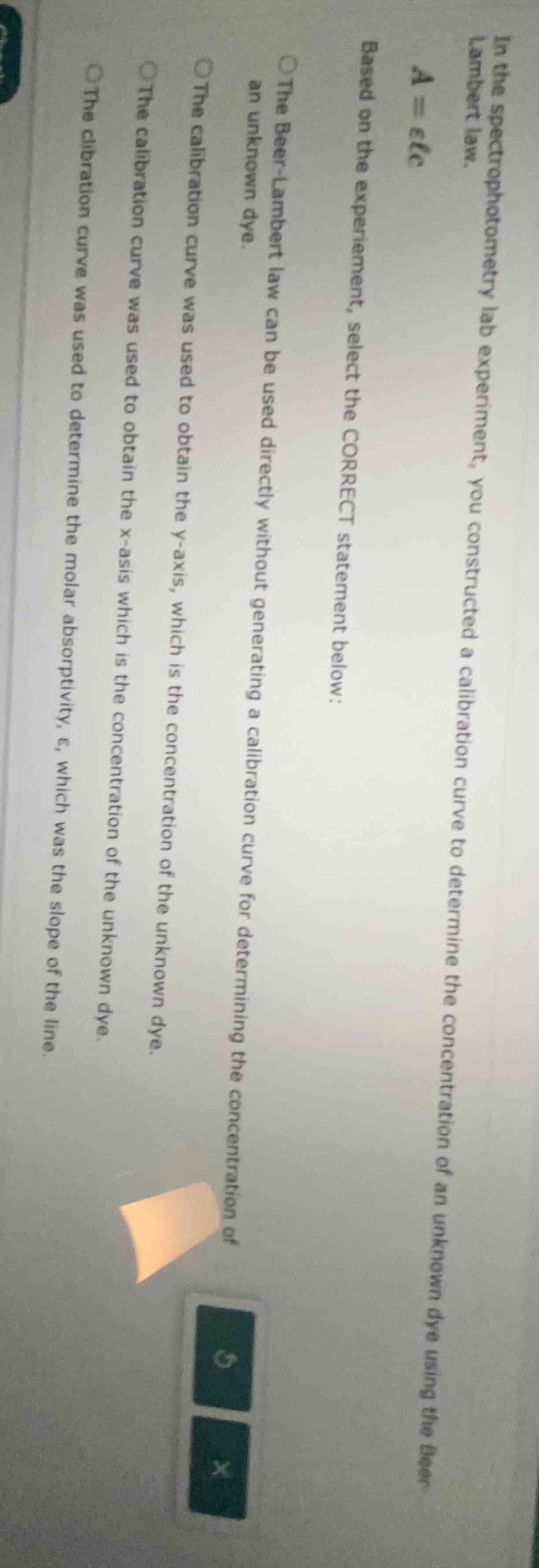
in the spectrophotometry lab experiment, you constructed a calibration curve to determine the concentration of an unknown dye using the beer-lambert law.
a = εlc
based on the experiment, select the correct statement below:
the beer-lambert law can be used directly without generating a calibration curve for determining the concentration of an unknown dye.
the calibration curve was used to obtain the y-axis, which is the concentration of the unknown dye.
the calibration curve was used to obtain the x-axis which is the concentration of the unknown dye.
the calibration curve was used to determine the molar absorptivity, ε, which was the slope of the line.
- Analyze each option:
- Option 1: Beer - Lambert law ($A=\epsilon lc$) needs a calibration curve (plot of absorbance $A$ vs concentration $c$ for known standards) to find concentration of unknown. So it can't be used directly without calibration curve. Eliminate this.
- Option 2: In a calibration curve for Beer - Lambert, $y$-axis is absorbance ($A$) and $x$-axis is concentration ($c$). So to get concentration (unknown) we use the curve, but the option says $y$-axis is concentration which is wrong. Eliminate this.
- Option 3: In calibration curve, $x$-axis is concentration (of known standards initially, then used for unknown). To find concentration of unknown, we use the curve (find $x$ for a given $y$ (absorbance of unknown)). But the statement says "to obtain the $x$-axis which is the concentration of the unknown dye" which is incorrect as $x$-axis is concentration (we use the curve to find the concentration value, not the axis). Eliminate this.
- Option 4: The calibration curve (plot of $A$ vs $c$ for known $c$) has a slope of $\epsilon l$. So molar absorptivity $\epsilon=\frac{\text{slope}}{l}$ (path length $l$ is known). So the calibration curve's slope (along with $l$) gives $\epsilon$. This is correct.

Snap & solve any problem in the app
Get step-by-step solutions on Sovi AI
Photo-based solutions with guided steps
Explore more problems and detailed explanations
The calibration curve was used to determine the molar absorptivity, $\epsilon$, which was the slope of the line.