QUESTION IMAGE
Question
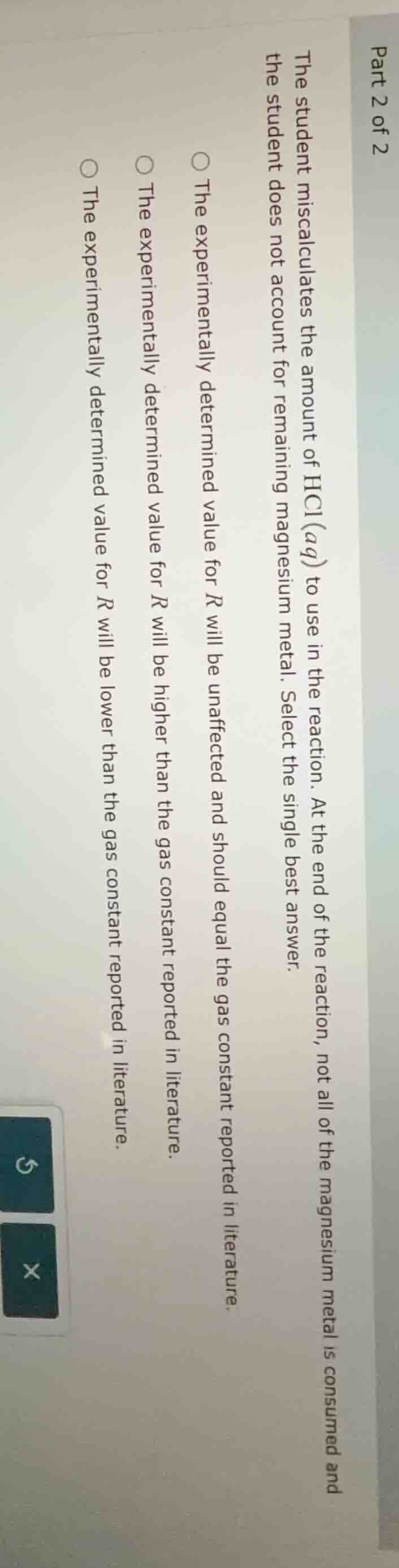
the student miscalculates the amount of hcl(aq) to use in the reaction. at the end of the reaction, not all of the magnesium metal is consumed and the student does not account for remaining magnesium metal. select the single best answer. the experimentally determined value for r will be unaffected and should equal the gas constant reported in literature. the experimentally determined value for r will be higher than the gas constant reported in literature. the experimentally determined value for r will be lower than the gas constant reported in literature.
To determine \( R \), the ideal gas law \( PV = nRT \) is used, so \( R=\frac{PV}{nT} \). The student miscalculated \( \ce{HCl} \) amount, likely overestimating \( n \) (moles of gas, from \( \ce{Mg + 2HCl -> MgCl2 + H2} \); if \( \ce{HCl} \) is overestimated, \( n \) (of \( \ce{H2} \)) is overestimated). A larger \( n \) in \( R=\frac{PV}{nT} \) (with \( P, V, T \) measured) makes \( R \) smaller than literature. Wait, no—wait, the student miscalculates \( \ce{HCl} \) amount (maybe used more \( \ce{HCl} \) than needed, but \( \ce{Mg} \) is limiting). If \( \ce{Mg} \) is left, the actual \( n \) of \( \ce{H2} \) is less than what the student calculated (if student used \( \ce{HCl} \) moles to find \( \ce{H2} \) moles, but \( \ce{Mg} \) was limiting). Wait, the problem says: "the student miscalculates the amount of \( \ce{HCl}(aq) \) to use... not all of the magnesium metal is consumed and the student does not account for remaining magnesium". So the student probably calculated \( n \) (of \( \ce{H2} \)) based on \( \ce{HCl} \) (assuming all \( \ce{Mg} \) reacted), but actually, \( \ce{Mg} \) was in excess (since not all consumed), so the actual \( n \) of \( \ce{H2} \) is less than the student's calculated \( n \). Wait, no—if \( \ce{HCl} \) is the limiting reactant? Wait, \( \ce{Mg} + 2\ce{HCl} -> \ce{MgCl2} + \ce{H2} \). Moles of \( \ce{H2} = \frac{1}{2} \) moles of \( \ce{HCl} \) (if \( \ce{HCl} \) is limiting) or moles of \( \ce{Mg} \) (if \( \ce{Mg} \) is limiting). The student miscalculated \( \ce{HCl} \) amount (maybe used too much \( \ce{HCl} \), but \( \ce{Mg} \) is limiting). So the student, when calculating \( n \) (of \( \ce{H2} \)), might have used \( \ce{HCl} \) moles (thinking \( \ce{HCl} \) is limiting), but actually, \( \ce{Mg} \) is limiting, so the actual \( n \) of \( \ce{H2} \) is moles of \( \ce{Mg} \) reacted. But the student did not account for remaining \( \ce{Mg} \), so the student's calculated \( n \) (of \( \ce{H2} \)) is higher than actual (because student used total \( \ce{Mg} \) instead of reacted \( \ce{Mg} \)). Wait, no—if the student miscalculates \( \ce{HCl} \) amount (e.g., used more \( \ce{HCl} \) than needed, so \( \ce{Mg} \) is limiting, but student thinks \( \ce{HCl} \) is limiting). So the student calculates \( n(\ce{H2}) = \frac{1}{2}n(\ce{HCl}) \), but actual \( n(\ce{H2}) = n(\ce{Mg}) \) (reacted). If \( \ce{Mg} \) is less than \( \frac{1}{2}n(\ce{HCl}) \), then actual \( n(\ce{H2}) \) is less than student's calculated \( n(\ce{H2}) \). Then, in \( R = \frac{PV}{nT} \), the student uses a larger \( n \) (calculated) than actual, so \( R = \frac{PV}{nT} \) would be smaller (since \( n \) is in denominator? Wait, no: \( R = \frac{PV}{nT} \), so if \( n \) is overestimated (student's \( n \) is larger than actual), then \( R \) calculated by student is smaller than actual? Wait, no—wait, the experimental \( R \) is calculated as \( R = \frac{PV}{nT} \), where \( n \) is the moles the student thinks were produced (but actual \( n \) is less). So if the student's \( n \) is too big, then \( R = \frac{PV}{nT} \) will be too small (because dividing by a larger \( n \)). So the experimentally determined \( R \) (using wrong \( n \)) is lower than literature. Wait, but let's re-express:
Ideal gas law: \( PV = nRT \) → \( R = \frac{PV}{nT} \).
- \( P \): measured pressure (correct, assuming no error here).
- \( V \): measured volume (correct).
- \( T \): measured temperature (correct).
- \( n \): moles of \( \ce{H2} \) produced, calculated by the student.
The student miscalculated \( \ce{HCl} \) a…

Snap & solve any problem in the app
Get step-by-step solutions on Sovi AI
Photo-based solutions with guided steps
Explore more problems and detailed explanations
The experimentally determined value for \( R \) will be lower than the gas constant reported in literature. (The option with this text, e.g., the third radio button option as per the image: "The experimentally determined value for \( R \) will be lower than the gas constant reported in literature.")