QUESTION IMAGE
Question
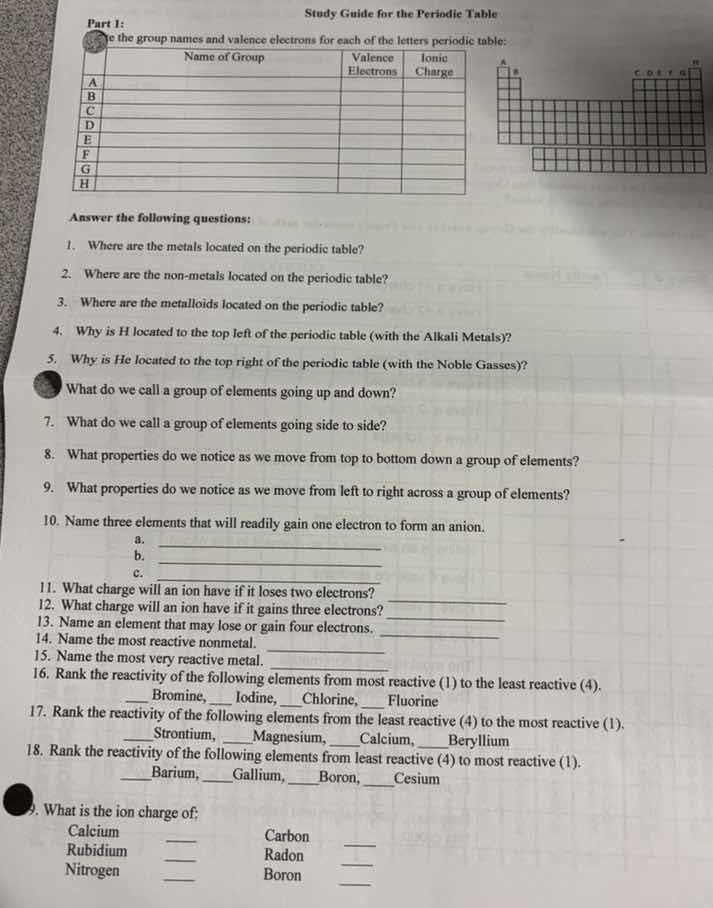
study guide for the periodic table
part i:
fill the group names and valence electrons for each of the letters periodic table:
name of group valence electrons ionic charge
a
b
c
d
e
f
g
h
answer the following questions:
- where are the metals located on the periodic table?
- where are the non-metals located on the periodic table?
- where are the metalloids located on the periodic table?
- why is h located to the top left of the periodic table (with the alkali metals)?
- why is he located to the top right of the periodic table (with the noble gasses)?
- what do we call a group of elements going up and down?
- what do we call a group of elements going side to side?
- what properties do we notice as we move from top to bottom down a group of elements?
- what properties do we notice as we move from left to right across a group of elements?
- name three elements that will readily gain one electron to form an anion.
a. _______________
b. _______________
c. _______________
- what charge will an ion have if it loses two electrons? _______________
- what charge will an ion have if it gains three electrons? _______________
- name an element that may lose or gain four electrons. _______________
- name the most reactive nonmetal. _______________
- name the most very reactive metal. _______________
- rank the reactivity of the following elements from most reactive (1) to the least reactive (4).
bromine, __ iodine, chlorine, __ fluorine
- rank the reactivity of the following elements from the least reactive (4) to the most reactive (1).
strontium, __ magnesium, calcium, __ beryllium
- rank the reactivity of the following elements from least reactive (4) to most reactive (1).
barium, __ gallium, boron, __ cesium
- what is the ion charge of:
calcium ____ carbon ____
rubidium ____ radon ____
nitrogen ____ boron ____
Step1: Fill group details
| Name of Group | Valence Electrons | Ionic Charge |
|---|---|---|
| B (Alkaline Earth Metals) | 2 | $+2$ |
| C (Group 13) | 3 | $+3$ |
| D (Group 14) | 4 | $\pm4$ |
| E (Group 15) | 5 | $-3$ |
| F (Group 16) | 6 | $-2$ |
| G (Group 17, Halogens) | 7 | $-1$ |
| H (Group 18, Noble Gases) | 8 (2 for He) | $0$ |
Step2: Answer periodic table location questions
- Left/center of the table.
- Right side (except H).
- Staircase line (B, Si, Ge, As, Sb, Te).
- 1 valence electron, matches alkali metals.
- Full valence shell, matches noble gases.
Step3: Answer group terminology questions
- Group (or family).
- Period.
Step4: Answer periodic trend questions
- Increased reactivity (metals), decreased (nonmetals).
- Decreased metallic character, increased nonmetallic.
Step5: Answer ion/element questions
- a. Fluorine, b. Chlorine, c. Bromine
- $+2$
- $-3$
- Carbon
- Fluorine
- Francium (or Cesium)
Step6: Rank reactivity
- 3. Bromine, 2. Iodine, 4. Chlorine, 1. Fluorine
- 1. Strontium, 2. Magnesium, 3. Calcium, 4. Beryllium
- 3. Barium, 2. Gallium, 4. Boron, 1. Cesium
Step7: Find ionic charges
Calcium: $+2$, Carbon: $\pm4$, Rubidium: $+1$, Radon: $0$, Nitrogen: $-3$, Boron: $+3$

Snap & solve any problem in the app
Get step-by-step solutions on Sovi AI
Photo-based solutions with guided steps
Explore more problems and detailed explanations
Part 1 Table:
| Name of Group | Valence Electrons | Ionic Charge |
|---|---|---|
| Alkaline Earth Metals | 2 | $+2$ |
| Group 13 Elements | 3 | $+3$ |
| Group 14 Elements | 4 | $\pm4$ |
| Group 15 Elements | 5 | $-3$ |
| Group 16 Elements | 6 | $-2$ |
| Halogens | 7 | $-1$ |
| Noble Gases | 8 (2 for He) | $0$ |