QUESTION IMAGE
Question
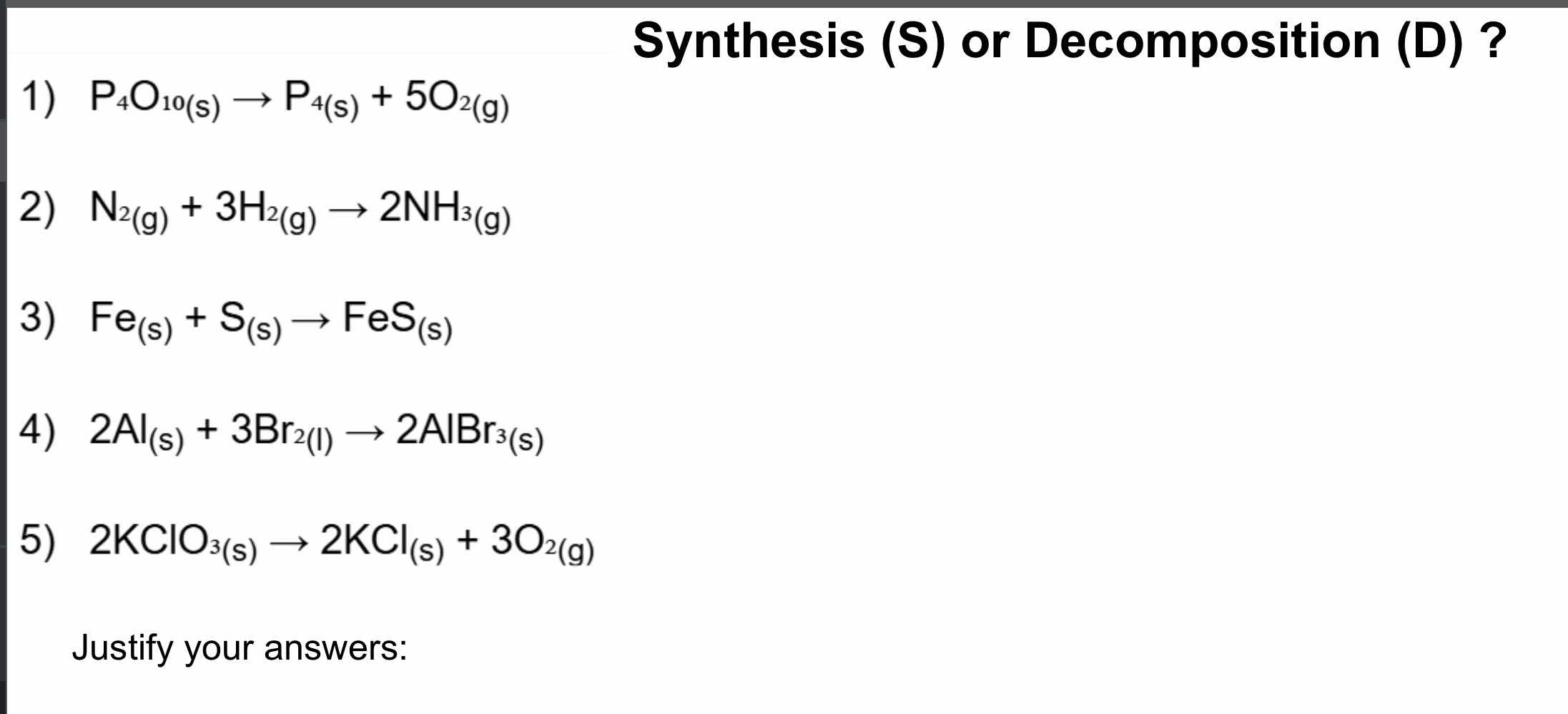
synthesis (s) or decomposition (d) ?
- \\( \text{p}_4\text{o}_{10(\text{s})} \
ightarrow \text{p}_{4(\text{s})} + 5\text{o}_{2(\text{g})} \\)
- \\( \text{n}_{2(\text{g})} + 3\text{h}_{2(\text{g})} \
ightarrow 2\text{nh}_{3(\text{g})} \\)
- \\( \text{fe}_{(\text{s})} + \text{s}_{(\text{s})} \
ightarrow \text{fes}_{(\text{s})} \\)
- \\( 2\text{al}_{(\text{s})} + 3\text{br}_{2(\text{l})} \
ightarrow 2\text{albr}_{3(\text{s})} \\)
- \\( 2\text{kclo}_{3(\text{s})} \
ightarrow 2\text{kcl}_{(\text{s})} + 3\text{o}_{2(\text{g})} \\)
justify your answers:
1)
A decomposition reaction is when a single compound breaks down into two or more simpler substances. Here, $\ce{P4O10}$ (one compound) breaks down into $\ce{P4}$ and $\ce{O2}$. So it's decomposition (D).
A synthesis reaction is when two or more substances combine to form a single compound. Here, $\ce{N2}$ and $\ce{H2}$ (two substances) combine to form $\ce{NH3}$ (one compound). So it's synthesis (S).
Synthesis reaction: two substances ($\ce{Fe}$ and $\ce{S}$) combine to form one compound ($\ce{FeS}$). So it's synthesis (S).

Snap & solve any problem in the app
Get step-by-step solutions on Sovi AI
Photo-based solutions with guided steps
Explore more problems and detailed explanations
D