QUESTION IMAGE
Question
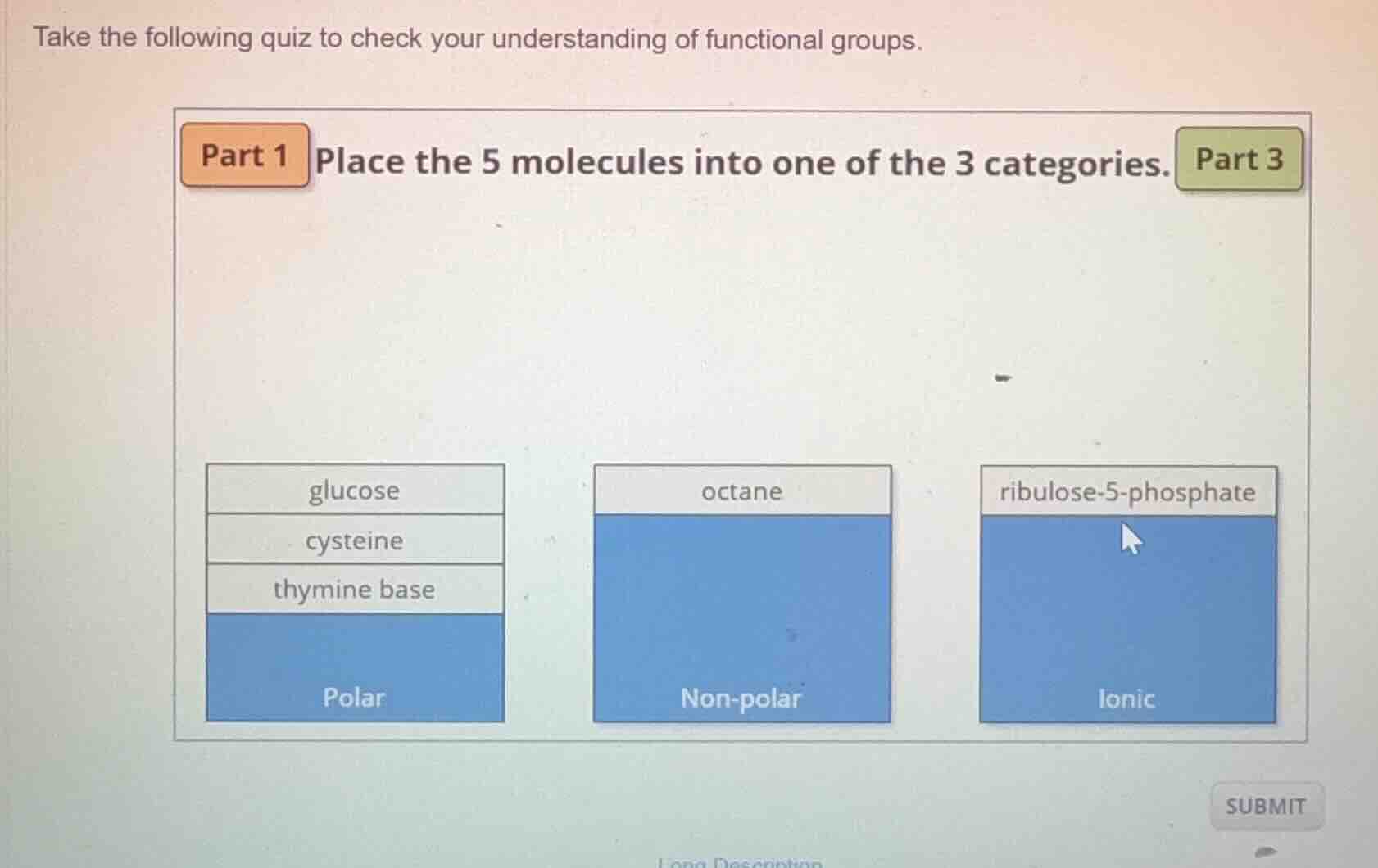
take the following quiz to check your understanding of functional groups.
part 1 place the 5 molecules into one of the 3 categories. part 3
glucose
cysteine
thymine base
polar
octane
non - polar
ribulose - 5 - phosphate
ionic
To solve this, we analyze each molecule's properties:
1. Glucose
Glucose has multiple hydroxyl (-OH) groups, creating a polar structure due to electronegativity differences (O is more electronegative than C/H). So it belongs to Polar.
2. Cysteine
Cysteine is an amino acid with polar functional groups (e.g., -COOH, -NH₂, and a polar -SH group). Its structure has regions of partial charge, so it is Polar.
3. Thymine Base
Thymine (a nucleic acid base) has polar functional groups (carbonyl, amine-like groups) that create partial charges. Thus, it is Polar.
4. Octane
Octane is a hydrocarbon (C₈H₁₈) with only C-C and C-H bonds. These bonds have minimal electronegativity difference, so octane is non - polar (hydrocarbons are typical non - polar molecules). So it belongs to Non - polar.
5. Ribulose - 5 - phosphate
Ribulose - 5 - phosphate has polar functional groups (hydroxyl, phosphate) with significant electronegativity differences (e.g., P - O, O - H bonds), creating partial charges. Thus, it is Polar.
Final Categorization:
- Polar: glucose, cysteine, thymine base, ribulose - 5 - phosphate
- Non - polar: octane
- Ionic: (None of the 5 molecules are ionic; ionic compounds typically involve metal - nonmetal bonds or charged ions, which these organic molecules lack)

Snap & solve any problem in the app
Get step-by-step solutions on Sovi AI
Photo-based solutions with guided steps
Explore more problems and detailed explanations
To solve this, we analyze each molecule's properties:
1. Glucose
Glucose has multiple hydroxyl (-OH) groups, creating a polar structure due to electronegativity differences (O is more electronegative than C/H). So it belongs to Polar.
2. Cysteine
Cysteine is an amino acid with polar functional groups (e.g., -COOH, -NH₂, and a polar -SH group). Its structure has regions of partial charge, so it is Polar.
3. Thymine Base
Thymine (a nucleic acid base) has polar functional groups (carbonyl, amine-like groups) that create partial charges. Thus, it is Polar.
4. Octane
Octane is a hydrocarbon (C₈H₁₈) with only C-C and C-H bonds. These bonds have minimal electronegativity difference, so octane is non - polar (hydrocarbons are typical non - polar molecules). So it belongs to Non - polar.
5. Ribulose - 5 - phosphate
Ribulose - 5 - phosphate has polar functional groups (hydroxyl, phosphate) with significant electronegativity differences (e.g., P - O, O - H bonds), creating partial charges. Thus, it is Polar.
Final Categorization:
- Polar: glucose, cysteine, thymine base, ribulose - 5 - phosphate
- Non - polar: octane
- Ionic: (None of the 5 molecules are ionic; ionic compounds typically involve metal - nonmetal bonds or charged ions, which these organic molecules lack)