QUESTION IMAGE
Question
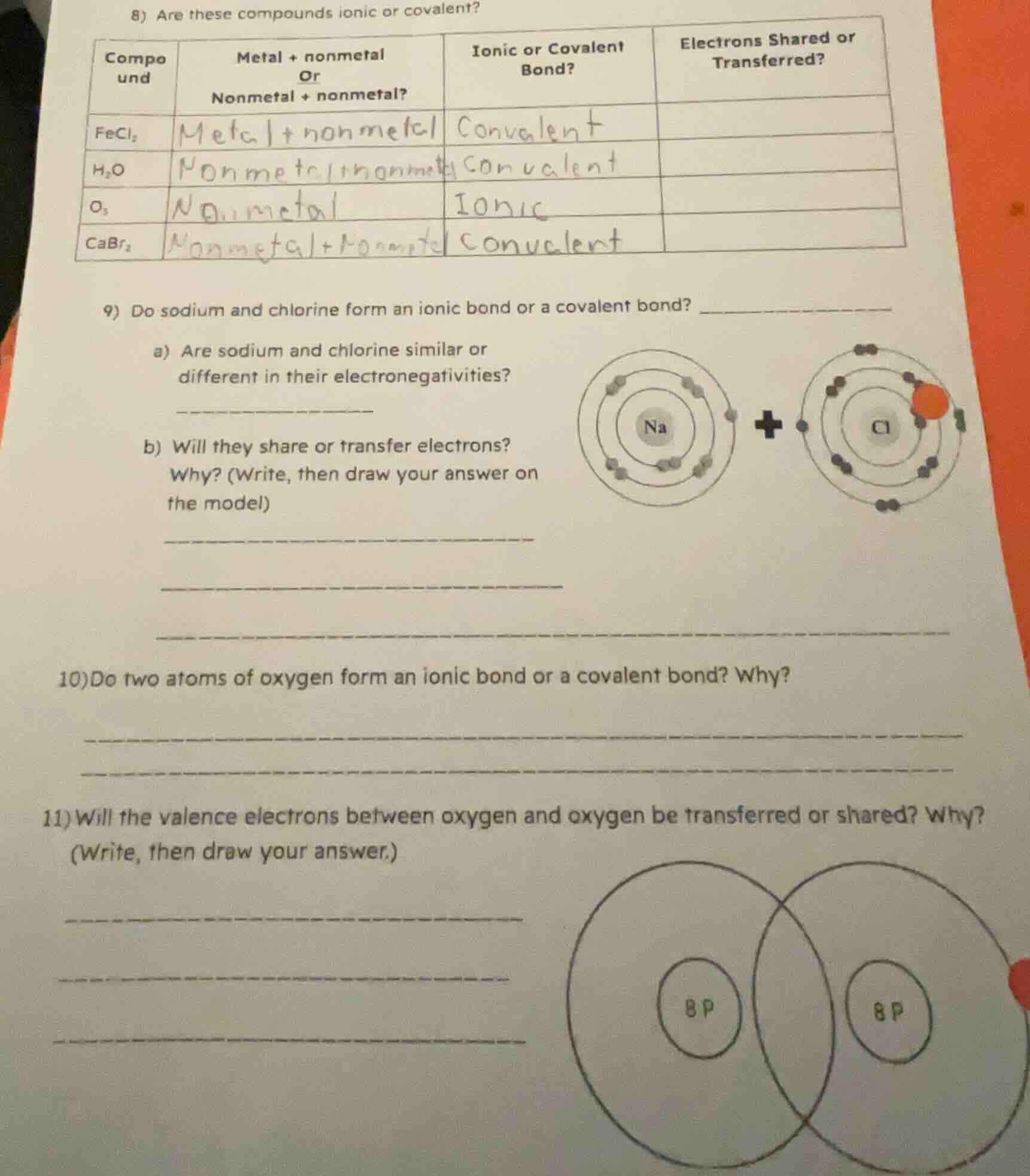
- are these compounds ionic or covalent?
compound | metal + nonmetal or nonmetal + nonmetal? | ionic or covalent bond? | electrons shared or transferred?
fecl₂ | metal + nonmetal | covalent |
h₂o | nonmetal + nonmetal | covalent |
o₃ | nonmetal | ionic |
cabr₂ | nonmetal + nonmetal | covalent |
- do sodium and chlorine form an ionic bond or a covalent bond?
a) are sodium and chlorine similar or different in their electronegativities?
b) will they share or transfer electrons? why? (write, then draw your answer on the model)
10)do two atoms of oxygen form an ionic bond or a covalent bond? why?
11)will the valence electrons between oxygen and oxygen be transferred or shared? why? (write, then draw your answer.)
Problem 8: Correcting the Table (Ionic/Covalent Bonds)
Step 1: Analyze \( \text{FeCl}_2 \)
- Type of Atoms: Iron (Fe) is a metal, Chlorine (Cl) is a nonmetal.
- Bond Type: Metal + nonmetal → ionic bond (not covalent).
- Electrons: Transferred (ionic bonds involve electron transfer).
Step 2: Analyze \( \text{H}_2\text{O} \)
- Type of Atoms: Hydrogen (H) and Oxygen (O) are nonmetals.
- Bond Type: Nonmetal + nonmetal → covalent bond (correct as written, but “Nonmetal + nonmetal” is the category).
- Electrons: Shared (covalent bonds involve electron sharing).
Step 3: Analyze \( \text{O}_3 \)
- Type of Atoms: Oxygen (O) is a nonmetal (diatomic/molecular, but still nonmetal + nonmetal).
- Bond Type: Nonmetal + nonmetal → covalent bond (not ionic).
- Electrons: Shared (covalent).
Step 4: Analyze \( \text{CaBr}_2 \)
- Type of Atoms: Calcium (Ca) is a metal, Bromine (Br) is a nonmetal.
- Bond Type: Metal + nonmetal → ionic bond (not covalent).
- Electrons: Transferred (ionic).
Problem 9: Sodium (Na) and Chlorine (Cl)
9) Bond Type:
Sodium is a metal, Chlorine is a nonmetal. Metal + nonmetal → ionic bond.
a) Electronegativity:
Sodium (Na) has low electronegativity (loses electrons), Chlorine (Cl) has high electronegativity (gains electrons). Thus, they are different in electronegativity.
b) Electron Behavior:
They will transfer electrons. Reason: Na (metal) has 1 valence electron, Cl (nonmetal) needs 1 electron to fill its outer shell. Na donates its electron to Cl, forming \( \text{Na}^+ \) and \( \text{Cl}^- \) (ionic bond via electron transfer).
Problem 10: Two Oxygen Atoms (\( \text{O}_2 \))
- Bond Type: Covalent bond.
- Why?: Both oxygen atoms are nonmetals (same element, nonmetal + nonmetal). Covalent bonds form between nonmetals (electrons are shared, not transferred, since electronegativities are equal).
Problem 11: Valence Electrons in \( \text{O}_2 \)
- Behavior: Shared.
- Why?: Both oxygen atoms have 6 valence electrons and need 2 more to fill their outer shells. They share 2 pairs of electrons (a double covalent bond) to satisfy the octet rule. Since they are identical nonmetals, electronegativity is equal, so electrons are shared (not transferred).
Corrected Table for Problem 8:
| Compound | Metal + nonmetal <br> Or <br> Nonmetal + nonmetal? | Ionic or Covalent Bond? | Electrons Shared or Transferred? |
|---|---|---|---|
| \( \text{H}_2\text{O} \) | Nonmetal + nonmetal | Covalent | Shared |
| \( \text{O}_3 \) | Nonmetal + nonmetal | Covalent | Shared |
| \( \text{CaBr}_2 \) | Metal + nonmetal | Ionic | Transferred |
Final Answers (Key Points):
- Corrected table (see above).
- Bond: Ionic; a) Different; b) Transfer (reason: metal + nonmetal, electron donation).
- Covalent (nonmetal + nonmetal, equal electronegativity → sharing).
- Shared (nonmetals, equal electronegativity → covalent bond via sharing).

Snap & solve any problem in the app
Get step-by-step solutions on Sovi AI
Photo-based solutions with guided steps
Explore more problems and detailed explanations
Problem 8: Correcting the Table (Ionic/Covalent Bonds)
Step 1: Analyze \( \text{FeCl}_2 \)
- Type of Atoms: Iron (Fe) is a metal, Chlorine (Cl) is a nonmetal.
- Bond Type: Metal + nonmetal → ionic bond (not covalent).
- Electrons: Transferred (ionic bonds involve electron transfer).
Step 2: Analyze \( \text{H}_2\text{O} \)
- Type of Atoms: Hydrogen (H) and Oxygen (O) are nonmetals.
- Bond Type: Nonmetal + nonmetal → covalent bond (correct as written, but “Nonmetal + nonmetal” is the category).
- Electrons: Shared (covalent bonds involve electron sharing).
Step 3: Analyze \( \text{O}_3 \)
- Type of Atoms: Oxygen (O) is a nonmetal (diatomic/molecular, but still nonmetal + nonmetal).
- Bond Type: Nonmetal + nonmetal → covalent bond (not ionic).
- Electrons: Shared (covalent).
Step 4: Analyze \( \text{CaBr}_2 \)
- Type of Atoms: Calcium (Ca) is a metal, Bromine (Br) is a nonmetal.
- Bond Type: Metal + nonmetal → ionic bond (not covalent).
- Electrons: Transferred (ionic).
Problem 9: Sodium (Na) and Chlorine (Cl)
9) Bond Type:
Sodium is a metal, Chlorine is a nonmetal. Metal + nonmetal → ionic bond.
a) Electronegativity:
Sodium (Na) has low electronegativity (loses electrons), Chlorine (Cl) has high electronegativity (gains electrons). Thus, they are different in electronegativity.
b) Electron Behavior:
They will transfer electrons. Reason: Na (metal) has 1 valence electron, Cl (nonmetal) needs 1 electron to fill its outer shell. Na donates its electron to Cl, forming \( \text{Na}^+ \) and \( \text{Cl}^- \) (ionic bond via electron transfer).
Problem 10: Two Oxygen Atoms (\( \text{O}_2 \))
- Bond Type: Covalent bond.
- Why?: Both oxygen atoms are nonmetals (same element, nonmetal + nonmetal). Covalent bonds form between nonmetals (electrons are shared, not transferred, since electronegativities are equal).
Problem 11: Valence Electrons in \( \text{O}_2 \)
- Behavior: Shared.
- Why?: Both oxygen atoms have 6 valence electrons and need 2 more to fill their outer shells. They share 2 pairs of electrons (a double covalent bond) to satisfy the octet rule. Since they are identical nonmetals, electronegativity is equal, so electrons are shared (not transferred).
Corrected Table for Problem 8:
| Compound | Metal + nonmetal <br> Or <br> Nonmetal + nonmetal? | Ionic or Covalent Bond? | Electrons Shared or Transferred? |
|---|---|---|---|
| \( \text{H}_2\text{O} \) | Nonmetal + nonmetal | Covalent | Shared |
| \( \text{O}_3 \) | Nonmetal + nonmetal | Covalent | Shared |
| \( \text{CaBr}_2 \) | Metal + nonmetal | Ionic | Transferred |
Final Answers (Key Points):
- Corrected table (see above).
- Bond: Ionic; a) Different; b) Transfer (reason: metal + nonmetal, electron donation).
- Covalent (nonmetal + nonmetal, equal electronegativity → sharing).
- Shared (nonmetals, equal electronegativity → covalent bond via sharing).