QUESTION IMAGE
Question
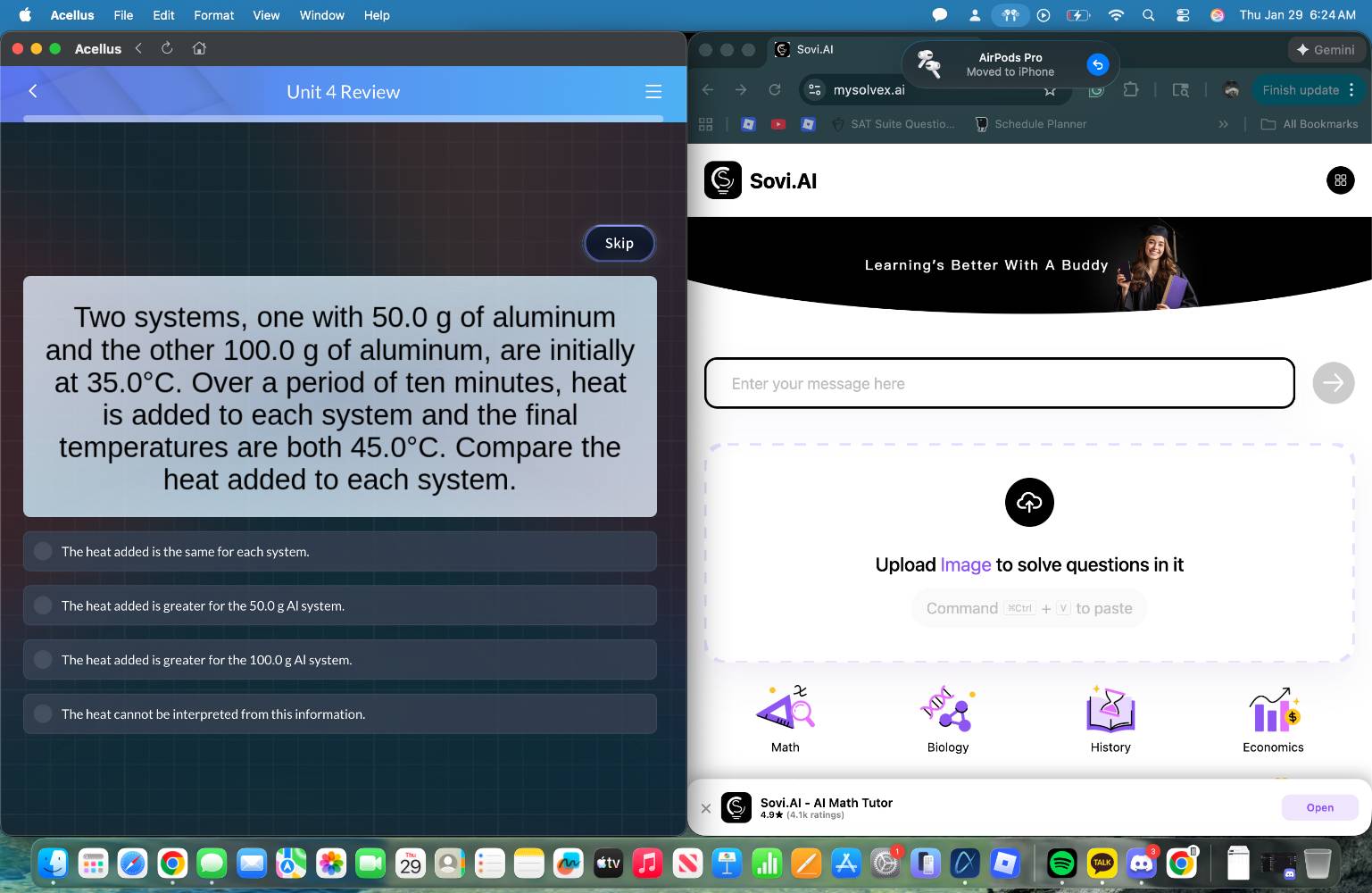
two systems, one with 50.0 g of aluminum and the other 100.0 g of aluminum, are initially at 35.0°c. over a period of ten minutes, heat is added to each system and the final temperatures are both 45.0°c. compare the heat added to each system. the heat added is the same for each system. the heat added is greater for the 50.0 g al system. the heat added is greater for the 100.0 g al system. the heat cannot be interpreted from this information.
Step1: Recall the heat formula
The formula for heat (\(q\)) is \(q = mc\Delta T\), where \(m\) is mass, \(c\) is specific heat capacity, and \(\Delta T\) is the change in temperature.
Step2: Analyze the variables
Both systems are aluminum, so \(c\) (specific heat of Al) is the same. Initial temperature (\(T_i = 35.0^\circ\text{C}\)) and final temperature (\(T_f = 45.0^\circ\text{C}\)) are the same for both, so \(\Delta T = T_f - T_i = 45.0 - 35.0 = 10.0^\circ\text{C}\) is the same. Masses are \(m_1 = 50.0\,\text{g}\) and \(m_2 = 100.0\,\text{g}\), with \(m_2 > m_1\).
Step3: Compare heat added
Since \(q \propto m\) (when \(c\) and \(\Delta T\) are constant), the system with more mass (\(100.0\,\text{g}\) Al) will have more heat added. So \(q_{100} > q_{50}\).

Snap & solve any problem in the app
Get step-by-step solutions on Sovi AI
Photo-based solutions with guided steps
Explore more problems and detailed explanations
The heat added is greater for the 100.0 g Al system. (Corresponding option: The heat added is greater for the 100.0 g Al system.)