QUESTION IMAGE
Question
unit 6 lesson 6 additional practice problems
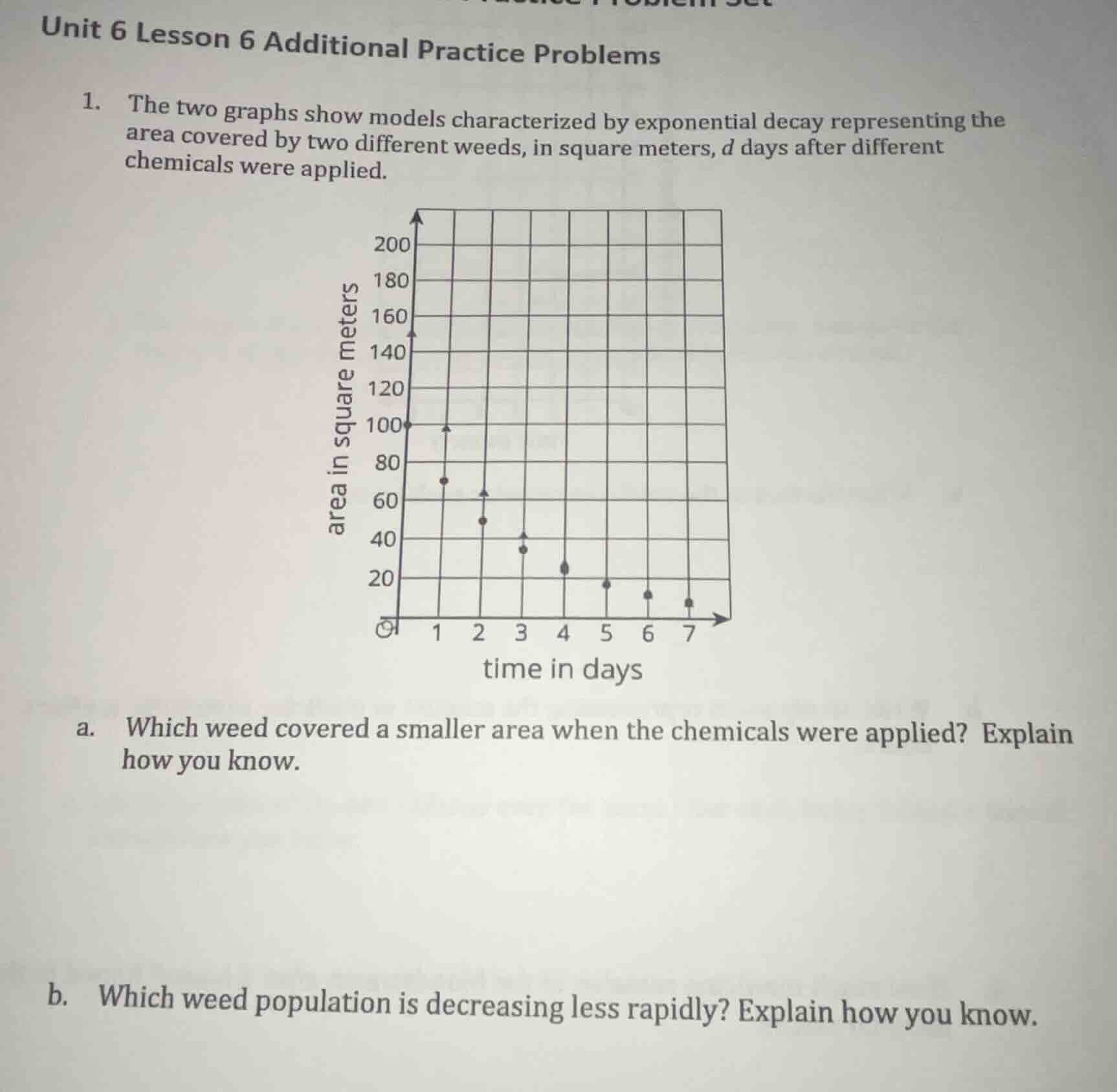
- the two graphs show models characterized by exponential decay representing the area covered by two different weeds, in square meters, d days after different chemicals were applied.
graph with x-axis time in days (0 - 7) and y-axis area in square meters (0 - 200), data points for two weeds
a. which weed covered a smaller area when the chemicals were applied? explain how you know.
b. which weed population is decreasing less rapidly? explain how you know.
Part (a)
To determine which weed covered a smaller area when chemicals were applied, we look at the initial value (when \( d = 0 \), the y - intercept of the exponential decay model). The y - intercept represents the area covered at day 0 (when chemicals were applied). From the graph, one of the graphs has a y - intercept (initial area) that is lower than the other. The weed with the lower y - intercept (smaller value on the y - axis at \( d = 0 \)) covered a smaller area initially.
For exponential decay models \( y = a(b)^d\), the base \( b\) (where \( 0 < b< 1\)) determines the rate of decay. A larger value of \( b\) means a slower rate of decay. We can also compare the graphs by looking at how much the area decreases over the same time interval. The weed whose area decreases by a smaller proportion (or has a less steep graph) over time is decreasing less rapidly. If we look at the two graphs, the one with the less steep slope (or the larger base \( b\) in the exponential formula) will represent the weed that is decreasing less rapidly.

Snap & solve any problem in the app
Get step-by-step solutions on Sovi AI
Photo-based solutions with guided steps
Explore more problems and detailed explanations
The weed represented by the graph with the lower y - intercept (smaller initial value on the y - axis at \( d = 0 \)) covered a smaller area when the chemicals were applied. We know this because the y - intercept of an exponential decay model \( y=a(b)^d\) (where \( a\) is the initial amount) gives the initial area, and a smaller \( a\) means a smaller initial area.