QUESTION IMAGE
Question
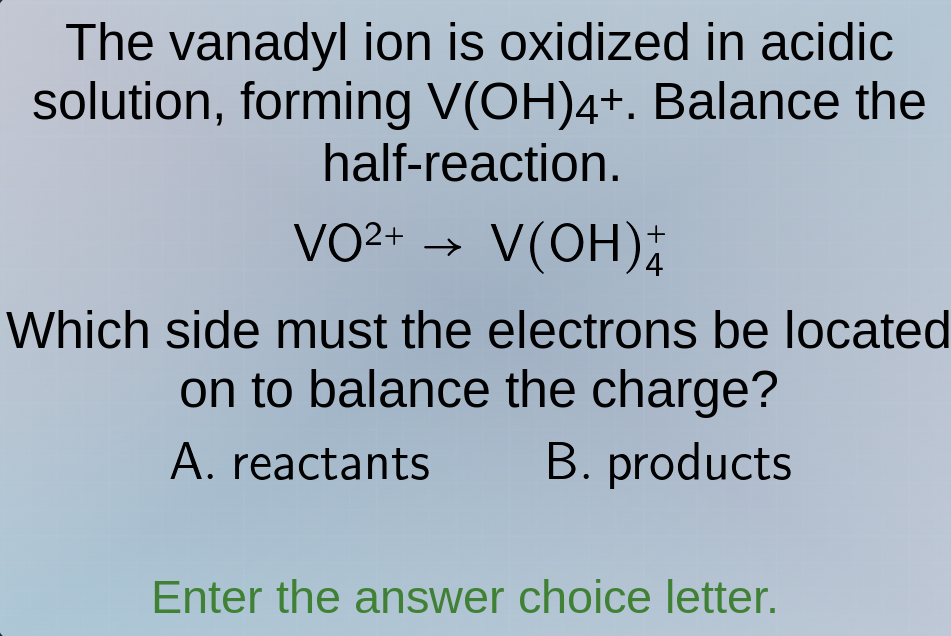
the vanadyl ion is oxidized in acidic solution, forming v(oh)₄⁺. balance the half - reaction.
vo²⁺ → v(oh)₄⁺
which side must the electrons be located on to balance the charge?
a. reactants b. products
enter the answer choice letter.
Brief Explanations
- First, balance the oxygen and hydrogen atoms in the half - reaction in acidic solution. The unbalanced half - reaction is \(VO^{2+}\to V(OH)_4^+\).
- To balance oxygen, we can add water molecules. On the left - hand side, we have 1 O atom in \(VO^{2+}\), and on the right - hand side, we have 4 O atoms in \(V(OH)_4^+\). So we add 2 \(H_2O\) molecules to the left - hand side: \(VO^{2+}+2H_2O\to V(OH)_4^+\).
- Now, balance the hydrogen atoms. The left - hand side has 4 H atoms (from \(2H_2O\)) and the right - hand side has 4 H atoms (from \(V(OH)_4^+\)), so hydrogen is balanced.
- Next, balance the charge.
- The charge on the left - hand side: The charge of \(VO^{2+}\) is +2, and the charge of \(2H_2O\) is 0, so the total charge on the left is +2.
- The charge on the right - hand side: The charge of \(V(OH)_4^+\) is +1.
- To balance the charge, we need to add electrons. Since the left - hand side has a higher positive charge (+2) than the right - hand side (+1), we need to add electrons to the right - hand side (reduction is gain of electrons, but in this case, we are looking at charge balance. The reaction is an oxidation? Wait, no. Wait, the vanadium in \(VO^{2+}\): let's calculate the oxidation state of V. In \(VO^{2+}\), O has an oxidation state of - 2. Let the oxidation state of V be \(x\), then \(x+( - 2)=+2\), so \(x = + 4\). In \(V(OH)_4^+\), O has an oxidation state of - 2, H has an oxidation state of +1. Let the oxidation state of V be \(y\), then \(y + 4\times( - 2)+4\times(+1)=+1\), \(y-8 + 4=+1\), \(y=+5\). So V is oxidized (oxidation state goes from +4 to +5). In an oxidation half - reaction, electrons are lost (oxidation is loss of electrons), and electrons are on the product side.
- Let's calculate the charge balance. Left - hand side charge: \(VO^{2+}\) has a charge of +2, \(2H_2O\) has a charge of 0, total charge \(Q_{left}=+2\). Right - hand side charge: \(V(OH)_4^+\) has a charge of +1. To balance the charge, we need to have the same charge on both sides. Let the number of electrons be \(n\). The charge on the right - hand side after adding electrons is \(+1 - n\) (since electrons have a charge of - 1). We want \(+2=+1 - n\), so \(n=-1\)? Wait, no, that's wrong. Wait, the correct way: the charge on the left is +2, the charge on the right is +1. For the charge to be balanced, we need to add electrons to the side with the higher positive charge? No, wait, electrons have a negative charge. If the left has a charge of +2 and the right has a charge of +1, to make the charges equal, we need to add electrons to the right (because adding an electron (charge - 1) to the right will make the right - hand side charge \(+1+( - 1\times n)\) and the left - hand side charge is +2. We want \(+2=+1 - n\), so \(n = - 1\)? No, I made a mistake. Wait, let's do it properly. The oxidation state of V goes from +4 to +5, so it loses 1 electron. In the half - reaction for oxidation, electrons are on the product side. So the electrons must be on the products side.

Snap & solve any problem in the app
Get step-by-step solutions on Sovi AI
Photo-based solutions with guided steps
Explore more problems and detailed explanations
B