QUESTION IMAGE
Question
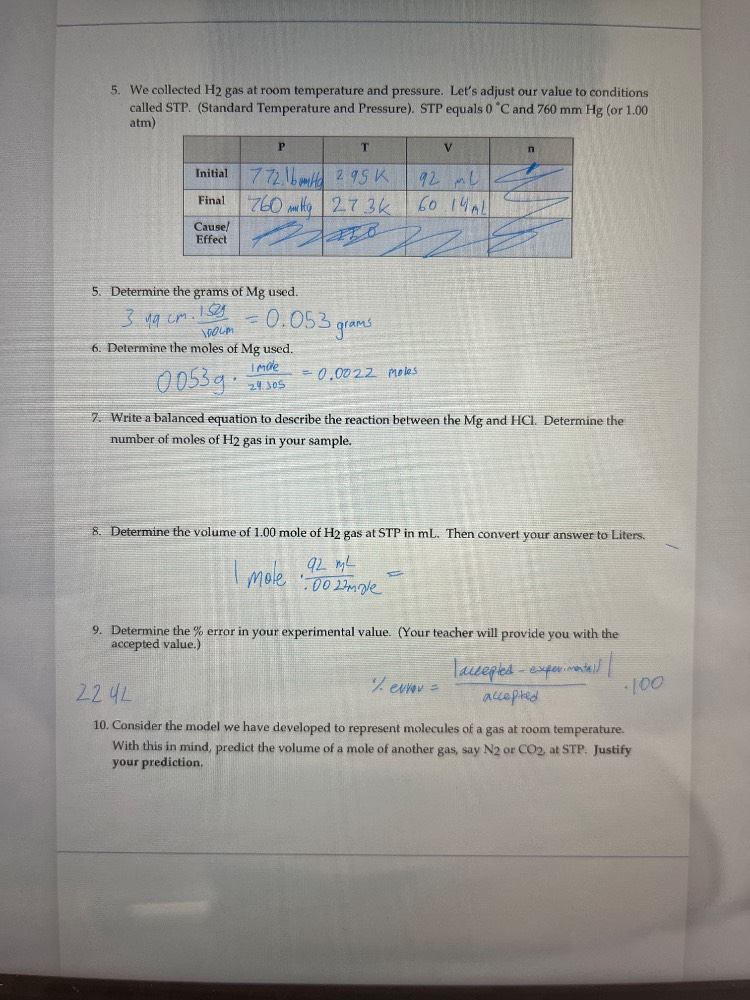
- we collected h₂ gas at room temperature and pressure. let’s adjust our value to conditions called stp. (standard temperature and pressure). stp equals 0 °c and 760 mm hg (or 1.00 atm)
| p | t | v | n | |
| initial | 732.1 mmhg | 295 k | 92 ml | |
| final | 760 mmhg | 273 k | 60.14 ml | |
| cause/effect |
- determine the grams of mg used.
3 49 cm·1.5g/volume = 0.053 grams
- determine the moles of mg used.
0.053g · 1 mole/24.305 = 0.0022 moles
- write a balanced equation to describe the reaction between the mg and hcl. determine the number of moles of h₂ gas in your sample.
- determine the volume of 1.00 mole of h₂ gas at stp in ml. then convert your answer to liters.
1 mole · 92 ml/0.0022 mole =
- determine the % error in your experimental value. (your teacher will provide you with the accepted value.)
22.4 l % error = |accepted - experimental| / accepted · 100
- consider the model we have developed to represent molecules of a gas at room temperature. with this in mind, predict the volume of a mole of another gas, say n₂ or co₂ at stp. justify your prediction.
Question 7
Step 1: Write the reaction between Mg and HCl
Magnesium (Mg) reacts with hydrochloric acid (HCl) to form magnesium chloride ($MgCl_2$) and hydrogen gas ($H_2$). The unbalanced equation is:
Step 2: Balance the equation
- Balance Cl: There are 2 Cl on the right, so add a coefficient of 2 to HCl:
- Check Mg: 1 Mg on left and right.
- Check H: 2 H on left (from 2 HCl) and 2 H on right (from $H_2$).
- Check Cl: 2 Cl on left (from 2 HCl) and 2 Cl on right (from $MgCl_2$).
The balanced equation is:
$$Mg + 2HCl = MgCl_2 + H_2$$
Step 3: Determine moles of $H_2$ (from Question 6)
From Question 6, moles of Mg used = 0.0022 moles. From the balanced equation, 1 mole of Mg produces 1 mole of $H_2$. Thus, moles of $H_2$ = moles of Mg = 0.0022 moles.
Question 8
Step 1: Recall molar volume at STP
At STP (0 °C, 1 atm), 1 mole of any ideal gas occupies 22.4 L (or 22400 mL).
Step 2: Calculate volume in mL
Volume of 1.00 mole of $H_2$ at STP = 1.00 mol × 22400 mL/mol = 22400 mL.
Step 3: Convert to Liters
Since 1 L = 1000 mL, divide by 1000:
$$\frac{22400\ \text{mL}}{1000\ \text{mL/L}} = 22.4\ \text{L}$$
Question 10
At STP, 1 mole of any ideal gas occupies 22.4 L (molar volume of ideal gases). This is based on Avogadro’s law, which states that equal volumes of gases at the same temperature and pressure contain equal numbers of molecules. For $N_2$ or $CO_2$ (assuming ideal behavior), 1 mole will occupy 22.4 L at STP because the molar volume depends on temperature and pressure, not the gas’s identity (for ideal gases).

Snap & solve any problem in the app
Get step-by-step solutions on Sovi AI
Photo-based solutions with guided steps
Explore more problems and detailed explanations
s:
- Balanced equation: $\boldsymbol{Mg + 2HCl = MgCl_2 + H_2}$; Moles of $H_2$: $\boldsymbol{0.0022\ \text{moles}}$
- Volume in mL: $\boldsymbol{22400\ \text{mL}}$; Volume in Liters: $\boldsymbol{22.4\ \text{L}}$
- Prediction: 1 mole of $N_2$ or $CO_2$ at STP will occupy $\boldsymbol{22.4\ \text{L}}$. Justification: Avogadro’s law (molar volume of ideal gases at STP is 22.4 L/mol, independent of gas identity).