QUESTION IMAGE
Question
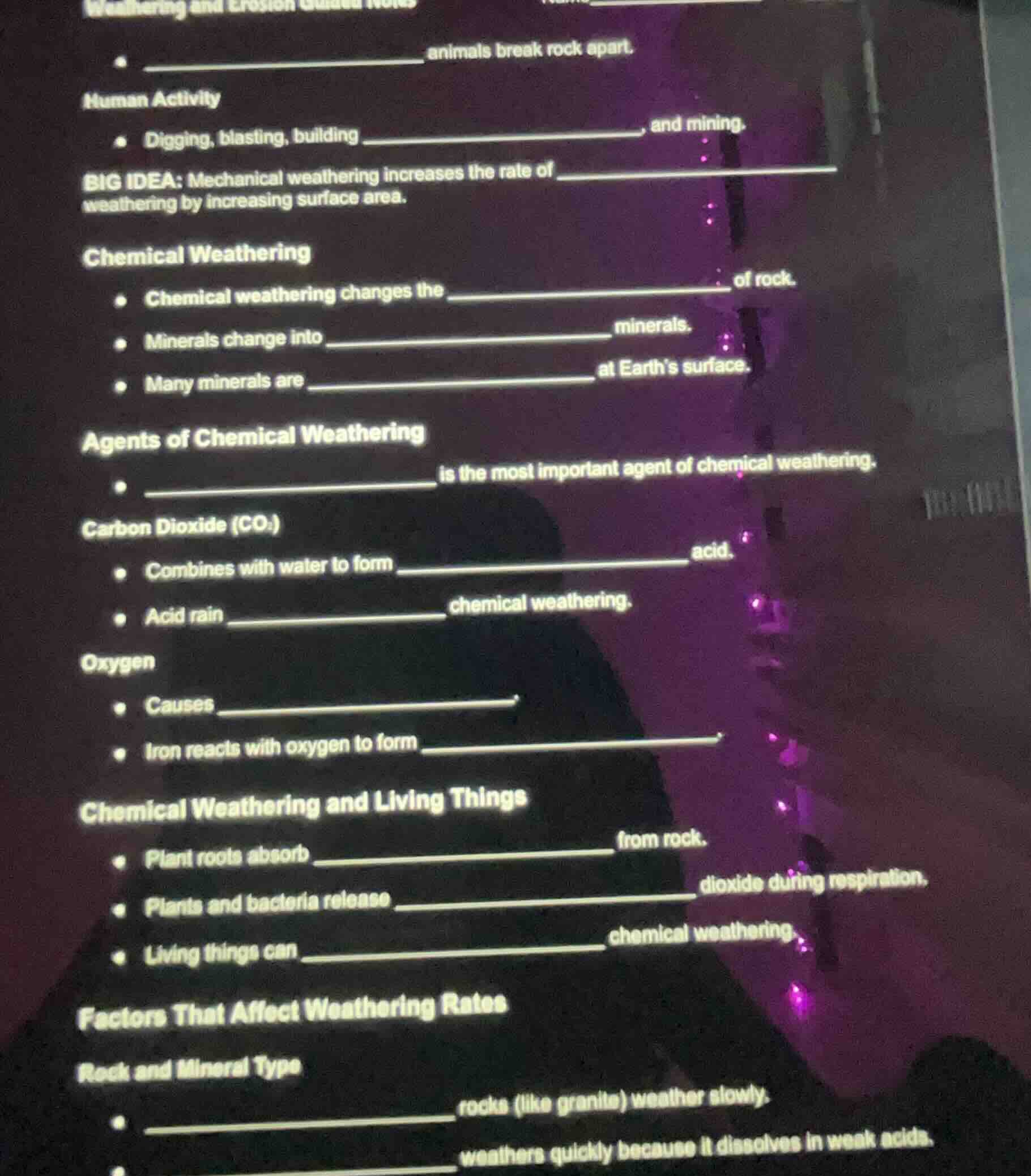
weathering and erosion guided notes
- ______ animals break rock apart.
human activity
- digging, blasting, building ______, and mining.
big idea: mechanical weathering increases the rate of ______ weathering by increasing surface area.
chemical weathering
- chemical weathering changes the ______ of rock.
- minerals change into ______ minerals.
- many minerals are ______ at earth’s surface.
agents of chemical weathering
- ______ is the most important agent of chemical weathering.
carbon dioxide (co₂)
- combines with water to form ______ acid.
- acid rain ______ chemical weathering.
oxygen
- causes ______.
- iron reacts with oxygen to form ______.
chemical weathering and living things
- plant roots absorb ______ from rock.
- plants and bacteria release ______ dioxide during respiration.
- living things can ______ chemical weathering.
factors that affect weathering rates
rock and mineral type
- ______ rocks (like granite) weather slowly.
- ______ weathers quickly because it dissolves in weak acids.
This is a fill - in - the - blank worksheet about weathering and erosion, which is related to the study of the Earth's surface processes. In the field of Natural Science, Geography (specifically geomorphology which is a sub - field of Geography) deals with such topics as weathering and erosion. The following are the answers based on the knowledge of weathering and erosion:
- For the first blank (animals break rock apart), the answer is "Burrowing" as burrowing animals can break rocks apart.
- For the blank under Human Activity (Digging, blasting, building ____, and mining), the answer is "roads" (other infrastructure like buildings or tunnels could also be possible, but roads are a common human activity related to rock disturbance).
- For the BIG IDEA blank (Mechanical weathering increases the rate of ____ weathering by increasing surface area), the answer is "chemical" as mechanical weathering exposes more surface area for chemical reactions to occur, thus increasing chemical weathering rate.
- For the first Chemical Weathering blank (Chemical weathering changes the ____ of rock), the answer is "composition". Chemical weathering alters the chemical makeup of rocks.
- For the second Chemical Weathering blank (Minerals change into ____ minerals), the answer is "new" as chemical weathering transforms existing minerals into different (new) ones.
- For the third Chemical Weathering blank (Many minerals are ____ at Earth’s surface), the answer is "unstable" as many minerals that are stable deep within the Earth are unstable at the surface due to different environmental conditions.
- For the Agents of Chemical Weathering blank (____ is the most important agent of chemical weathering), the answer is "Water". Water is crucial in many chemical weathering processes like hydrolysis, oxidation (when combined with oxygen), and dissolution.
- For the Carbon Dioxide (CO₂) first blank (Combines with water to form ____ acid), the answer is "carbonic" as \(CO_2 + H_2O=H_2CO_3\) (carbonic acid).
- For the Carbon Dioxide (CO₂) second blank (Acid rain ____ chemical weathering), the answer is "increases" as acid rain provides more acidic substances to react with rocks, thus increasing chemical weathering.
- For the Oxygen first blank (Causes ____), the answer is "oxidation". Oxygen is involved in oxidation reactions during chemical weathering.
- For the Oxygen second blank (Iron reacts with oxygen to form ____), the answer is "rust" (or iron oxide, \(Fe_2O_3\) is the chemical formula for rust).
- For the Chemical Weathering and Living Things first blank (Plant roots absorb ____ from rock), the answer is "nutrients" as plant roots can absorb nutrients from rocks through chemical processes like acid secretion.
- For the Chemical Weathering and Living Things second blank (Plants and bacteria release ____ dioxide during respiration), the answer is "carbon" (carbon dioxide, \(CO_2\)).
- For the Chemical Weathering and Living Things third blank (Living things can ____ chemical weathering), the answer is "increase" as living things like plants (through root growth and acid secretion) and bacteria (through releasing substances) can speed up chemical weathering.
- For the Rock and Mineral Type first blank (____ rocks (like granite) weather slowly), the answer is "Hard" (or "Intrusive igneous" as granite is an intrusive igneous rock and is hard and resistant to weathering).
- For the Rock and Mineral Type second blank (____ weathers quickly because it dissolves in weak acids), the answer is "Limestone" (limestone is mainly composed of calciu…

Snap & solve any problem in the app
Get step-by-step solutions on Sovi AI
Photo-based solutions with guided steps
Explore more problems and detailed explanations
- Burrowing
- roads
- chemical
- composition
- new
- unstable
- Water
- carbonic
- increases
- oxidation
- rust
- nutrients
- carbon
- increase
- Hard (or Intrusive igneous)
- Limestone