QUESTION IMAGE
Question
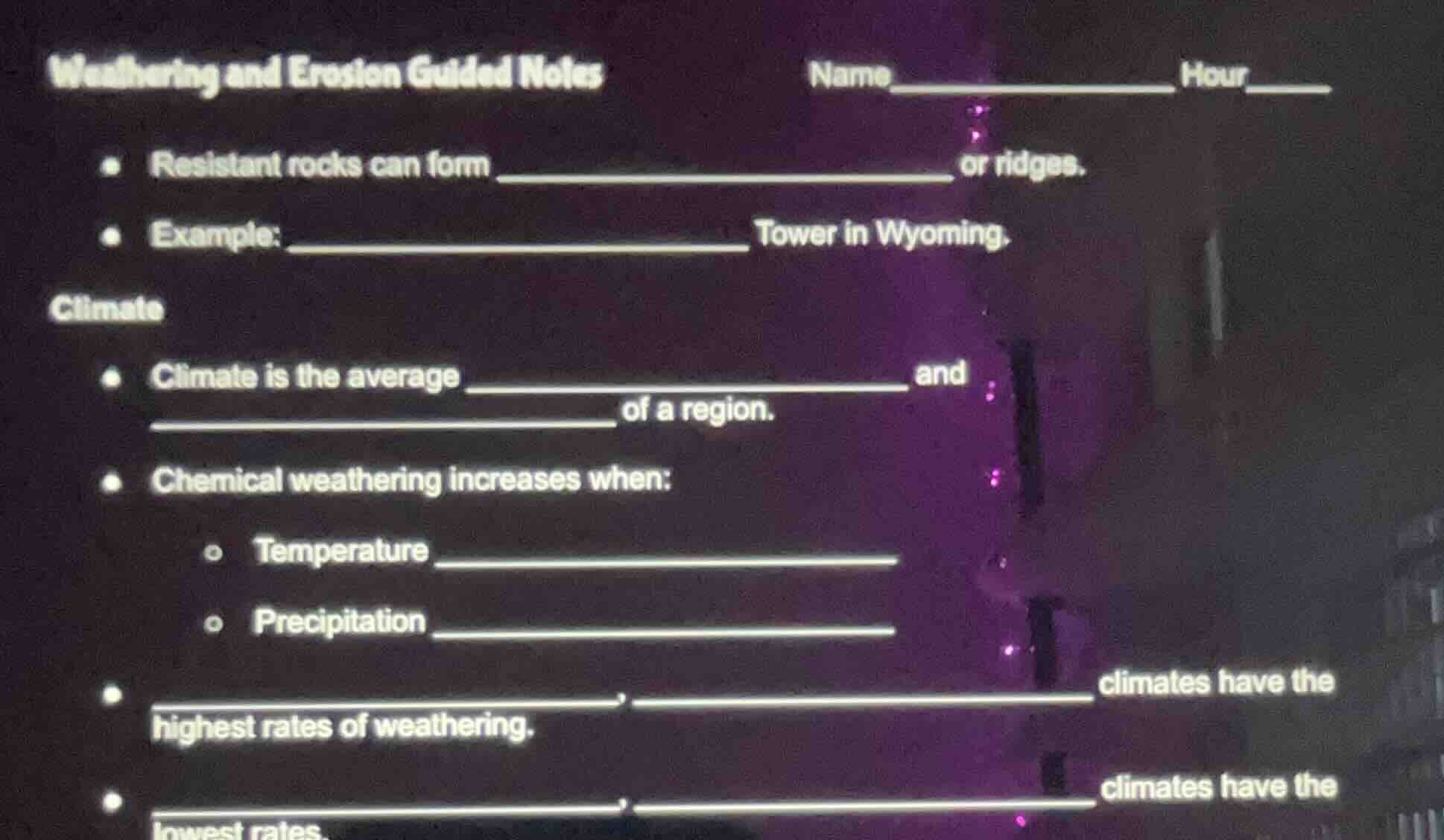
weathering and erosion guided notes name_____________ hour__
- resistant rocks can form __________________________ or ridges.
- example: __________________________ tower in wyoming.
climate
- climate is the average __________________________ and
__________________________ of a region.
- chemical weathering increases when:
- temperature __________________________
- precipitation __________________________
- ________________________, ________________________ climates have the highest rates of weathering.
- ________________________, ________________________ climates have the lowest rates.
Brief Explanations
- Resistant rocks, due to their ability to withstand erosion better than surrounding rocks, often form buttes (or similar landforms like ridges). A butte is a steep - sided hill with a flat top, formed when surrounding less - resistant rock is eroded away.
- The Devils Tower in Wyoming is a well - known example of a landform created by resistant rock (in this case, an igneous intrusion that was more resistant to erosion than the surrounding rock).
- Climate is defined as the average temperature and precipitation (or weather conditions over a long period) of a region. It represents the long - term pattern of weather in an area.
- Chemical weathering is a process that is affected by temperature and precipitation. As temperature increases, the rate of chemical reactions (which drive chemical weathering) also increases. Similarly, as precipitation increases, there is more water available to facilitate chemical reactions involved in weathering.
- Tropical and humid (or wet) climates have the highest rates of weathering. In these climates, there is high temperature and abundant precipitation, which both promote chemical weathering. Also, the high moisture and warmth support biological activity that can also contribute to weathering.
- Arid (dry) and cold climates have the lowest rates of weathering. In arid climates, there is little water to drive chemical weathering, and in cold climates, the low temperatures slow down chemical reactions. Also, biological activity is limited in these environments, further reducing weathering rates.

Snap & solve any problem in the app
Get step-by-step solutions on Sovi AI
Photo-based solutions with guided steps
Explore more problems and detailed explanations
s:
- Resistant rocks can form \(\boldsymbol{\text{buttes}}\) or ridges.
- Example: \(\boldsymbol{\text{Devils}}\) Tower in Wyoming.
- Climate is the average \(\boldsymbol{\text{temperature}}\) and \(\boldsymbol{\text{precipitation}}\) of a region.
- Chemical weathering increases when:
- Temperature \(\boldsymbol{\text{increases}}\)
- Precipitation \(\boldsymbol{\text{increases}}\)
- \(\boldsymbol{\text{Tropical}}\), \(\boldsymbol{\text{humid}}\) climates have the highest rates of weathering.
- \(\boldsymbol{\text{Arid}}\), \(\boldsymbol{\text{cold}}\) climates have the lowest rates.