QUESTION IMAGE
Question
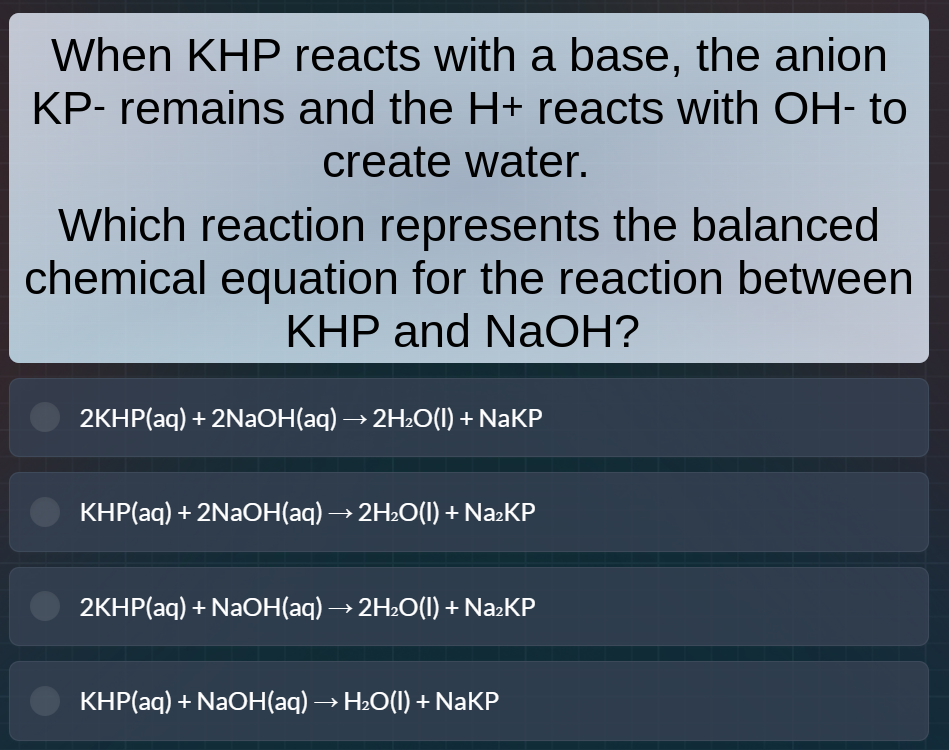
when khp reacts with a base, the anion kp- remains and the h+ reacts with oh- to create water. which reaction represents the balanced chemical equation for the reaction between khp and naoh? 2khp(aq) + 2naoh(aq) → 2h₂o(l) + nakp khp(aq) + 2naoh(aq) → 2h₂o(l) + na₂kp 2khp(aq) + naoh(aq) → 2h₂o(l) + na₂kp khp(aq) + naoh(aq) → h₂o(l) + nakp
Step1: Identify reactants and products
Reactants: KHP (aq) and NaOH (aq). Products: \( H_2O(l) \) and \( NaKP \) (or similar with Na and KP⁻).
Step2: Analyze ion reactions
KHP donates \( H^+ \), NaOH donates \( OH^- \). \( H^+ + OH^-
ightarrow H_2O \). The anion \( KP^- \) combines with \( Na^+ \) to form \( NaKP \).
Step3: Balance atoms
- For K: 1 in KHP, 1 in NaKP.
- For H: 1 (from KHP) + 1 (from NaOH) = 2 in \( H_2O \)? Wait, no: KHP has one \( H^+ \), NaOH has one \( OH^- \). So \( H^+ + OH^-
ightarrow H_2O \), so 1 H from KHP and 1 H from NaOH (in OH⁻) make 1 \( H_2O \). Wait, formula: KHP is \( KHC_8H_4O_4 \) (commonly), but here we use the given: KHP (aq) has \( K^+ \), \( HP^- \) (so \( H^+ \) and \( P^- \)? Wait, the problem says when KHP reacts with base, anion \( KP^- \) remains? Wait, no, the problem states: "the anion KP- remains and the H+ reacts with OH- to create water." So KHP dissociates into \( K^+ \), \( H^+ \), and \( P^- \)? Wait, no, KHP is potassium hydrogen phthalate, \( KHC_8H_4O_4 \), so it's \( K^+ \) and \( HC_8H_4O_4^- \) (hydrogen phthalate). But the problem simplifies: when reacting with base (NaOH, which is \( Na^+ \) and \( OH^- \)), the \( H^+ \) (from KHP) reacts with \( OH^- \) to form \( H_2O \), and the anion (after losing \( H^+ \)) is \( KP^- \) (simplified), which combines with \( Na^+ \) to form \( NaKP \).
So the reaction is: \( KHP(aq) + NaOH(aq)
ightarrow H_2O(l) + NaKP(aq) \). Now check balancing:
- K: 1 (KHP) → 1 (NaKP) ✔️
- H: 1 (KHP) + 1 (NaOH, in OH⁻) → 2 (H₂O)? Wait, no: H from KHP (1) and H from OH⁻ (1) → H₂O (which has 2 H). Wait, KHP has one H⁺, NaOH has one OH⁻. So H⁺ + OH⁻ → H₂O (1 H₂O). So H: 1 + 1 = 2 in H₂O ✔️.
- O: 1 (OH⁻) → 1 (H₂O) ✔️.
- Na: 1 (NaOH) → 1 (NaKP) ✔️.
- P: 1 (KHP) → 1 (NaKP) ✔️.
Now check the options:
- \( 2KHP(aq) + 2NaOH(aq)
ightarrow 2H_2O(l) + NaKP \): NaKP has 1 Na, but 2 NaOH (2 Na) → unbalanced Na.
- \( KHP(aq) + 2NaOH(aq)
ightarrow 2H_2O(l) + Na_2KP \): 2 NaOH (2 Na) → Na₂KP (2 Na), but H: 1 (KHP) + 2 (NaOH, 2 OH⁻) → 2 H₂O (4 H)? No, 1 + 2 = 3 H, but H₂O has 2 H per molecule. 2 H₂O has 4 H. Not balanced.
- \( 2KHP(aq) + NaOH(aq)
ightarrow 2H_2O(l) + Na_2KP \): 2 KHP (2 K) → Na₂KP (1 K)? No, K is 2 vs 1. Unbalanced.
- \( KHP(aq) + NaOH(aq)
ightarrow H_2O(l) + NaKP \): Balanced as above.
So the correct option is the fourth one.

Snap & solve any problem in the app
Get step-by-step solutions on Sovi AI
Photo-based solutions with guided steps
Explore more problems and detailed explanations
D. \( \text{KHP(aq)} + \text{NaOH(aq)}
ightarrow \text{H}_2\text{O(l)} + \text{NaKP} \) (assuming D is the fourth option; if options are labeled as A, B, C, D, then D is the correct one with that equation).