QUESTION IMAGE
Question
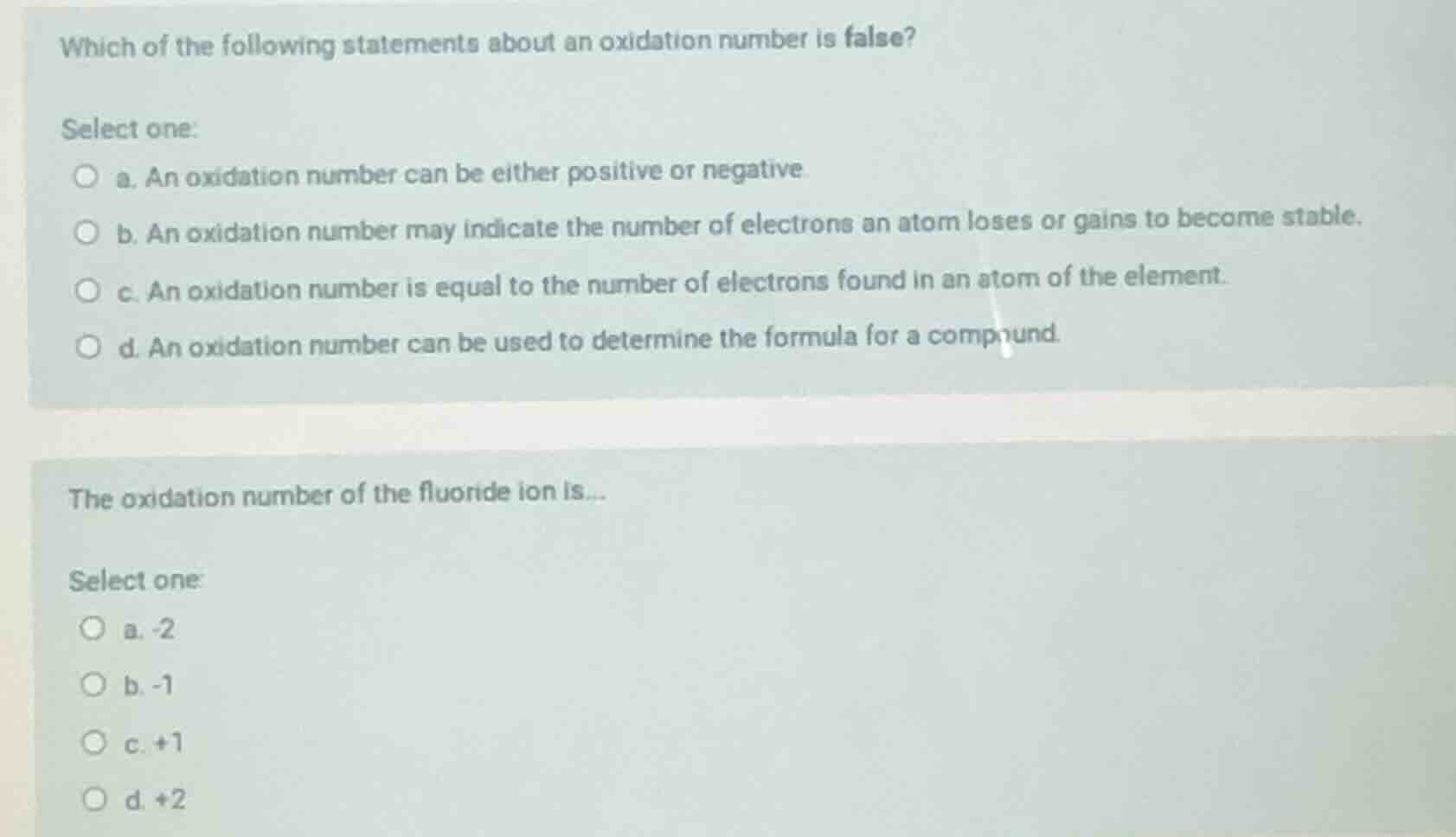
which of the following statements about an oxidation number is false?
select one:
a. an oxidation number can be either positive or negative
b. an oxidation number may indicate the number of electrons an atom loses or gains to become stable.
c. an oxidation number is equal to the number of electrons found in an atom of the element.
d. an oxidation number can be used to determine the formula for a compound.
the oxidation number of the fluoride ion is...
select one
a. -2
b. -1
c. +1
d. +2
For the first question:
- Option a: Oxidation numbers can be positive (e.g., +1 for Na⁺) or negative (e.g., -1 for Cl⁻), so this is true.
- Option b: Oxidation numbers reflect electron loss (positive) or gain (negative) for stability, so this is true.
- Option c: The number of electrons in a neutral atom equals its atomic number, not its oxidation number (which is a charge-related value), so this is false.
- Option d: Oxidation numbers are used to balance charges and find compound formulas (e.g., combining Al³⁺ and O²⁻ gives Al₂O₃), so this is true.
For the second question:
Fluorine is the most electronegative element, and it gains 1 electron to form the fluoride ion (F⁻), so its oxidation number is -1.

Snap & solve any problem in the app
Get step-by-step solutions on Sovi AI
Photo-based solutions with guided steps
Explore more problems and detailed explanations
- c. An oxidation number is equal to the number of electrons found in an atom of the element.
- b. -1