QUESTION IMAGE
Question
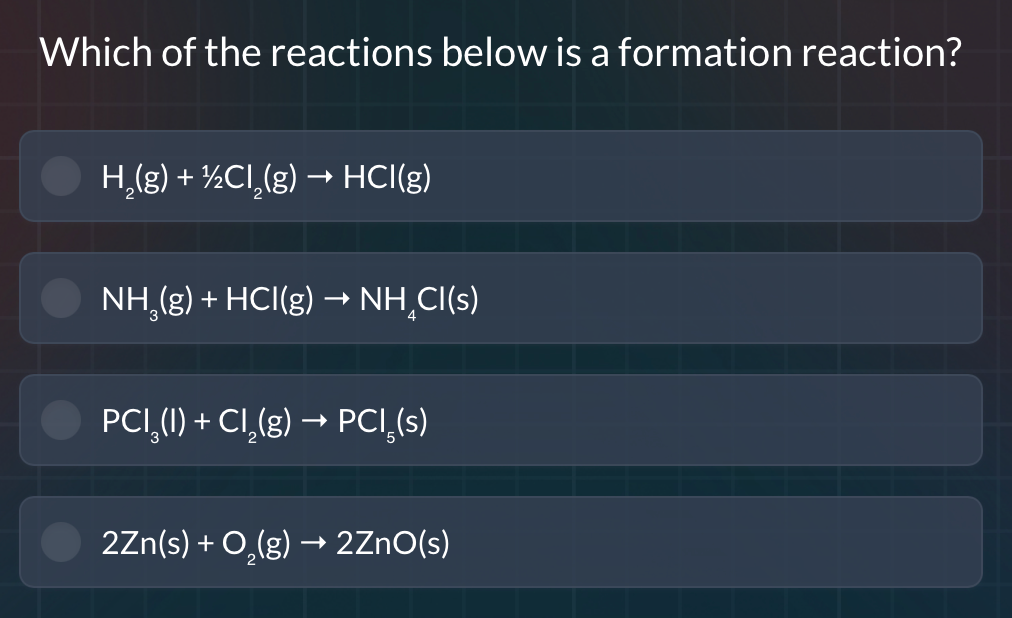
which of the reactions below is a formation reaction? h₂(g) + ½cl₂(g) → hcl(g) nh₃(g) + hcl(g) → nh₄cl(s) pcl₃(l) + cl₂(g) → pcl₅(s) 2zn(s) + o₂(g) → 2zno(s)
Brief Explanations
A formation reaction is a reaction where 1 mole of a compound is formed from its constituent elements in their standard states.
- For the first reaction: $\ce{H2(g) + 1/2Cl2(g) -> HCl(g)}$, hydrogen and chlorine are in their standard states (gaseous diatomic molecules), and 1 mole of $\ce{HCl(g)}$ is formed.
- The second reaction: $\ce{NH3(g) + HCl(g) -> NH4Cl(s)}$ involves two compounds reacting, not elements forming a compound.
- The third reaction: $\ce{PCl3(l) + Cl2(g) -> PCl5(s)}$ involves a compound ($\ce{PCl3}$) reacting with an element, not elements forming a compound from scratch.
- The fourth reaction: $\ce{2Zn(s) + O2(g) -> 2ZnO(s)}$ forms 2 moles of $\ce{ZnO}$, while a formation reaction should form 1 mole of the compound.
So the first reaction fits the definition of a formation reaction.

Snap & solve any problem in the app
Get step-by-step solutions on Sovi AI
Photo-based solutions with guided steps
Explore more problems and detailed explanations
$\boldsymbol{\ce{H2(g) + 1/2Cl2(g) -> HCl(g)}}$ (the first option: $\ce{H2(g) + 1/2Cl2(g) -> HCl(g)}$)