QUESTION IMAGE
Question
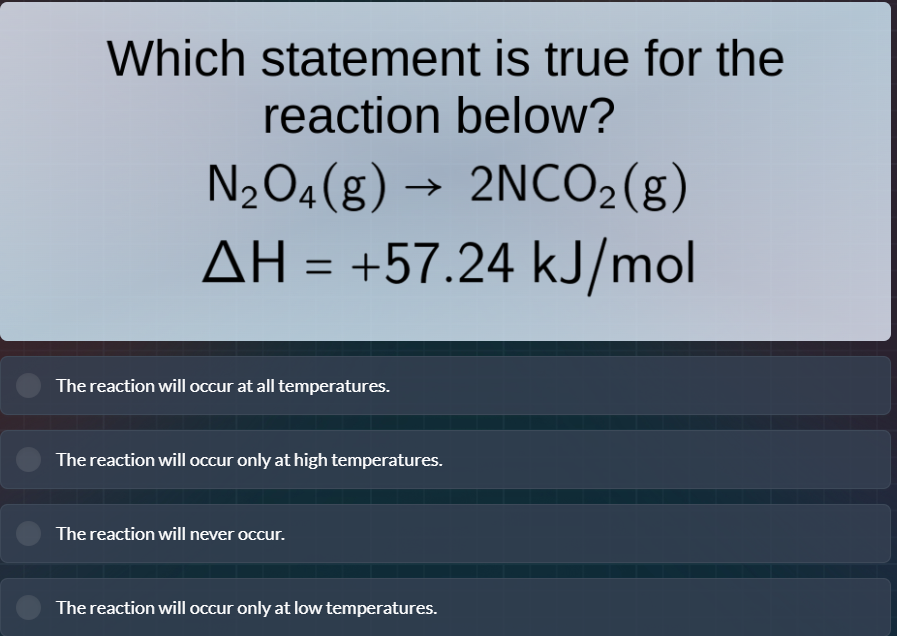
which statement is true for the reaction below?\
$\ce{n_{2}o_{4}(g) \
ightarrow 2no_{2}(g)}$\
$\delta h = +57.24\\ \mathrm{kj/mol}$\
the reaction will occur at all temperatures.\
the reaction will occur only at high temperatures.\
the reaction will never occur.\
the reaction will occur only at low temperatures.
Brief Explanations
- First, analyze the reaction: $\ce{N_{2}O_{4}(g) -> 2NO_{2}(g)}$ (corrected the product from $\ce{NCO_{2}}$ to $\ce{NO_{2}}$ as the original seems a typo), $\Delta H = + 57.24\space kJ/mol$ (endothermic, since $\Delta H>0$).
- For the spontaneity of a reaction, we consider the Gibbs free energy change $\Delta G=\Delta H - T\Delta S$.
- Calculate the entropy change ($\Delta S$): The number of moles of gas increases from 1 (reactant) to 2 (product), so $\Delta S>0$ (positive entropy change as more gas moles mean more disorder).
- Now, analyze $\Delta G$: $\Delta H>0$ (endothermic) and $\Delta S>0$. The term $-T\Delta S$ will be negative, and its magnitude increases with temperature ($T$). At high temperatures, the magnitude of $-T\Delta S$ will be large enough to make $\Delta G=\Delta H - T\Delta S<0$ (spontaneous). At low temperatures, $\Delta H$ (positive) will dominate, making $\Delta G>0$ (non - spontaneous). So the reaction is spontaneous (will occur) only at high temperatures.

Snap & solve any problem in the app
Get step-by-step solutions on Sovi AI
Photo-based solutions with guided steps
Explore more problems and detailed explanations
B. The reaction will occur only at high temperatures.