QUESTION IMAGE
Question
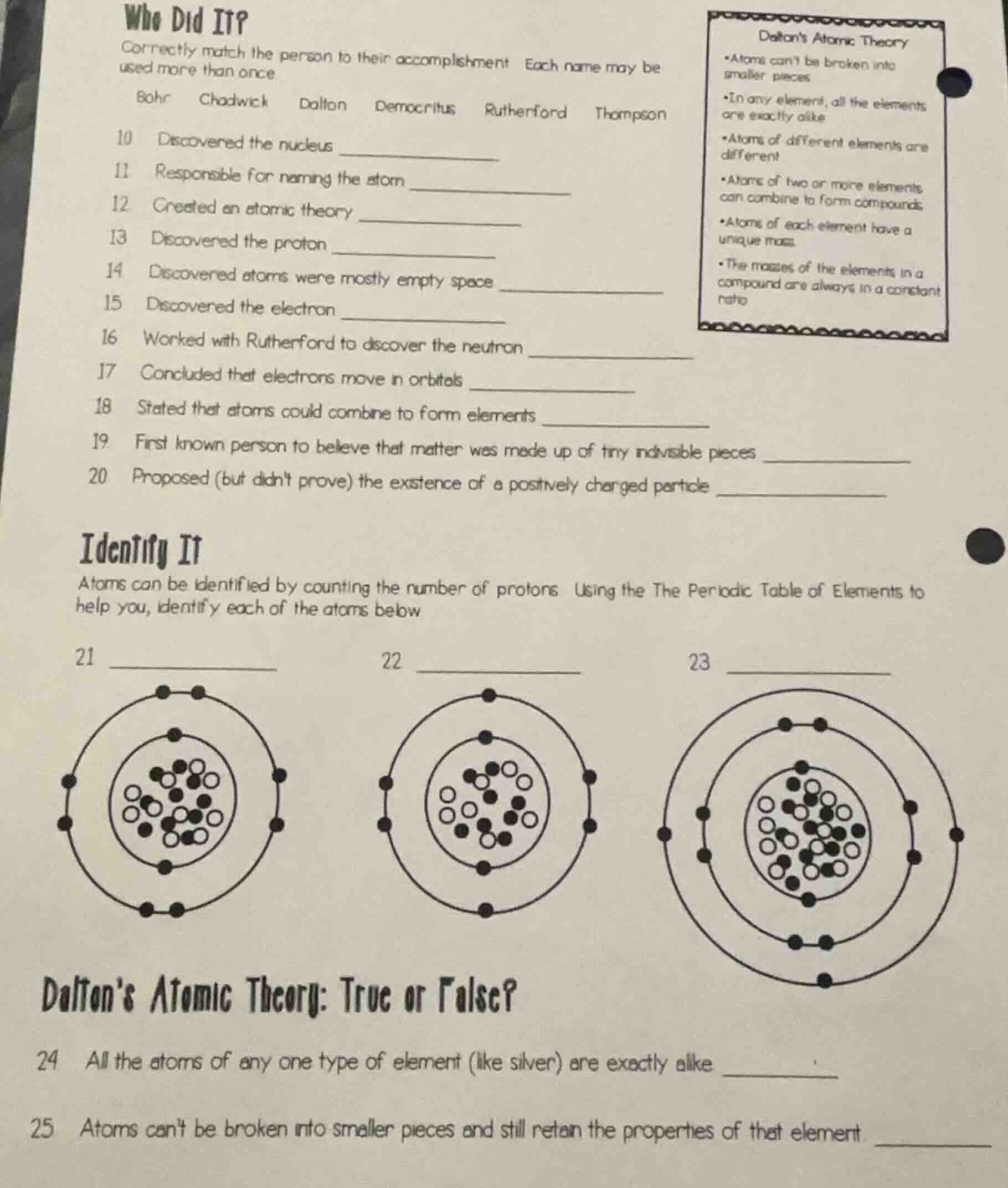
who did it?
correctly match the person to their accomplishment. each name may be used more than once
bohr chadwick dalton democritus rutherford thompson
10 discovered the nucleus _____________
11 responsible for naming the atom _____________
12 created an atomic theory _____________
13 discovered the proton _____________
14 discovered atoms were mostly empty space _____________
15 discovered the electron _____________
16 worked with rutherford to discover the neutron _____________
17 concluded that electrons move in orbitals _____________
18 stated that atoms could combine to form elements _____________
19 first known person to believe that matter was made up of tiny invisible pieces _____________
20 proposed (but didnt prove) the existence of a positively charged particle _____________
identify it
atoms can be identified by counting the number of protons. using the the periodic table of elements to help you, identify each of the atoms below
21 ___________ 22 _________ 23 ___________
images of atomic models for 21, 22, 23
daltons atomic theory: true or false?
24 all the atoms of any one type of element (like silver) are exactly alike _________
25 atoms cant be broken into smaller pieces and still retain the properties of that element _________
Who Did It? (Questions 10 - 20)
Question 10: Discovered the nucleus
- Explanation: Rutherford's gold foil experiment led to the discovery of the atomic nucleus.
- Answer: Rutherford
Question 11: Responsible for naming the atom
- Explanation: Democritus is credited with coining the term "atom" (from the Greek "atomos" meaning indivisible).
- Answer: Democritus
Question 12: Created an atomic theory
- Explanation: Dalton proposed the modern atomic theory with postulates about elements, compounds, etc.
- Answer: Dalton
Question 13: Discovered the proton
- Explanation: Rutherford's work led to the discovery of the proton (positive charge in nucleus).
- Answer: Rutherford
Question 14: Discovered atoms were mostly empty space
- Explanation: Rutherford's gold foil experiment showed most of the atom is empty space (nucleus is tiny, electrons orbit).
- Answer: Rutherford
Question 15: Discovered the electron
- Explanation: Thompson discovered the electron via cathode ray experiments.
- Answer: Thompson
Question 16: Worked with Rutherford to discover the neutron
- Explanation: Chadwick, under Rutherford's guidance, discovered the neutron.
- Answer: Chadwick
Question 17: Concluded that electrons move in orbits
- Explanation: Bohr proposed the planetary model of the atom with electrons in orbits.
- Answer: Bohr
Question 18: Stated that atoms could combine to form elements
- Explanation: Dalton's theory stated atoms combine to form compounds (note: the question might have a wording error, but Dalton's theory includes atoms combining to form compounds).
- Answer: Dalton
Question 19: First known person to believe that matter was made up of tiny invisible pieces
- Explanation: Democritus was the first to propose matter is made of indivisible atoms.
- Answer: Democritus
Question 20: Proposed (but didn't prove) the existence of a positively charged particle
- Explanation: Thompson proposed the existence of positive charges (in his plum - pudding model) before protons were fully characterized.
- Answer: Thompson
Identify It (Questions 21 - 23)
To identify the atom, we count the number of protons (which equals the number of electrons in a neutral atom). The number of protons is the atomic number.
- Question 21:
- Step 1: Count the number of protons (black dots in the nucleus). Let's assume the number of protons is 8 (oxygen has 8 protons, for example, if the dot count in the nucleus is 8 and electrons in shells match).
- Answer: Oxygen (if proton count is 8)
- Question 22:
- Step 1: Count protons. If proton count is 7 (nitrogen has 7 protons),
- Answer: Nitrogen
- Question 23:
- Step 1: Count protons. If proton count is 11 (sodium has 11 protons),
- Answer: Sodium
Dalton's Atomic Theory: True or False? (Questions 24 - 25)
Question 24: All the atoms of any one type of element (like silver) are exactly alike
- Explanation: Dalton's theory stated this, but in reality, isotopes exist (atoms of the same element with different neutrons). But according to Dalton's theory, this is true.
- Answer: True (based on Dalton's theory)
Question 25: Atoms can't be broken into smaller pieces and still retain the properties of that element
- Explanation: Dalton's theory said atoms are indivisible (can't be broken into smaller pieces and still be the same element). In reality, atoms can be split, but according to Dalton's theory, this is tru…

Snap & solve any problem in the app
Get step-by-step solutions on Sovi AI
Photo-based solutions with guided steps
Explore more problems and detailed explanations
Who Did It? (Questions 10 - 20)
Question 10: Discovered the nucleus
- Explanation: Rutherford's gold foil experiment led to the discovery of the atomic nucleus.
- Answer: Rutherford
Question 11: Responsible for naming the atom
- Explanation: Democritus is credited with coining the term "atom" (from the Greek "atomos" meaning indivisible).
- Answer: Democritus
Question 12: Created an atomic theory
- Explanation: Dalton proposed the modern atomic theory with postulates about elements, compounds, etc.
- Answer: Dalton
Question 13: Discovered the proton
- Explanation: Rutherford's work led to the discovery of the proton (positive charge in nucleus).
- Answer: Rutherford
Question 14: Discovered atoms were mostly empty space
- Explanation: Rutherford's gold foil experiment showed most of the atom is empty space (nucleus is tiny, electrons orbit).
- Answer: Rutherford
Question 15: Discovered the electron
- Explanation: Thompson discovered the electron via cathode ray experiments.
- Answer: Thompson
Question 16: Worked with Rutherford to discover the neutron
- Explanation: Chadwick, under Rutherford's guidance, discovered the neutron.
- Answer: Chadwick
Question 17: Concluded that electrons move in orbits
- Explanation: Bohr proposed the planetary model of the atom with electrons in orbits.
- Answer: Bohr
Question 18: Stated that atoms could combine to form elements
- Explanation: Dalton's theory stated atoms combine to form compounds (note: the question might have a wording error, but Dalton's theory includes atoms combining to form compounds).
- Answer: Dalton
Question 19: First known person to believe that matter was made up of tiny invisible pieces
- Explanation: Democritus was the first to propose matter is made of indivisible atoms.
- Answer: Democritus
Question 20: Proposed (but didn't prove) the existence of a positively charged particle
- Explanation: Thompson proposed the existence of positive charges (in his plum - pudding model) before protons were fully characterized.
- Answer: Thompson
Identify It (Questions 21 - 23)
To identify the atom, we count the number of protons (which equals the number of electrons in a neutral atom). The number of protons is the atomic number.
- Question 21:
- Step 1: Count the number of protons (black dots in the nucleus). Let's assume the number of protons is 8 (oxygen has 8 protons, for example, if the dot count in the nucleus is 8 and electrons in shells match).
- Answer: Oxygen (if proton count is 8)
- Question 22:
- Step 1: Count protons. If proton count is 7 (nitrogen has 7 protons),
- Answer: Nitrogen
- Question 23:
- Step 1: Count protons. If proton count is 11 (sodium has 11 protons),
- Answer: Sodium
Dalton's Atomic Theory: True or False? (Questions 24 - 25)
Question 24: All the atoms of any one type of element (like silver) are exactly alike
- Explanation: Dalton's theory stated this, but in reality, isotopes exist (atoms of the same element with different neutrons). But according to Dalton's theory, this is true.
- Answer: True (based on Dalton's theory)
Question 25: Atoms can't be broken into smaller pieces and still retain the properties of that element
- Explanation: Dalton's theory said atoms are indivisible (can't be broken into smaller pieces and still be the same element). In reality, atoms can be split, but according to Dalton's theory, this is true.
- Answer: True (based on Dalton's theory)