QUESTION IMAGE
Question
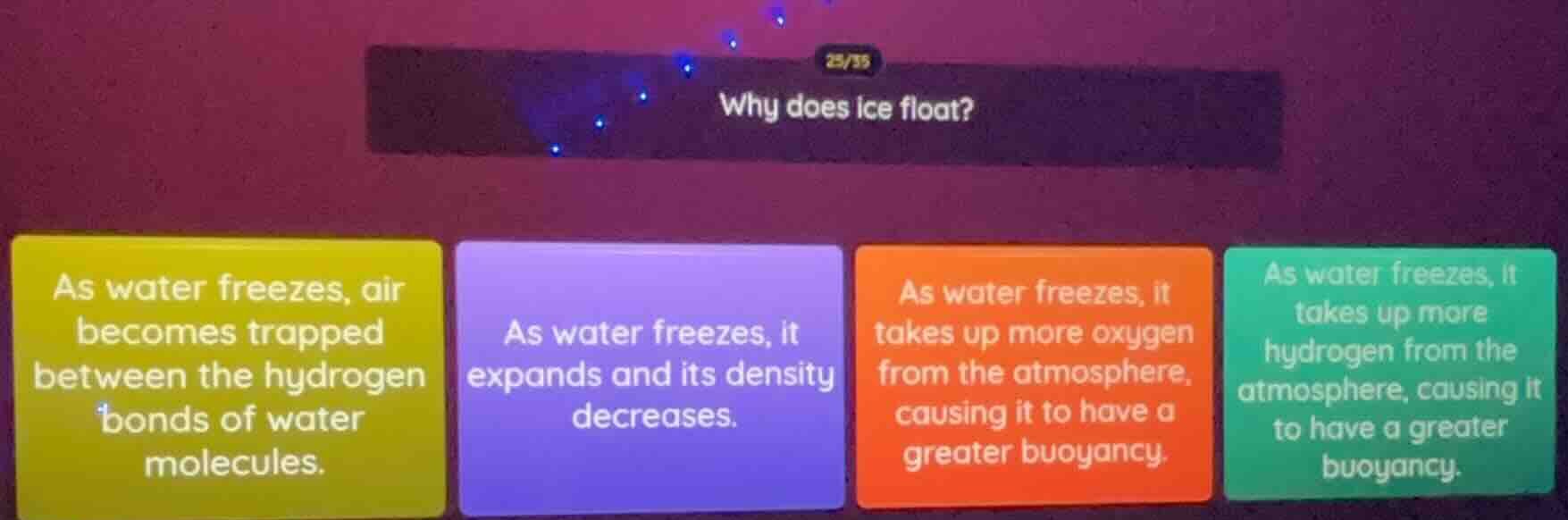
why does ice float?
as water freezes, air becomes trapped between the hydrogen bonds of water molecules.
as water freezes, it expands and its density decreases.
as water freezes, it takes up more oxygen from the atmosphere, causing it to have a greater buoyancy.
as water freezes, it takes up more hydrogen from the atmosphere, causing it to have a greater buoyancy.
To determine why ice floats, we analyze the density concept. The floating of an object in a fluid depends on the density of the object relative to the fluid. If the object's density is less than the fluid's, it floats. For water and ice:
- When water freezes into ice, the water molecules arrange in a hexagonal lattice structure due to hydrogen bonding. This arrangement causes the ice to expand (take up more space) compared to liquid water.
- Density is defined as mass per unit volume ($
ho=\frac{m}{V}$). Since the mass of water remains the same when it freezes (mass is conserved), but the volume increases, the density ($
ho$) of ice becomes less than the density of liquid water (because $V$ is in the denominator, and an increase in $V$ with constant $m$ leads to a decrease in $
ho$).
- Now let's analyze the options:
- The yellow option says air is trapped between hydrogen bonds. While there can be some air bubbles, the main reason for ice's lower density is the molecular arrangement causing expansion, not trapped air as the primary factor.
- The purple option states that as water freezes, it expands and its density decreases. This matches the scientific explanation: expansion (increased volume) with constant mass leads to lower density, making ice less dense than water so it floats.
- The orange option claims it takes up more oxygen from the atmosphere. There's no significant uptake of atmospheric oxygen during freezing that causes buoyancy; the process is about the state change of water, not gas absorption.
- The green option says it takes up more hydrogen from the atmosphere. Water already has hydrogen in its molecular structure ($H_2O$), and freezing doesn't involve taking in atmospheric hydrogen to affect buoyancy.

Snap & solve any problem in the app
Get step-by-step solutions on Sovi AI
Photo-based solutions with guided steps
Explore more problems and detailed explanations
B. As water freezes, it expands and its density decreases.