QUESTION IMAGE
Question
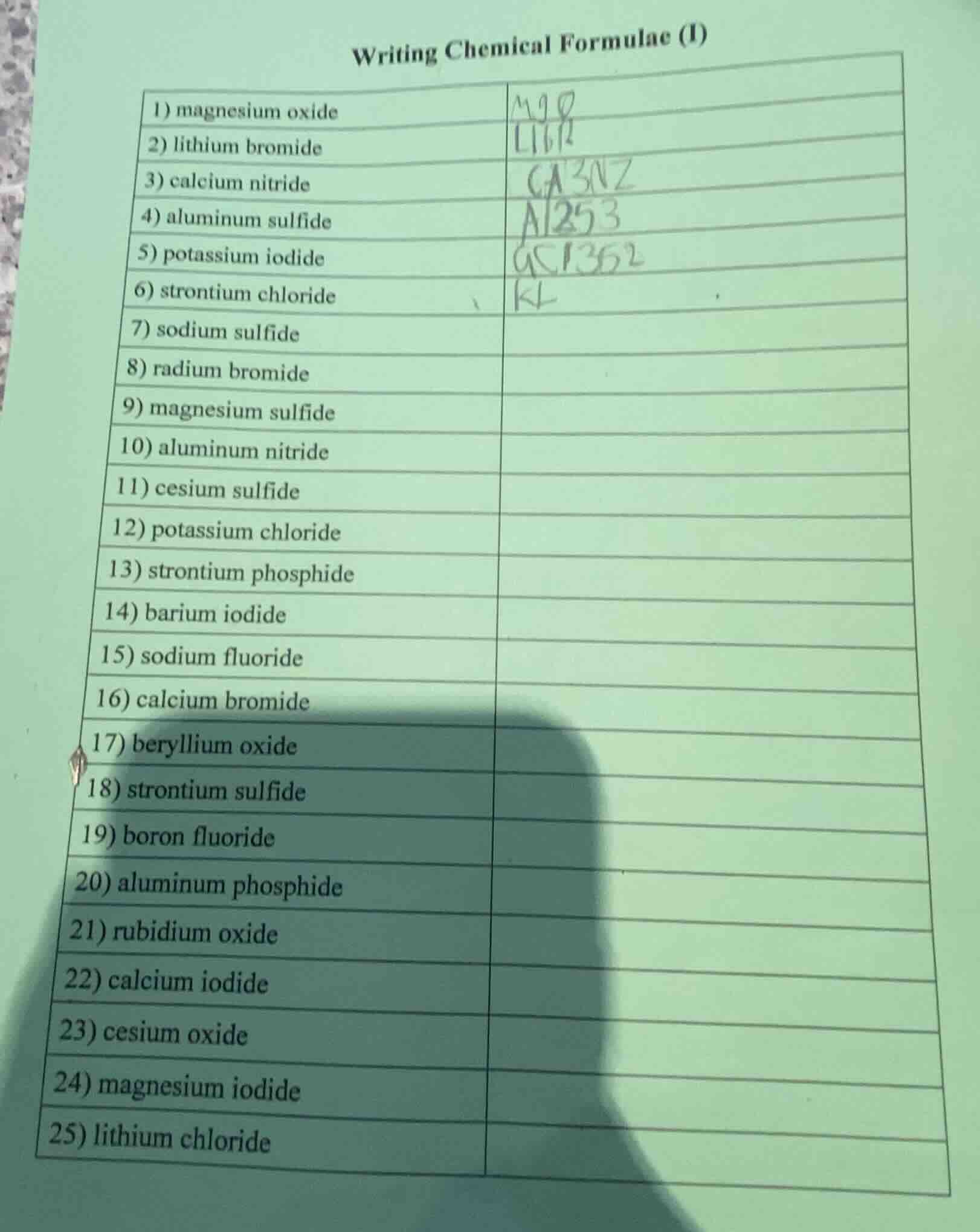
writing chemical formulae (i)
- magnesium oxide
- lithium bromide
- calcium nitride
- aluminum sulfide
- potassium iodide
- strontium chloride
- sodium sulfide
- radium bromide
- magnesium sulfide
- aluminum nitride
- cesium sulfide
- potassium chloride
- strontium phosphide
- barium iodide
- sodium fluoride
- calcium bromide
- beryllium oxide
- strontium sulfide
- boron fluoride
- aluminum phosphide
- rubidium oxide
- calcium iodide
- cesium oxide
- magnesium iodide
- lithium chloride
Step1: Use ion charge balancing
For each compound, match cation/anion charges to make the compound neutral. Subscripts balance total positive/negative charge.
Step2: Write correct formula
Use element symbols and subscripts (omit subscript 1) for neutral compounds.
- Magnesium ($\text{Mg}^{2+}$) + Oxide ($\text{O}^{2-}$): charges balance 1:1
$\text{MgO}$
- Lithium ($\text{Li}^+$) + Bromide ($\text{Br}^-$): charges balance 1:1
$\text{LiBr}$
- Calcium ($\text{Ca}^{2+}$) + Nitride ($\text{N}^{3-}$): 3(+2) + 2(-3) = 0
$\text{Ca}_3\text{N}_2$
- Aluminum ($\text{Al}^{3+}$) + Sulfide ($\text{S}^{2-}$): 2(+3) + 3(-2) = 0
$\text{Al}_2\text{S}_3$
- Potassium ($\text{K}^+$) + Iodide ($\text{I}^-$): charges balance 1:1
$\text{KI}$
- Strontium ($\text{Sr}^{2+}$) + Chloride ($\text{Cl}^-$): 1(+2) + 2(-1) = 0
$\text{SrCl}_2$
- Sodium ($\text{Na}^+$) + Sulfide ($\text{S}^{2-}$): 2(+1) + 1(-2) = 0
$\text{Na}_2\text{S}$
- Radium ($\text{Ra}^{2+}$) + Bromide ($\text{Br}^-$): 1(+2) + 2(-1) = 0
$\text{RaBr}_2$
- Magnesium ($\text{Mg}^{2+}$) + Sulfide ($\text{S}^{2-}$): charges balance 1:1
$\text{MgS}$
- Aluminum ($\text{Al}^{3+}$) + Nitride ($\text{N}^{3-}$): charges balance 1:1
$\text{AlN}$
- Cesium ($\text{Cs}^+$) + Sulfide ($\text{S}^{2-}$): 2(+1) + 1(-2) = 0
$\text{Cs}_2\text{S}$
- Potassium ($\text{K}^+$) + Chloride ($\text{Cl}^-$): charges balance 1:1
$\text{KCl}$
- Strontium ($\text{Sr}^{2+}$) + Phosphide ($\text{P}^{3-}$): 3(+2) + 2(-3) = 0
$\text{Sr}_3\text{P}_2$
- Barium ($\text{Ba}^{2+}$) + Iodide ($\text{I}^-$): 1(+2) + 2(-1) = 0
$\text{BaI}_2$
- Sodium ($\text{Na}^+$) + Fluoride ($\text{F}^-$): charges balance 1:1
$\text{NaF}$
- Calcium ($\text{Ca}^{2+}$) + Bromide ($\text{Br}^-$): 1(+2) + 2(-1) = 0
$\text{CaBr}_2$
- Beryllium ($\text{Be}^{2+}$) + Oxide ($\text{O}^{2-}$): charges balance 1:1
$\text{BeO}$
- Strontium ($\text{Sr}^{2+}$) + Sulfide ($\text{S}^{2-}$): charges balance 1:1
$\text{SrS}$
- Boron ($\text{B}^{3+}$) + Fluoride ($\text{F}^-$): 1(+3) + 3(-1) = 0
$\text{BF}_3$
- Aluminum ($\text{Al}^{3+}$) + Phosphide ($\text{P}^{3-}$): charges balance 1:1
$\text{AlP}$
- Rubidium ($\text{Rb}^+$) + Oxide ($\text{O}^{2-}$): 2(+1) + 1(-2) = 0
$\text{Rb}_2\text{O}$
- Calcium ($\text{Ca}^{2+}$) + Iodide ($\text{I}^-$): 1(+2) + 2(-1) = 0
$\text{CaI}_2$
- Cesium ($\text{Cs}^+$) + Oxide ($\text{O}^{2-}$): 2(+1) + 1(-2) = 0
$\text{Cs}_2\text{O}$
- Magnesium ($\text{Mg}^{2+}$) + Iodide ($\text{I}^-$): 1(+2) + 2(-1) = 0
$\text{MgI}_2$
- Lithium ($\text{Li}^+$) + Chloride ($\text{Cl}^-$): charges balance 1:1
$\text{LiCl}$

Snap & solve any problem in the app
Get step-by-step solutions on Sovi AI
Photo-based solutions with guided steps
Explore more problems and detailed explanations
- $\text{MgO}$
- $\text{LiBr}$
- $\text{Ca}_3\text{N}_2$
- $\text{Al}_2\text{S}_3$
- $\text{KI}$
- $\text{SrCl}_2$
- $\text{Na}_2\text{S}$
- $\text{RaBr}_2$
- $\text{MgS}$
- $\text{AlN}$
- $\text{Cs}_2\text{S}$
- $\text{KCl}$
- $\text{Sr}_3\text{P}_2$
- $\text{BaI}_2$
- $\text{NaF}$
- $\text{CaBr}_2$
- $\text{BeO}$
- $\text{SrS}$
- $\text{BF}_3$
- $\text{AlP}$
- $\text{Rb}_2\text{O}$
- $\text{CaI}_2$
- $\text{Cs}_2\text{O}$
- $\text{MgI}_2$
- $\text{LiCl}$